
© Unsplash
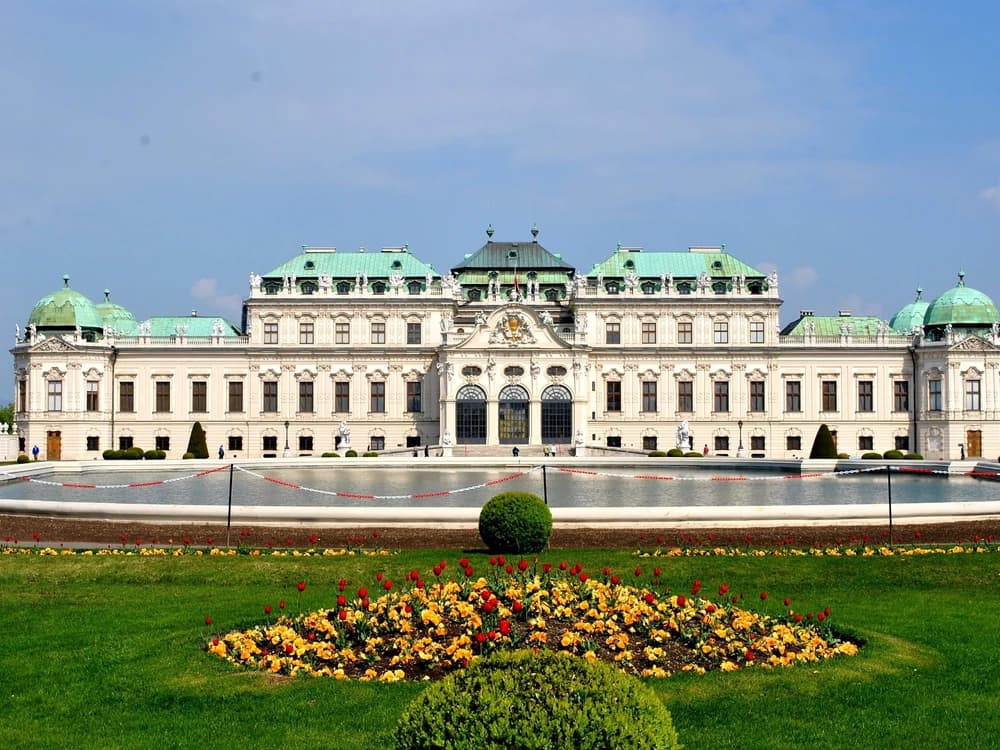
Belvedere Palace
Schloss Belvedere
Austria · Vienna · Near Vienna
Built 1714 · Baroque
Quick Facts
- Hours
- Upper Belvedere open daily 09:00–18:00, last entry 17:30. Gardens open daily from dawn to dusk, free of charge. Check belvedere.at for temporary exhibition hours, which occasionally vary.
- Entry via GYG
- €26
- Duration
- 2–3 hours
- Best time
- Spring (April–May) for the Baroque garden in full bloom; September for comfortable temperatures and fewer crowds than summer
- Nearest city
- Vienna
Highlights
- ✦Klimt's The Kiss hangs in the Upper Belvedere — the single most visited painting in Austria and the centrepiece of the world's largest Klimt collection
- ✦The Baroque garden's central axis frames a perfect view from the Upper Belvedere down a cascade of fountains and parterres to the Lower Belvedere and the city beyond
- ✦Two palaces in one estate: the Upper Belvedere (state rooms and the Klimt/Schiele collection) and the Lower Belvedere (Prince Eugene's private apartments and decorative arts)
- ✦Built as the summer residence of Prince Eugene of Savoy, the military commander who saved Vienna from Ottoman conquest and became the wealthiest man in the Habsburg Empire
- ✦The Orangery and former imperial stables, now exhibition spaces, complete a Baroque ensemble that ranks among the finest garden palaces in Europe
Skip the queue with a guided tour
Skip-the-line tickets & expert guides
Where Schönbrunn is the residence of an empire, Belvedere is the residence of the man who made that empire's survival possible — and today it functions less as a palace to tour and more as Austria's national art museum, with the Baroque architecture as its frame rather than its main event. The single image most visitors come for is Gustav Klimt's The Kiss, displayed in the Upper Belvedere's gilded rooms, where its gold leaf catches the same light that once illuminated Prince Eugene's state receptions. It is, by most counts, the most-viewed painting in Austria, and the gallery around it holds the largest concentration of Klimt's work anywhere in the world, alongside major canvases by Egon Schiele, Oskar Kokoschka, and the broader sweep of Austrian art from the medieval period to the present.
The building itself rewards a slower look. Two palaces — Upper and Lower — sit at opposite ends of a sloped Baroque garden, connected by a sequence of terraces, fountains, and sphinxes that Johann Lukas von Hildebrandt designed as a single theatrical composition. Stand on the terrace of the Upper Belvedere and the garden's central axis falls away below you: cascading water basins, clipped hedges, and gravel parterres descending in steps to the Lower Belvedere roofline, with the spires of Vienna visible beyond. It is one of the great garden views in Europe, and unlike the palace interior, it costs nothing to see.
Prince Eugene of Savoy, who commissioned the palace, was a Savoyard nobleman who became the Habsburg Empire's most successful general — the man whose victories at Zenta and elsewhere broke Ottoman momentum in Central Europe and made Vienna safe for the next two centuries. Eugene used his immense wealth to build Belvedere as a private pleasure palace, separate from court life, filled with art, exotic plants, and a menagerie. He never married, and on his death in 1736 the estate passed out of his family and eventually into Habsburg hands.
Today the Lower Belvedere houses changing exhibitions and the palace's decorative arts holdings, while the Upper Belvedere's permanent collection moves chronologically from medieval altarpieces through Biedermeier painting to the Vienna Secession — Klimt and Schiele's rooms forming the emotional and visual climax of the visit.
History
Prince Eugene of Savoy commissioned Belvedere in 1714, fresh from his decisive military victories against the Ottoman Empire and at the height of his wealth and influence in the Habsburg court. He hired Johann Lukas von Hildebrandt, the leading Baroque architect of the day, to build not one palace but two: the Lower Belvedere, completed first as Eugene's residence and reception rooms, and the Upper Belvedere, completed by 1723 as a grander showpiece for state occasions and his art collection, connected by the sloping garden between them.
Eugene died unmarried and without legitimate heirs in 1736. The estate passed to his niece, who sold it to Empress Maria Theresa in 1752. The Habsburgs used the Upper Belvedere to display the imperial art collection from 1776 onward, making it one of the first purpose-built public picture galleries in Europe — a role it has never fully relinquished. Archduke Franz Ferdinand, the same Habsburg heir whose later residence was Konopiště Castle, lived at Belvedere before his assassination in 1914.
The palace's modern significance was sealed on 15 May 1955, when the foreign ministers of the Allied powers and Austria signed the Austrian State Treaty in the Marble Hall of the Upper Belvedere, restoring full Austrian sovereignty after a decade of post-war occupation. The building has operated as Austria's national gallery of 19th- and 20th-century art since the mid-20th century, with the Klimt collection — including The Kiss, acquired by the state in 1908 — its defining holding.
How to Visit
Getting there: Take tram D to the Schloss Belvedere stop, which lets you off directly at the Upper Belvedere entrance, or trams 71 or O to the Lower Belvedere end of the garden. Both are about 10–15 minutes from the city centre. The Südbahnhof/Hauptbahnhof train station is a short walk from the Lower Belvedere gate.
Tickets: A standard Upper Belvedere ticket covers the Klimt and Schiele collection and the permanent galleries. The Belvedere Card combines Upper and Lower Belvedere plus the Orangery's contemporary art space — worth it if you want the full estate rather than just the Klimt rooms. Book online in advance; the Upper Belvedere's morning queue can run long in summer, especially for tour groups arriving for The Kiss.
The garden: Free to enter and open from dawn, regardless of whether you buy a palace ticket. Walking up from the Lower Belvedere gate to the Upper Belvedere terrace, against the cascade, gives the most dramatic first impression of the estate.
Timing the Klimt room: The gallery holding The Kiss gets crowded by mid-morning, particularly with group tours. Arriving at opening time (09:00) gives the best chance of a quieter view. The Lower Belvedere, with its rotating special exhibitions and decorative arts, is usually far less crowded and worth the extra half hour.
Frequently Asked Questions
The Kiss hangs in the Upper Belvedere, in the galleries devoted to Gustav Klimt and the Vienna Secession. The Upper Belvedere holds the world's largest collection of Klimt's paintings, including The Kiss and Judith, making it the essential stop for anyone visiting specifically to see the painting.
Location
Prinz Eugen-Straße 27, 1030 Vienna, Austria
Nearby Castles
Featured Tour
Vienna: Upper Belvedere & Permanent Collection Entry Ticket
Cancellation available · Instant confirmation
Tours & Tickets
Powered by GetYourGuide
Entry from
€17/ adult