
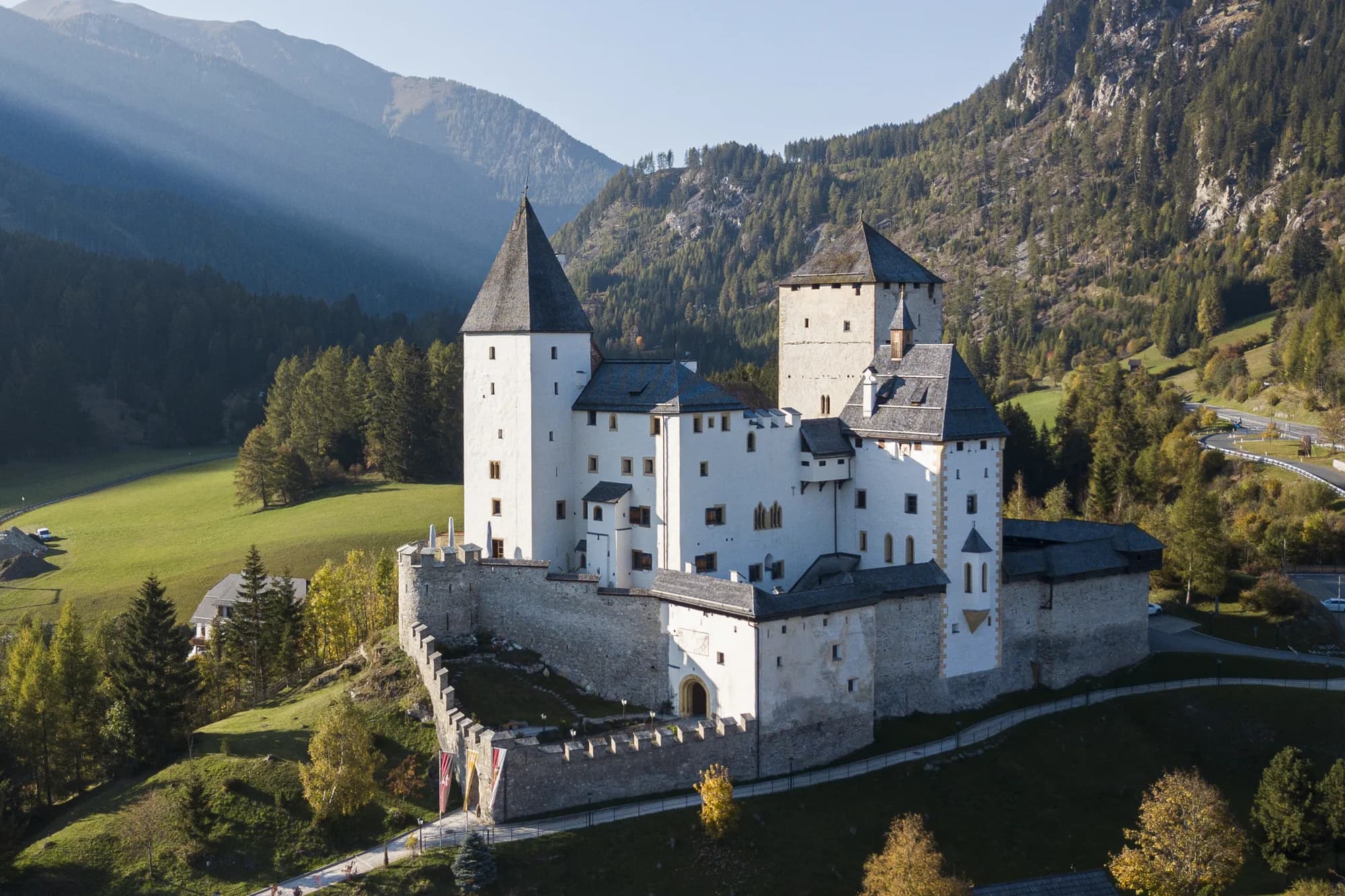
© Castles & Palaces
Mauterndorf Castle
Burg Mauterndorf
Austria · Salzburg · Near Mauterndorf
Built 1253 · Medieval Romanesque/Gothic; built c.1253 by the Archbishops of Salzburg as a toll and control post on the Tauern Pass route; expanded 14th–15th centuries; Romanesque chapel, Gothic tower; awarded to the Hohenzollern family in 1894 (personal gift from Kaiser Franz Joseph to Kaiser Wilhelm II, who had it restored 1894–1905); now a regional history museum
Quick Facts
- Hours
- Open May to October only; closed in winter.
- Entry from
- €16
- Duration
- 1.5–2 hours
- Best time
- May to October
- Nearest city
- Mauterndorf
Highlights
- ✦Built around 1253 by the Archbishops of Salzburg as a toll and customs post controlling the ancient Tauern Pass trade route across the Alps
- ✦A rare surviving 14th-century fresco cycle in the castle's Romanesque chapel, dedicated to St. Henry
- ✦Given by Kaiser Franz Joseph of Austria to Kaiser Wilhelm II of Germany in 1894 as a personal diplomatic gift, then sensitively restored under Wilhelm's patronage between 1894 and 1905
- ✦Set in the Lungau, a high alpine valley recognised as a UNESCO Biosphere Reserve in 2012 for its preserved traditional farming landscape
- ✦A compact, largely unmodernised medieval fortress, preserved closer to its working 15th-century state than most Austrian castles open to visitors
Skip the queue with a guided tour
Skip-the-line tickets & expert guides
The Lungau is one of the least-visited regions in Austria — a high alpine valley, geographically isolated, that has produced its own dialect, its own folk traditions, and an unusual density of medieval castles per square kilometre. In the centre of the Lungau, on a low ridge above the village of Mauterndorf, stands the best-preserved of these castles: Burg Mauterndorf, a compact, intact medieval fortress that has stood on the Tauern Pass trade route since the 13th century. It was also, briefly, a possession of Kaiser Wilhelm II of Germany — a connection that adds an unexpected thread to an already interesting story.
The castle was built around 1253 by the Archbishops of Salzburg as a toll and customs post on the Tauern route, the ancient road crossing the Niedere Tauern range that connected northern and southern Europe. The Archbishops of Salzburg controlled this route and derived substantial income from the merchants and traders who depended on it. The castle's function was therefore not primarily military but fiscal: to stop travellers, inspect their goods, and collect the transit tax that funded much of the Archbishopric's wealth. The Archbishops expanded and improved the structure through the 14th and 15th centuries, adding the Gothic tower, the chapel, and the outer courtyard that together give the castle its present compact, fortified profile.
The castle chapel, dedicated to St. Henry, retains a 14th-century fresco cycle — a rare survival among Austrian mountain castles, where the combination of humidity, altitude and repeated reconstruction has destroyed most medieval painted decoration elsewhere. The chapel itself is small and plain, and its austerity is part of what makes the surviving frescoes affecting rather than merely decorative. The great hall and the tower rooms preserve the original medieval stonework largely intact, with later additions limited mostly to windows and flooring. Mauterndorf is not a showpiece castle furnished with elaborate state rooms; it is a working fortification, preserved largely as it stood in the 15th century, and it rewards visitors precisely because of that restraint.
In 1894, Kaiser Franz Joseph of Austria gave the castle of Mauterndorf as a personal gift to Kaiser Wilhelm II of Germany, an unusual act of personal diplomacy between the two emperors at a moment when the Austro-German alliance stood at the centre of European politics. Wilhelm, who had a pronounced taste for medieval German heritage and for personal building projects of his own, hired the Berlin architect Franz Schwechten to restore the castle between 1894 and 1905. Schwechten's restoration was relatively sensitive by the standards of the era, consolidating the existing medieval structure rather than rebuilding it in the neo-medieval fantasy style then fashionable elsewhere in Wilhelmine Germany. The Hohenzollern family retained ownership of the castle until 1934.
The Lungau, where Mauterndorf sits, received UNESCO Biosphere Reserve status in 2012 as part of the joint Salzburger Lungau and Kärntner Nockberge reserve, recognition of its exceptional preservation of alpine landscapes and traditional farming practices. The region maintains some of the most intact summer pasture traditions, or Almbewirtschaftung, found anywhere in Austria. Visiting the castle as part of a broader Lungau itinerary, which might include the nearby castles of Moosham and Finstergrün and the traditional villages of Tamsweg and St. Michael, gives Mauterndorf a depth of regional context that the castle alone, however well preserved, cannot fully convey.
The current exhibition inside the castle traces its history from Roman-era precursors — the Tauern route saw substantial use in antiquity, long before the Archbishops formalised it as a toll road — through the medieval period and into the modern era, with displays on the Lungau's distinctive folk traditions, including the Samson processions, distinctive local festival parades featuring giant carried figures that are themselves listed on UNESCO's Intangible Cultural Heritage register, and the period of Hohenzollern ownership that briefly linked this remote Austrian valley to the German imperial court in Berlin.
History
The Archbishops of Salzburg built Burg Mauterndorf around 1253 as a toll and customs post controlling the Tauern Pass route, the ancient alpine road connecting northern and southern Europe through the Niedere Tauern range. The castle's primary purpose for much of its medieval history was fiscal rather than military, generating toll revenue for the Archbishopric, and it was expanded through the 14th and 15th centuries with the addition of its Gothic tower, chapel, and outer courtyard.
In 1894, Kaiser Franz Joseph of Austria gave the castle to Kaiser Wilhelm II of Germany as a personal gift, prompting a sensitive restoration carried out between 1894 and 1905 under the direction of Berlin architect Franz Schwechten. The Hohenzollern family held the castle until 1934. Today Mauterndorf operates as a regional history museum, situated within the Lungau, a high alpine valley recognised since 2012 as part of a UNESCO Biosphere Reserve for its well-preserved traditional landscape and farming practices.
How to Visit
Getting there: Mauterndorf is in the Lungau, reachable by train from Salzburg via the Murtal railway (about 2 hours, with a change at Unzmarkt) or by car via the A10 motorway and the Tauern Pass road.
Tickets: GYG tour t370041 covers entry to all areas of the castle. The listing currently has only 8 reviews, below the threshold this site uses to display a star rating, so no rating appears on the tour card despite a strong underlying score.
Seasonal note: The castle is open May to October only.
Combine with: Burg Moosham, 15km away, is also worth visiting as part of a wider Lungau day.
Frequently Asked Questions
The 1894 gift was an act of personal diplomacy between the Austrian and German emperors at a time when the alliance between their two empires was the central pillar of European politics. Wilhelm II had a well-documented enthusiasm for medieval German heritage and for restoration projects of his own, and Franz Joseph's gift gave him a genuine, historically significant castle to apply that interest to. The Hohenzollern family subsequently funded a careful restoration of the castle, completed in 1905, and retained ownership until 1934.
Location
Schloßstraße 1, 5570 Mauterndorf, Austria
Nearby Castles
Featured Tour
Mauterndorf: Burg Mauterndorf Entry Ticket
Cancellation available · Instant confirmation
Tours & Tickets
Powered by GetYourGuide
Entry from
€16/ adult