
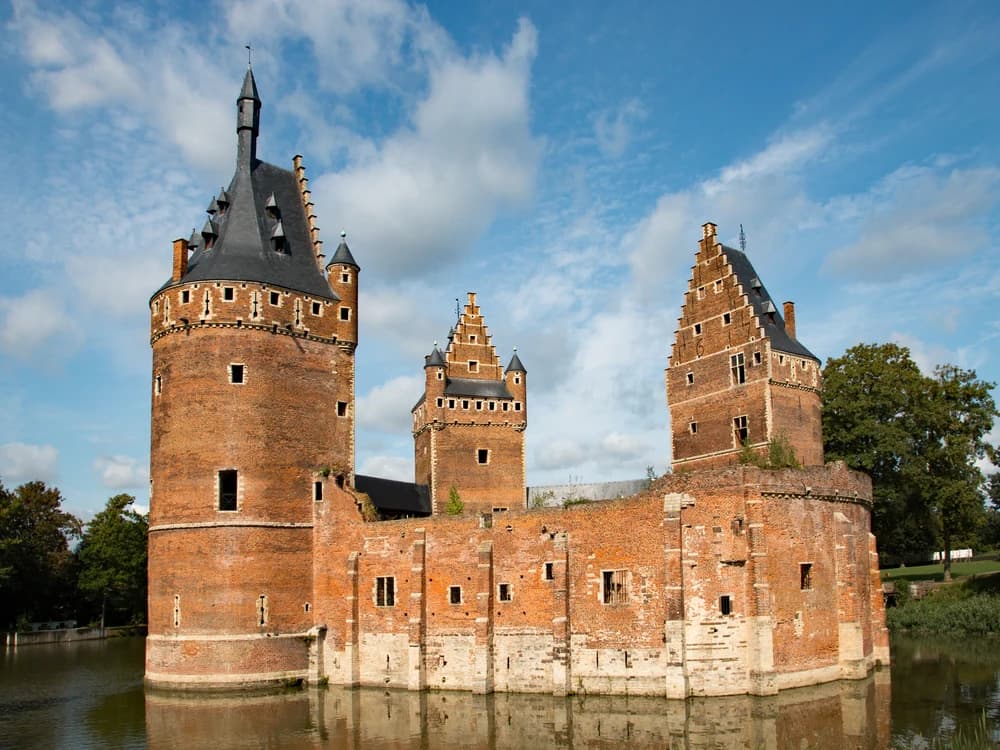
© Unsplash
Beersel Castle
Kasteel van Beersel
Belgium · Flemish Brabant / Brussels · Near Brussels
Built 1315 · Gothic Medieval / Moated
Quick Facts
- Hours
- Open Tue–Sun Mar–Nov 10:00–18:00; Dec–Feb 10:00–17:00. Closed Mondays and January.
- Entry from
- €5
- Duration
- 1–1.5 hours
- Best time
- Spring and summer — the moat reflects the castle beautifully in morning light
- Nearest city
- Brussels
Highlights
- ✦One of the best-preserved medieval moated castles in Belgium, essentially unchanged since the 14th century
- ✦Three round towers and a complete curtain wall surrounded by a still-water moat — the classic fairy-tale image
- ✦Only 15 km from Brussels — the most accessible medieval castle from the Belgian capital
- ✦Survived two major sieges intact, including an assault by Charles the Bold of Burgundy in 1489
- ✦The surrounding landscape of Flemish countryside and orchards gives it a storybook quality
Skip the queue with a guided tour
Skip-the-line tickets & expert guides
Beersel Castle is the medieval castle that Brussels forgot it had on its doorstep. Fifteen kilometres south of the capital, along a quiet road through Flemish orchards and farmland, three round towers rise from a perfectly still moat and reflect themselves in the dark water with an exactness that seems almost too compositionally perfect to be real. This is the image that comes to mind when someone says 'medieval castle' — and Beersel delivers it within easy reach of a major European capital.
The castle was built in 1315 by Godfrey of Heverlee as a frontier fortress protecting the southern approaches to Brussels and the Duchy of Brabant. The three round towers, connected by a curtain wall, represent the fully developed military architecture of early 14th-century Brabant — arrow slits, projecting corbels for dropping materials on attackers, a moat fed by a natural stream, and a drawbridge controlling the single entrance. The construction is in local ferruginous sandstone that has weathered to a warm reddish-brown.
Beersel withstood two major sieges: the first in 1388 by Duke Wenceslas of Brabant, and the second in 1489 by Maximilian of Austria's forces during the conflicts following Charles the Bold's death. Both times the walls held. The castle fell into private hands and gradual disrepair in the 17th century, then was purchased and restored in the 19th century. Today it is one of the most photogenic and least crowded castle experiences in Belgium — a medieval fortress that has escaped the tour-bus circuit simply because no one thought to put it on the map.
History
The castle was commissioned by Godfrey of Heverlee, lord of the village of Beersel, in 1315. Construction used the local ferruginous sandstone that gives the towers their characteristic warm-red colour. The strategic purpose was to defend the southern route into the Duchy of Brabant from the County of Namur — a recurring medieval flashpoint.
The castle suffered its most significant damage during the siege of 1489, when forces loyal to Maximilian of Austria besieged Beersel because its lords had supported the rebellious towns of Flanders and Brabant. The town of Beersel was burned, but the castle itself held. The lords of Beersel subsequently submitted and the castle was returned to them.
From the 17th century onwards, Beersel's military role ended and the castle passed through several private owners. By the 19th century it had fallen into substantial disrepair — the interior buildings were long gone, and vegetation had taken over. A major restoration campaign in the late 19th and early 20th century stabilised the towers and walls, cleared the moat, and opened the castle to visitors. The restoration was conservative by Victorian standards — far less interventionist than the restorations of Pierrefonds or Carcassonne in France — and the result is a castle that reads as genuinely medieval rather than reconstructed.
How to Visit
Getting there from Brussels: By public transport, take the Brussels metro to Gare du Midi (South Station), then a train to Ruisbroek or Lot (about 15 minutes), followed by a short walk or taxi to the castle. By car, Beersel is about 20 minutes from central Brussels via the R0 ring road — take the Beersel exit and follow signs. Parking is available near the castle entrance.
Combine with: Beersel pairs naturally with a visit to the Sonian Forest (Forêt de Soignes), one of the most beautiful beech forests in Europe, which begins just north of Beersel. A day combining the castle, a walk in the forest, and lunch in the village of Beersel makes for an excellent Brussels escape. The Brewers' House in Brussels and the abbey of Villers-la-Ville (ruins of a 12th-century Cistercian abbey, about 30 km south) are also worth combining.
Frequently Asked Questions
By car, Beersel Castle is about 20 minutes south of central Brussels — take the R0 ring road and exit at Beersel. By public transport, take a train from Brussels Midi (South Station) to Ruisbroek or Lot station (about 15 minutes), then a 20-minute walk or short taxi to the castle. It is one of the few genuinely medieval Belgian castles accessible without a car from Brussels, though a car makes it easier.
Location
Lotstraat 65, 1650 Beersel, Belgium
Nearby Castles
Tours & Tickets
Powered by GetYourGuide
Entry from
€5/ adult