
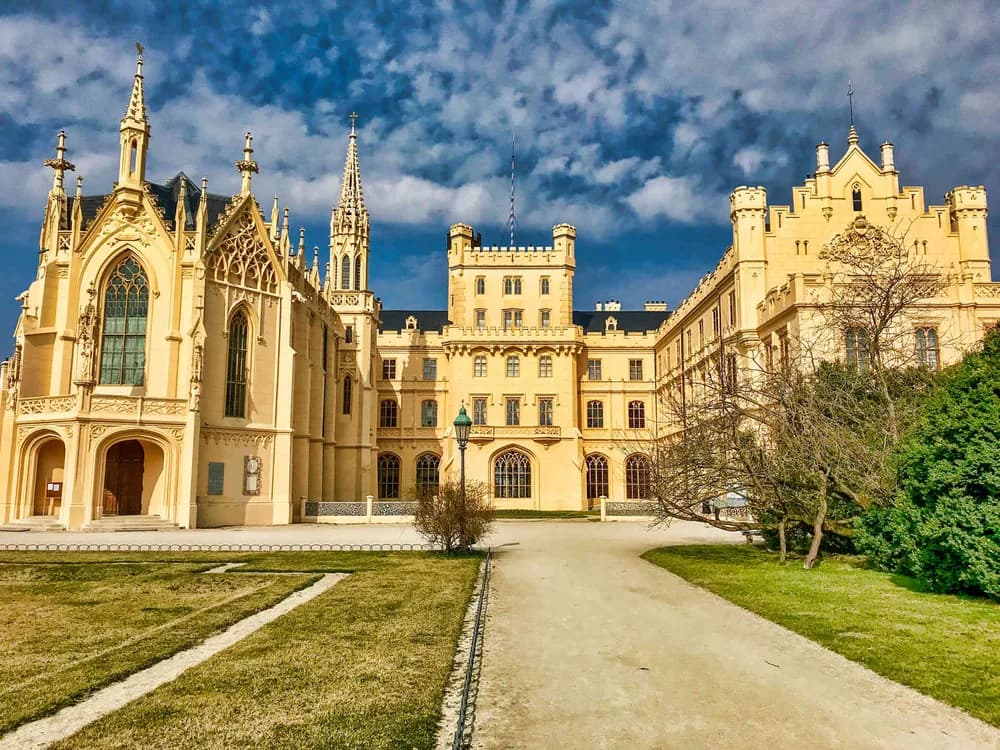
© Unsplash
Lednice Castle
Zámek Lednice
Czech republic · South Moravia · Near Brno
Built 1222 · Neo-Gothic (Tudor Gothic Revival)
Quick Facts
- Hours
- Open April to October, Tuesday to Sunday. May–August extended to 18:00 on weekends. Closed Mondays year-round and November to March. The park and gardens are freely accessible year-round from dawn to dusk.
- Entry from
- €15
- Duration
- 3–5 hours (castle + landscape park)
- Best time
- May to September — the park is at its most beautiful in spring and summer
- Nearest city
- Brno
Highlights
- ✦Part of the UNESCO-listed Lednice-Valtice Cultural Landscape — 283 square kilometres of designed parkland, one of the largest artificially created landscapes in the world
- ✦The castle's ornate Neo-Gothic facade and interior — carved wood ceilings, tapestries, and a palm greenhouse containing one of Europe's largest collection of sub-tropical plants
- ✦The 60-metre minaret in the park — the tallest minaret in Central Europe, built not for religious use but as a Romantic garden folly visible across the flat Moravian plain
- ✦Boat tours on the ponds through the UNESCO landscape, passing follies, temples, and game reserves — one of the most unusual ways to explore a castle's grounds in Europe
- ✦The UNESCO Lednice-Valtice corridor connects Lednice to Valtice Castle (12km), Mikulov fortress, and dozens of landscape follies — easily a full day of exploration
Skip the queue with a guided tour
Skip-the-line tickets & expert guides
Lednice Castle sits at the heart of one of the most extraordinary designed landscapes in the world. The Lednice-Valtice Cultural Landscape — 283 square kilometres of engineered parkland, ponds, hunting grounds, and garden follies spread across the flat wine country of South Moravia — was inscribed as a UNESCO World Heritage Site in 1996, recognised as one of the largest artificially created landscapes on Earth. The castle is its centrepiece.
The building itself is a masterpiece of Neo-Gothic architecture — a gleaming white palace with elaborate turrets, tracery windows, and a facade that manages to look both medieval and theatrical in equal measure. Inside, the state rooms are furnished with the accumulated wealth of the Liechtenstein family, who owned the Lednice-Valtice estate from the 13th century until 1945: carved wood ceilings, Flemish tapestries, an extraordinary library, and a vast palm greenhouse that remains one of the largest in the Czech Republic.
But Lednice's appeal goes far beyond the castle itself. The park is a landscape designer's fantasy: artificial ponds connected by channels, a 60-metre minaret (the tallest in Central Europe, built as a pure garden folly in 1797), temples, columns, a Roman triumphal arch, and a neo-Gothic hunting lodge, all arranged in a composition designed to be experienced on foot, on horseback, or by boat. Boat tours depart from beside the castle through the ponds and past the follies — one of the most unusual touring experiences in Central European heritage tourism.
Lednice is in South Moravia, 50 kilometres south of Brno and 12 kilometres from the Austrian border. It pairs naturally with Valtice Castle and the Mikulov wine region for a South Moravia day trip.
History
The Liechtenstein family acquired the Lednice estate in 1222 and held it for over 700 years — one of the longest-lived noble estates in Central European history. The present castle dates primarily to the mid-19th century, when Prince Alois II of Liechtenstein commissioned a radical reconstruction in the Neo-Gothic style fashionable among European aristocracy at the time. The project, led by the Viennese architect Georg Wingelmüller working from designs inspired by the English Gothic Revival, ran from 1846 to 1858.
The surrounding landscape had been under development since the 17th century, when the Liechtenstein family began transforming the flat Moravian floodplains into a designed park. Over two centuries, successive princes added ponds, channels, allées, and follies — including the famous minaret (1797), the Temple of Diana (1810), and the neo-Gothic hunting lodge at Pohansko — creating the extraordinary composite landscape that UNESCO recognised in 1996.
The estate was confiscated from the Liechtenstein family in 1945 under the Beneš Decrees and became state property. The castle was opened as a museum in 1950. The Liechtenstein family has since sought restitution through Czech courts, though the estate remains state property. The castle and landscape are administered by the National Heritage Institute of the Czech Republic.
How to Visit
Lednice is 50 kilometres south of Brno and 250 kilometres from Prague. By car from Brno, take the D2 motorway south towards the Slovak border, exit at Podivín, and continue to Lednice (approximately 45 minutes). By car from Prague, plan for 2.5 to 3 hours via the D1/D2 motorway.
By public transport from Brno, regional trains and buses connect to Břeclav, from where local buses run to Lednice. From Vienna (80 kilometres), direct bus services and private tours connect to the Lednice-Valtice area.
The Lednice-Valtice landscape is best explored by bicycle — rental bikes are available at the castle — allowing you to follow the UNESCO landscape cycle routes through the ponds and follies to Valtice Castle (12km). Guided boat tours on the ponds run daily in summer from the quay below the castle terrace.
Frequently Asked Questions
The Lednice-Valtice Cultural Landscape is a UNESCO World Heritage Site encompassing 283 square kilometres of designed parkland, ponds, hunting grounds, and Romantic garden follies in South Moravia. Created by the Liechtenstein family over three centuries, it is one of the largest artificially created landscapes in the world. The landscape connects Lednice Castle and Valtice Castle via a network of paths, cycle routes, and waterways lined with Romantic follies including a minaret, Roman triumphal arch, temples, and hunting lodges.
Location
692 44 Lednice, Czech Republic
Nearby Castles
Featured Tour
From Bratislava: Moravia — Lednice Castle and Park
Cancellation available · Instant confirmation
Tours & Tickets
Powered by GetYourGuide
Entry from
€15/ adult