
© Castles & Palaces
Amalienborg Palace
Amalienborg Slot
Denmark · Capital Region · Near Copenhagen
Built 1750 · Rococo; four identical palaces built 1749–1760 by architect Nicolai Eigtved for four noble families; became royal residence after Christiansborg Palace fire of 1794; arranged around an octagonal courtyard with equestrian statue of Frederick V (1771) by Jacques Saly
Quick Facts
- Hours
- Shorter hours in winter (often 11:00–16:00); check the museum site before visiting. The courtyard and statue are accessible at all times, free of charge.
- Entry from
- €21
- Duration
- 1–1.5 hours
- Best time
- Year-round
- Nearest city
- Copenhagen
Highlights
- ✦Four architecturally identical Rococo palaces, designed by Nicolai Eigtved for four noble families and completed between 1749 and 1760, arranged around a grand octagonal courtyard
- ✦The primary residence of the Danish royal family since the catastrophic 1794 fire that destroyed Christiansborg Palace overnight
- ✦An equestrian statue of King Frederick V by French sculptor Jacques Saly, seventeen years in the making and once the single most expensive object in Denmark
- ✦The Amalienborg Museum in Christian VIII's Palace, presenting royal apartments preserved exactly as they were used by Danish monarchs between roughly 1863 and 1947
- ✦The daily changing of the guard at noon, when the Royal Life Guard marches from Rosenborg Castle through central Copenhagen to Amalienborg
Skip the queue with a guided tour
Skip-the-line tickets & expert guides
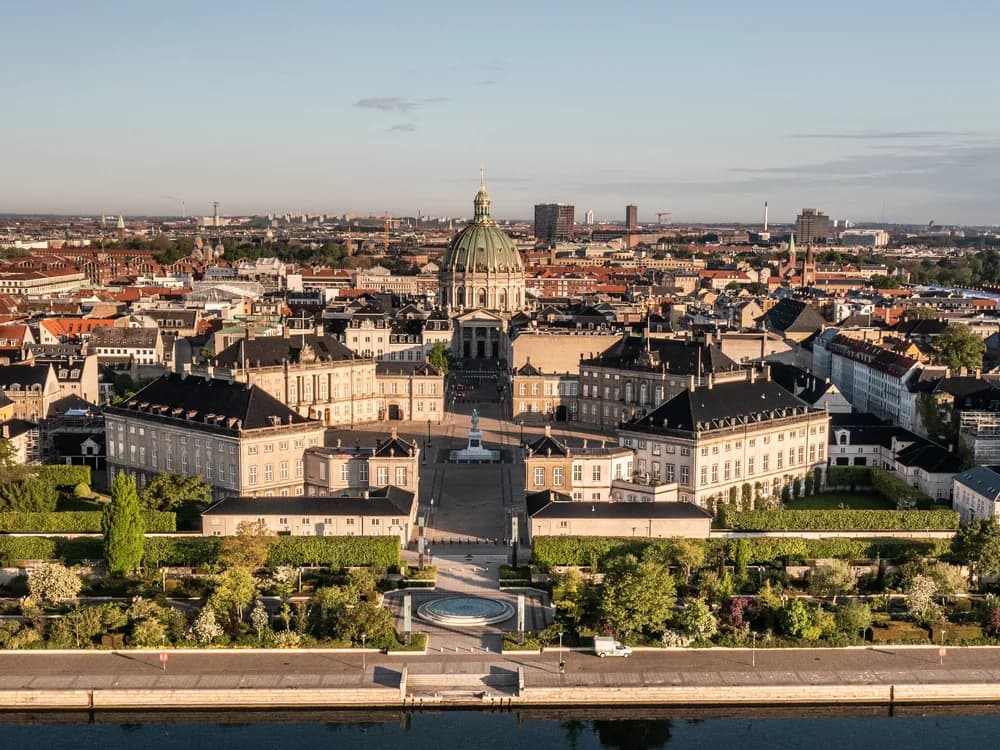
In the centre of Copenhagen, eight minutes' walk from Nyhavn, four identical Rococo palaces face one another across an octagonal courtyard. Between them stands a bronze equestrian statue of the king who commissioned them, Frederick V, gazing out toward the harbour and the dome of the Marble Church beyond. This is Amalienborg, the primary residence of the Danish royal family since 1794, a palace complex that manages simultaneously to be one of the most visited sites in Denmark and, for most of the year, a genuinely occupied royal home. The Danish monarchy is the oldest continuous monarchy in Europe. Amalienborg is where it lives.
The palace complex was not originally built as a royal residence at all. In the 1740s, King Frederick V was developing Frederiksstaden, a prestigious new district of Copenhagen centred on a grand octagonal square, and invited four noble families to build aristocratic town palaces facing onto it. The architect Nicolai Eigtved designed all four in an identical Rococo style, ensuring the square would read as a single coherent architectural composition rather than four competing private projects. The four palaces were completed between 1749 and 1760. The scheme succeeded architecturally but strained the finances of the families involved: the cost of building to Eigtved's standard proved difficult for at least two of the noble owners to sustain, and their palaces passed to the Crown not long after completion.
The Danish royal family had, until that point, lived at Christiansborg Palace, the great fortress-palace on the island of Slotsholmen. That changed abruptly in January 1794, when Christiansborg burned to the ground in a catastrophic fire that destroyed the main palace overnight. With no alternative royal residence ready, the family moved immediately into two of the four Amalienborg palaces that the Crown had already acquired. The remaining two passed into royal hands by 1794 and 1803 respectively. What had been conceived as an aristocratic quarter became, almost by accident, a royal compound — and has remained one ever since.
The four palaces today are known by the names of the successive monarchs who occupied them. Christian VII's Palace, originally Moltke's Palace and the most ornate of the four, retains a Great Hall regarded as among the finest Rococo interiors in Scandinavia. Christian VIII's Palace, the former Levetzau Palace, houses the Amalienborg Museum, the only one of the four open to the public. Frederik VIII's Palace, the former Brockdorff Palace, serves as the residence of the Crown Prince. Christian IX's Palace, the former Schack Palace, was the residence of Queen Margrethe II until her abdication in January 2024 — the first Danish monarch to abdicate in almost 900 years, after 52 years on the throne.
The Amalienborg Museum occupies a sequence of preserved rooms within Christian VIII's Palace, presenting roughly a century and a half of the Danish monarchy through its private, lived-in spaces rather than ceremonial state rooms. Visitors walk through the dining room used by Christian X and Queen Alexandrine between 1899 and 1947, Christian X's study with its dark, sober gentleman's furnishings, and Queen Louise's salon, reflecting the late-Victorian taste of around 1895. The Fabergé Chamber displays objects reflecting the close personal ties between the Danish and Russian royal families, including a Fabergé coronation brooch made for the coronation of Tsar Nicholas II. The exhibition's strength lies in this intimacy and specificity rather than scale.
Every day at noon, the Royal Life Guard marches from Rosenborg Castle through the streets of central Copenhagen to Amalienborg for the changing of the guard, arriving at the palace square at around 12:45. When the monarch is in residence, the ceremony is more elaborate, with additional musicians and a longer route. The march, passing along Gothersgade and down Bredgade before reaching the square, is free to watch and is one of Copenhagen's most reliable daily spectacles, drawing a far broader audience than the museum itself.
The bronze equestrian statue at the centre of the octagonal square, depicting Frederick V in Roman armour astride a stepping horse, was created by the French sculptor Jacques Saly between 1754 and 1771 — seventeen years of continuous work. It is considered one of the finest equestrian monuments in Europe and reportedly cost more than the construction of all four surrounding palaces combined; the Danish state, having commissioned it, took decades to fully settle the bill. The statue's combination of technical refinement and sheer expense makes it as much a monument to 18th-century royal ambition as to Frederick V himself.
History
Amalienborg began in the 1740s as a private aristocratic development within Frederiksstaden, a new district of Copenhagen commissioned by King Frederick V and designed around a grand octagonal square. The architect Nicolai Eigtved designed four identical Rococo palaces for four noble families, completed between 1749 and 1760, but financial pressure on at least two of the families led to their palaces passing into royal ownership not long afterward.
The palaces became the full-time royal residence only after a catastrophic fire destroyed Christiansborg Palace, the previous seat of the Danish monarchy, in January 1794. The royal family relocated to Amalienborg immediately, eventually occupying all four palaces, which have remained the working home of the Danish monarchy ever since. The equestrian statue of Frederick V at the centre of the square, by the French sculptor Jacques Saly, was completed in 1771 after seventeen years of work. In January 2024, Queen Margrethe II abdicated from Christian IX's Palace after 52 years on the throne, the first Danish monarch to abdicate in nearly nine centuries, passing the throne to her son, King Frederik X.
How to Visit
Getting there: Amalienborg is an 8-minute walk from Nyhavn, or 12 minutes from Kongens Nytorv metro station.
Tickets: GYG tour t743612 (4.3★, 762 reviews, $21) is the official museum entry to Christian VIII's Palace, the only one of the four palaces open to the public — the other three remain private royal residences.
Timing: The changing of the guard takes place daily at noon from Rosenborg Castle, arriving at Amalienborg at approximately 12:45 — worth building a visit around.
Combine with: Frederiks Church, known as the Marble Church, stands directly opposite the palace square and has one of Copenhagen's most dramatic domed interiors.
Frequently Asked Questions
No. Only Christian VIII's Palace, home to the Amalienborg Museum, is open to the public. Christian VII's Palace, Frederik VIII's Palace and Christian IX's Palace remain working residences for the Danish royal family and are not accessible to visitors, though the courtyard between all four palaces, and the equestrian statue of Frederick V at its centre, are open and free to view at any time.
Location
Amalienborg Slotsplads, 1257 Copenhagen, Denmark
Nearby Castles
Featured Tour
Copenhagen: Amalienborg Palace Museum Entry Ticket
Cancellation available · Instant confirmation
Tours & Tickets
Powered by GetYourGuide
Entry from
€21/ adult