
© Castles & Palaces
Castle Howard
Castle Howard
England · North Yorkshire · Near York
Built 1699 · English Baroque; John Vanbrugh and Nicholas Hawksmoor 1699–1712; first building designed by Vanbrugh (playwright turned architect); central copper dome — first private dome in England; south wing destroyed by fire 1940, rebuilt 1961
Quick Facts
- Hours
- House open March to November; grounds open year-round, typically 10:00–16:30 in winter. The house occasionally closes for private and filming events even within the open season — check the official calendar before travelling.
- Entry from
- €18
- Duration
- 2–3 hours
- Best time
- March to November (house open March–November; grounds open year-round)
- Nearest city
- York
Highlights
- ✦Designed from 1699 by John Vanbrugh, a Restoration playwright with no architectural training, in collaboration with Nicholas Hawksmoor
- ✦England's first private dome — a 24-metre painted ceiling flooding the central Great Hall with light, completed around 1703
- ✦The fictional setting of Brideshead in the 1981 ITV adaptation of Evelyn Waugh's Brideshead Revisited, starring Jeremy Irons and Anthony Andrews
- ✦Vanbrugh's Temple of the Four Winds (1726) and Hawksmoor's circular Mausoleum (1729), among the finest 18th-century garden buildings in England
- ✦A south wing and dome destroyed by fire in 1940, left open to the sky for two decades before being faithfully rebuilt in the 1960s
Skip the queue with a guided tour
Skip-the-line tickets & expert guides
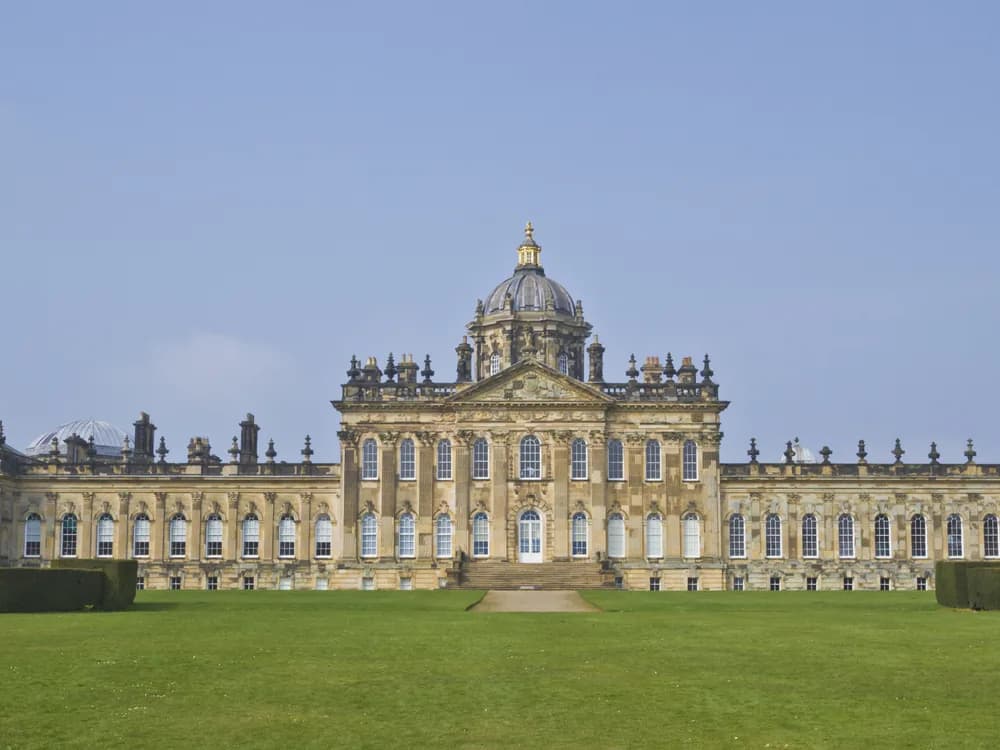
Despite its name, Castle Howard is not a castle in any defensive sense — it never had battlements, a drawbridge, or a garrison. It is one of the greatest Baroque houses in England, set within 10,000 acres of North Yorkshire parkland, and its name reflects nothing more than the fact that the Howard family, Earls of Carlisle, built it on land that had once contained a medieval castle. What they built instead, beginning in 1699 with a playwright as their architect, changed the course of English architecture.
The 3rd Earl of Carlisle commissioned John Vanbrugh in 1699 to design his new house. Vanbrugh had never designed a building in his life. He was a playwright — author of The Relapse and The Provok'd Wife, a comic dramatist of the Restoration stage — with no formal architectural training whatsoever. But he had ideas, ambition, and access to Nicholas Hawksmoor, who had trained under Christopher Wren. The resulting Vanbrugh-Hawksmoor collaboration — Vanbrugh supplying the grand conception and dramatic instinct, Hawksmoor supplying the technical knowledge required to make the walls actually stand up — produced a building unlike anything previously built in England.
The central dome, completed around 1703, was the first private dome in England. Christopher Wren had built the dome of St. Paul's Cathedral; now a private aristocrat was putting one over his own entrance hall. The dome rises 24 metres above the floor of the Great Hall, painted with mythological scenes and ringed by an arcade that floods the central space with light. The effect is theatrical in the best sense: arriving at the house, a visitor immediately understands that this is a place conceived on an operatic scale, designed to overwhelm before a single room has been entered.
In 1981, the ITV adaptation of Evelyn Waugh's novel Brideshead Revisited used Castle Howard as the fictional Brideshead — ancestral home of the Catholic Marchmain family. The eleven-episode series, starring Jeremy Irons as narrator Charles Ryder and Anthony Andrews as the doomed Sebastian Flyte, became a landmark of British television. The resulting association with the novel's themes of aristocratic decline, Catholic guilt and lost innocence gave Castle Howard a cultural resonance that extends well beyond architectural tourism — visitors arriving expecting a straightforward stately home often find themselves thinking instead about the novel's meditation on what it means to belong to a place.
During the Second World War, Castle Howard was used as a girls' school. In November 1940, a fire destroyed the south wing and the central dome entirely; the great painted ceiling collapsed into the hall below. For two decades the ruined wing stood open to the sky, a startling sight for visitors to the otherwise intact house. George Howard, later Baron Howard of Henderskelfe, undertook a full rebuilding in the 1960s, following the original plans as closely as the surviving records allowed. The dome was restored and the south wing rebuilt, though the scar of the fire remains faintly visible to anyone who knows where to look — the east range carries a different tone of stonework from the west, the visible seam between original and reconstructed fabric.
The house remains owned and lived in by the Howard family today. The State Rooms on the ground floor include the Great Hall beneath the restored dome, the Garden Hall, the Red Passage with its collection of antique sculpture, and the Long Gallery; the family's private apartments occupy the upper floors and are not open to visitors. The house holds a significant art collection, including Van Dyck portraits, Gainsborough landscapes and Venetian works, alongside a substantial collection of historical costume displayed in a dedicated gallery.
The grounds extend over 1,000 acres of formal gardens, parkland, lakes and garden temples, set within the wider 10,000-acre estate. The Temple of the Four Winds, designed by Vanbrugh in 1726, and the circular Mausoleum, designed by Hawksmoor in 1729, are the two key garden buildings and are counted among the finest 18th-century garden structures anywhere in England. The Atlas Fountain, the Great Lake and Ray Wood — one of the earliest landscape gardens in England — make the grounds arguably as significant as the house itself, and reward at least as much time as the State Rooms.
History
The 3rd Earl of Carlisle commissioned John Vanbrugh to design Castle Howard in 1699, an unconventional choice given that Vanbrugh, a successful Restoration playwright, had no prior architectural experience. Vanbrugh worked alongside Nicholas Hawksmoor, who supplied the technical engineering expertise the project required, and construction proceeded from 1699 to roughly 1712, producing a Baroque house centred on the first privately built dome in England, completed around 1703.
The house remained the seat of the Howard family, Earls of Carlisle, through the 18th and 19th centuries, accumulating a significant art collection and an extensive landscaped park containing some of the finest 18th-century garden architecture in the country, including Vanbrugh's Temple of the Four Winds and Hawksmoor's Mausoleum. During the Second World War the house was requisitioned as a girls' school, and in November 1940 a fire destroyed the south wing and the central dome, leaving the wing open to the sky for nearly two decades. George Howard, later Baron Howard of Henderskelfe, undertook a faithful rebuilding in the 1960s based on the original architectural plans, restoring the dome and reconstructing the south wing. The house gained wide public recognition in 1981 when it served as the setting for the ITV television adaptation of Evelyn Waugh's Brideshead Revisited, and remains privately owned and inhabited by the Howard family today.
How to Visit
Getting there: Castle Howard is 24km north of York by road, about 30 minutes' drive. There is no direct public transport; a car or taxi from York is required.
Tickets: The grounds are open year-round; the house itself closes over winter, so check the official website for exact seasonal dates before travelling. GYG tour t64183 (4.9★, 146 reviews, from $22) is the official self-guided house and grounds ticket.
Combine with: York itself — with York Minster, the Shambles, and the Jorvik Viking Centre — makes an excellent base for a Castle Howard day trip, with the drive out to the estate fitting comfortably into a half-day alongside time in the city.
Frequently Asked Questions
No — despite its name, Castle Howard was never built as a defensive structure; it has no battlements, drawbridge or garrison history. It is a Baroque country house begun in 1699 for the Howard family, Earls of Carlisle, on land that had once held a medieval castle, which is the sole reason for the name. Architecturally it has far more in common with grand 18th-century stately homes than with any fortified castle.
Location
Castle Howard, York YO60 7DA, United Kingdom
Nearby Castles
Featured Tour
York: Castle Howard Self-Guided Entry Ticket
Cancellation available · Instant confirmation
Tours & Tickets
Powered by GetYourGuide
Entry from
€18/ adult