
© Unsplash
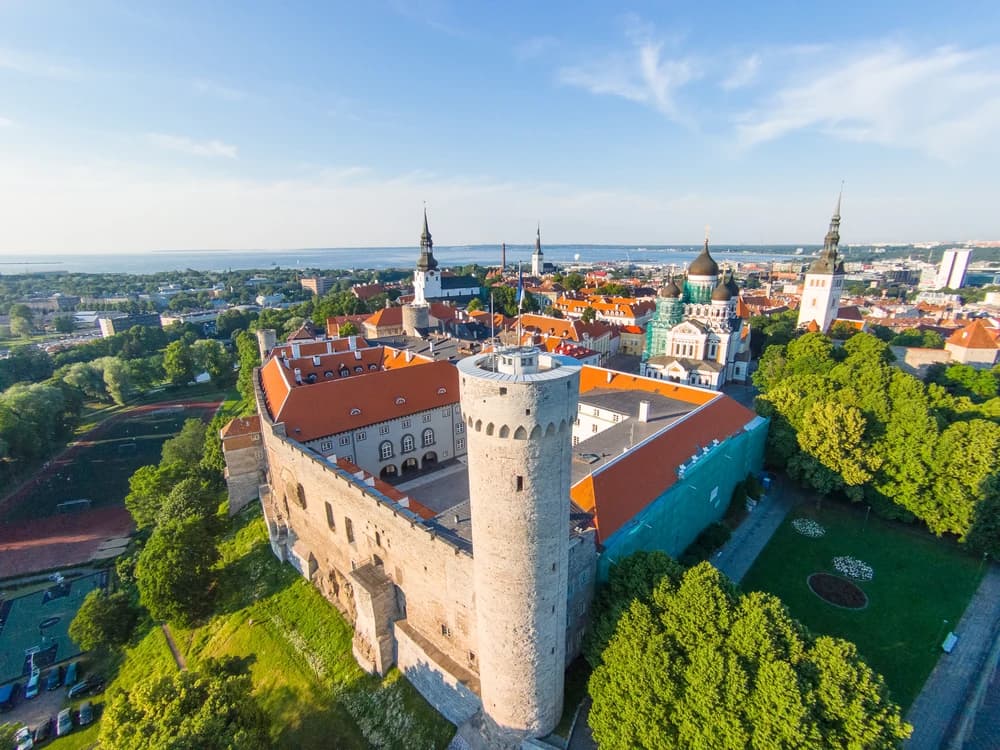
Toompea Castle
Toompea loss
Estonia · Harju County / Tallinn · Near Tallinn
Built 1227 · Medieval / Danish Crusader
Quick Facts
- Hours
- The castle exterior and Toompea hill are freely accessible at all times. The Tall Hermann tower interior: guided tours available May–Sep. The Kiek in de Kök bastion museum opens Tue–Sun 10:00–18:00. The Estonian Parliament building (inside the castle walls) is not open to the public for general visits.
- Entry from
- Free
- Duration
- 1–2 hours (castle area) + 2–3 hours (Tallinn Old Town)
- Best time
- Year-round — Tallinn's medieval Old Town is spectacular in every season, including snow
- Nearest city
- Tallinn
Highlights
- ✦Tall Hermann (Pikk Hermann) — a 46-metre tower flying the Estonian flag, the most recognisable symbol of Estonian statehood
- ✦The hill fortress that has served as the seat of power in Estonia without interruption since 1227 — today it houses the Estonian Parliament
- ✦Part of the UNESCO-listed Historic Centre of Tallinn, one of the best-preserved medieval cities in northern Europe
- ✦The limestone cliff and castle towers dominate Tallinn's famous skyline — visible from almost every angle of the city
- ✦The views from Toompea over the red-roofed lower town and Tallinn Bay are among the finest city views in the Baltic
Skip the queue with a guided tour
Skip-the-line tickets & expert guides
Tallinn's skyline is defined by two things: the limestone cliff of Toompea rising 40 metres above the lower city, and the towers and walls of the castle that has crowned that cliff for nearly 800 years. Toompea Castle is not a single discrete structure but a walled compound built and rebuilt over centuries — Danish, Teutonic, Swedish, Russian, and finally Estonian hands have all left their mark — and its most famous element, the 46-metre Tall Hermann tower with the Estonian blue-black-white flag flying from its summit, has become the defining symbol of the country itself.
The Danes built the first stone fortress on Toompea in 1227, establishing a power base for their crusade-driven colonisation of what is now Estonia. The Teutonic Knights acquired the castle in 1346 and expanded it substantially, adding the three remaining towers and creating the curtain wall that still defines the compound's outline. The Tall Hermann tower was built in the 1360s and named — in ironic contrast to its height — after the common German name Hermann. It has flown the Estonian flag from its summit since 1884, a tradition suppressed during Soviet occupation and joyfully reinstated in 1989 as Estonia moved towards independence.
The castle's interior today houses the Riigikogu — the Estonian Parliament — which is not generally open to visitors. But the exterior and towers are the real experience at Toompea. The castle walls define the edge of the hill, the lower town's medieval rooftops spread below, Tallinn Bay is visible beyond, and the city's extraordinary network of medieval towers, churches, and merchants' houses fills the view in every direction. Combine with the Kiek in de Kök bastion museum for underground tours of Tallinn's medieval tunnel network.
History
The Toompea hill was the site of an Estonian hill fort before the Danish crusade, and its capture by Danish forces under King Valdemar II in 1219 marked the beginning of seven centuries of foreign domination of Estonia. The Danes built the first stone castle here in 1227, establishing a bishop's seat and administrative centre for the new territory.
The Teutonic Knights — a German military-religious order that controlled much of the eastern Baltic — purchased Estonia from the Danish crown in 1346 and undertook major construction at Toompea, building the three conical-roofed towers that survive today (including Tall Hermann, completed around 1371) and the curtain wall that enclosed the compound. The castle served as the administrative centre of the Livonian Order's Estonian territories.
Sweden acquired Estonia in 1561, and Toompea became a Swedish provincial administration centre. Russia took it in 1710, and the tsarist administration converted the interior medieval buildings into a neoclassical palace (the pink baroque building now used by Parliament, completed 1773). Estonian independence in 1918 established the Riigikogu in the castle, a function interrupted by Soviet occupation (1940–1991) and restored with independence. In 1997, Tallinn's Historic Centre — including Toompea — was inscribed as a UNESCO World Heritage Site.
How to Visit
Getting to Tallinn: Tallinn is served by Lennart Meri Tallinn Airport with direct flights from most European cities. Ferries run from Helsinki (2–2.5 hours, several daily) and Stockholm (overnight). Tallinn is also 3.5 hours by bus from Riga.
Getting to Toompea: From the lower Old Town, two medieval gate towers give access to the hill: Pikk jalg (Long Leg) and Lühike jalg (Short Leg), both steep cobbled lanes lined with historic buildings. There is also a modern glass elevator from the lower town car park. The castle compound and Toompea hill are freely accessible at all times.
What to see: From Toompea, the two main viewpoints (Kohtuotsa and Patkuli terraces) give panoramic views over the lower town. The Alexander Nevsky Cathedral (Russian Orthodox, 1900) and Dome Church (Toomkirik, medieval) are both on the hill. For the castle itself, focus on the towers visible from outside, then descend to the lower Old Town for the full medieval townscape.
Frequently Asked Questions
The Estonian Parliament (Riigikogu) occupies the interior of Toompea Castle and is not open to general visitors. However, the castle exterior — the towers, walls, and the Toompea hill itself — is freely accessible. The Tall Hermann tower can be visited on guided tours in summer. The nearby Kiek in de Kök bastion (a separate medieval tower now a museum, about 200m away) offers underground tours of Tallinn's medieval tunnel and bastion system, which is highly recommended.
Location
Lossi plats 1a, 15165 Tallinn, Estonia
Nearby Castles
Tours & Tickets
Powered by GetYourGuide
Free Entry