
© Castles & Palaces
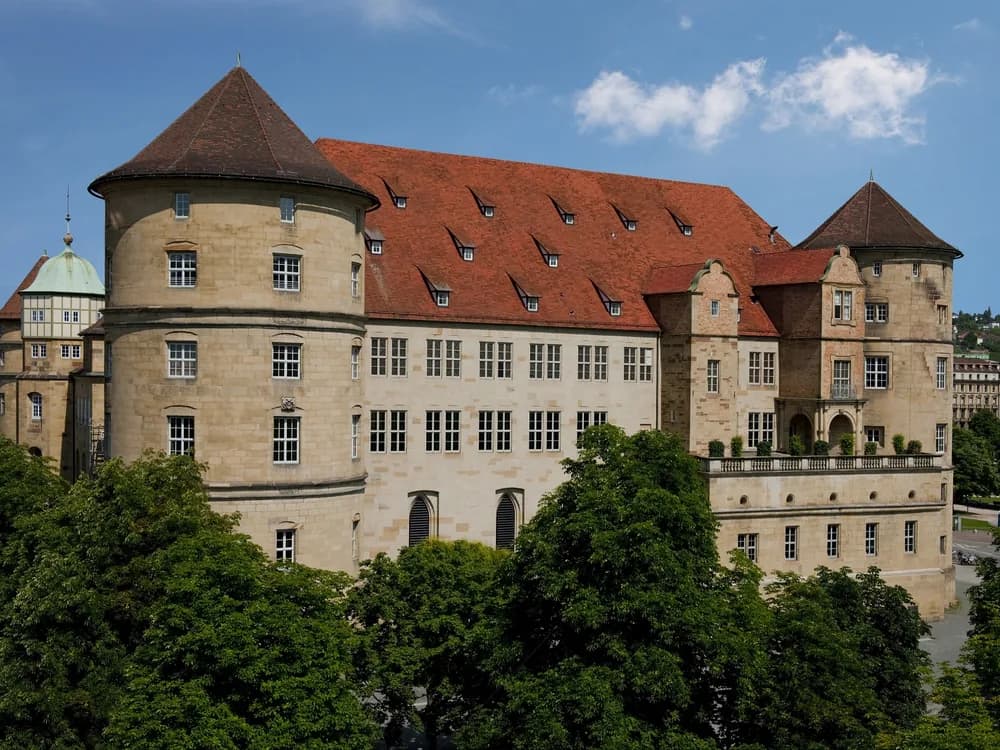
Altes Schloss Stuttgart
Altes Schloss Stuttgart
Germany · Baden-Württemberg · Near Stuttgart
Built 1320 · Medieval origins c.1320 as a moated castle (Wasserschloss); rebuilt as Renaissance palace 1553–1578 by Aberlin Tretsch and later Blasius Berwart for Duke Christoph of Württemberg; the square inner courtyard with three-storey arcaded galleries is the finest Renaissance courtyard in Baden-Württemberg; now houses the Württemberg State Museum (Landesmuseum Württemberg)
Quick Facts
- Hours
- Closed Mondays. Open late on Thursdays until 21:00. The courtyard hosts the Stuttgart Summer Festival in August — check seasonal programming.
- Entry from
- €9
- Duration
- 2 hours
- Best time
- Year-round
- Nearest city
- Stuttgart
Highlights
- ✦A three-storey Renaissance arcaded courtyard, 55 metres long, widely considered the finest Renaissance architectural space in Baden-Württemberg
- ✦Home to the Württemberg State Museum since 1862, covering Celtic, Roman, medieval and modern collections under one Renaissance roof
- ✦The Württemberg Crown Jewels, a complete set of royal regalia created between 1803 and 1806 when Napoleon elevated Württemberg to a kingdom
- ✦Celtic gold and silver torcs from the 5th century BC Hochdorf burial, among the most significant Iron Age finds in Central Europe
- ✦One of the only substantial historic ensembles to survive in central Stuttgart, most of which was destroyed in 1944
Skip the queue with a guided tour
Skip-the-line tickets & expert guides
In the heart of Stuttgart, two minutes' walk from the Schlossplatz and directly opposite the much grander Neues Schloss, stands a castle that most visitors pass on their way elsewhere. The Altes Schloss, the Old Castle, is the oldest royal building in Stuttgart, a Renaissance palace built on medieval foundations that now houses one of the finest regional history museums in Germany. It is not, primarily, a castle experience in the traditional sense: you come here to understand Württemberg, one of the most consequential German principalities, through two thousand years of archaeology, art and material culture. You stay because the Renaissance courtyard is among the most beautiful in Germany, and the collection inside is better than almost anywhere else of comparable size.
The site was first fortified around 1320 as a moated castle, a Wasserschloss, for the Counts of Württemberg — a typical defensive arrangement for the river plain on which Stuttgart sits. The original structure was modest: a single tower, residential quarters, and a water-filled moat encircling the whole. Over the following two centuries, the castle expanded steadily as Württemberg grew in political weight, becoming the settled residence of the Württemberg counts and, later, dukes.
The transformation from medieval fortress to Renaissance palace was carried out between 1553 and 1578 under Duke Christoph of Württemberg, led by the architects Aberlin Tretsch and, in the later phase, Blasius Berwart. The result is the central courtyard that defines the castle today: a three-storey arcade of round-arched galleries running along all four sides, executed in a classical Renaissance vocabulary with occasional German Gothic survivals visible in the detailing. The courtyard runs 55 metres in length and ranks among the finest Renaissance architectural spaces in southern Germany — comparable in ambition to the great Italian cortile, but unmistakably northern in its proportions and restraint.
Since 1862, the castle has housed the Württemberg State Museum, the Landesmuseum Württemberg. The collection spans an unusually long arc: the Celtic period, Roman occupation, early medieval Alemanni grave goods, medieval decorative objects, Renaissance applied arts, and material running into the modern era. Among the highlights are the Württemberg Crown Jewels, a full set of royal regalia created in 1803–1806 when Napoleon elevated Württemberg from a duchy to a kingdom; a set of Celtic gold and silver torcs recovered from the 5th-century-BC Hochdorf burial, one of the most significant Iron Age archaeological finds in Central Europe; an important collection of medieval ivory and bone carvings; and one of the largest clock and automata collections in Germany.
The Württemberg Crown Jewels deserve particular attention. The Kingdom of Württemberg lasted only from 1806 to 1918, a mere 112 years, but in that relatively short span its kings commissioned a complete set of regalia: a crown, sceptre, orb, sword of state and coronation mantle. The crown itself, made in 1806, is set with rubies, emeralds and 191 diamonds. Unlike the Prussian and Bavarian royal regalia, which have been dispersed across multiple institutions over the past century, the Württemberg set has remained together in Stuttgart, displayed in something close to its original case.
The Altes Schloss faces the Schillerplatz, one of Stuttgart's most elegant small squares, named for Friedrich Schiller, who was born within the Württemberg duchy. The square is framed by the Stiftskirche, a partly medieval collegiate church; the Fruchtkasten, a 16th-century granary now used as a concert venue; and the Prinzenbau. Together, the Schillerplatz and the castle courtyard form the closest thing Stuttgart has to a genuinely historic city centre, since most of the old city was destroyed in the bombing raids of 1944. Walking from the square into the courtyard, and then into the museum's galleries, is as close as Stuttgart comes to a continuous historical narrative told through its own surviving fabric.
History
The Counts of Württemberg fortified the site of the Altes Schloss around 1320 as a moated castle controlling a position in the Stuttgart river plain, beginning as a modest tower and residential complex surrounded by a water-filled moat. Over the following two centuries the castle grew in step with Württemberg's rising political importance, becoming the settled seat of the ruling counts and, eventually, dukes.
Duke Christoph of Württemberg commissioned the castle's transformation into a Renaissance palace between 1553 and 1578, employing the architects Aberlin Tretsch and Blasius Berwart to design the three-storey arcaded courtyard that remains the building's defining feature. The castle continued in residential and administrative use under successive rulers until 1862, when it was repurposed to house the Württemberg State Museum, a role it has retained ever since, presenting collections spanning from the Celtic Iron Age through the Roman, medieval and early modern periods, including the regalia of the short-lived Kingdom of Württemberg (1806–1918).
How to Visit
Getting there: The Altes Schloss sits in Stuttgart's pedestrianised city centre, a 5-minute walk from Schlossplatz. Take the U-Bahn or S-Bahn to Stadtmitte.
Tickets: GYG tour t640080 (4.5★, 29 reviews, $9) is exceptional value for the scope of the collection.
Hours: Open Tuesday to Sunday, 10:00–17:00, with extended hours until 21:00 on Thursdays.
Combine with: The Schillerplatz ensemble — the Stiftskirche, the Fruchtkasten granary and the Prinzenbau — and the Stuttgart Summer Festival, held in the castle courtyard each August.
Frequently Asked Questions
Both, in practical terms, though the museum experience dominates. The building is a genuine Renaissance palace built over medieval foundations, and its courtyard is one of the finest Renaissance architectural spaces in Baden-Württemberg, but since 1862 the interior has functioned as the Württemberg State Museum. Visitors come primarily for the collection — spanning Celtic, Roman, medieval and modern Württemberg history — rather than for furnished royal apartments, which the castle does not currently present.
Location
Schillerplatz 6, 70173 Stuttgart, Germany
Nearby Castles
Featured Tour
Stuttgart: Altes Schloss Museum Entry Ticket
Cancellation available · Instant confirmation
Tours & Tickets
Powered by GetYourGuide
Entry from
€9/ adult