
© Castles & Palaces
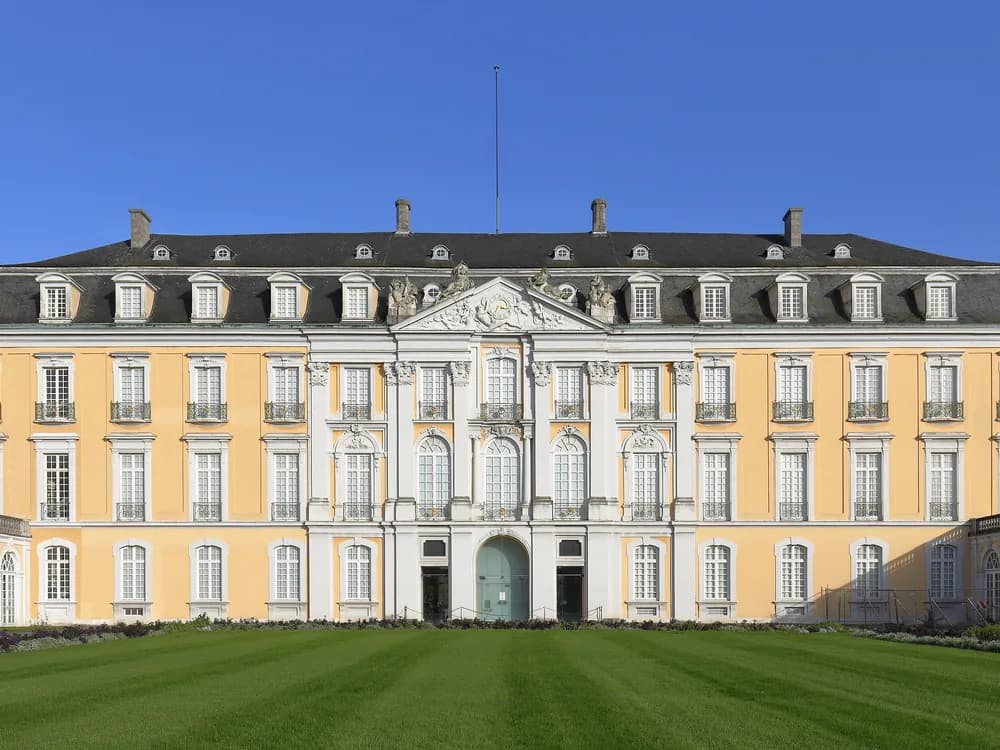
Augustusburg Palace
Schloss Augustusburg
Germany · North Rhine-Westphalia · Near Cologne
Built 1725 · German Baroque and Rococo; built 1725–1768 for Archbishop-Elector Clemens August of Bavaria; designed by Johann Conrad Schlaun 1725, completed by François de Cuvilliés and Balthasar Neumann; staircase by Balthasar Neumann is one of the finest Baroque staircase compositions in Germany; UNESCO World Heritage Site (1984) together with Falkenlust Hunting Lodge
Quick Facts
- Hours
- Closed Mondays and throughout January. Interior visits are by guided tour only, on a fixed schedule — check the official site for tour times.
- Entry from
- €9
- Duration
- 1–1.5 hours (guided tour only for interior)
- Best time
- Year-round (closed January; check guided tour schedule)
- Nearest city
- Cologne
Highlights
- ✦Balthasar Neumann's grand staircase, widely regarded as one of the masterpieces of European Baroque architecture, cited by UNESCO as 'a masterpiece of human creative genius'
- ✦Built for Clemens August of Bavaria, Archbishop-Elector of Cologne, who held five bishoprics simultaneously and spent the resulting income on building, hunting and entertainment
- ✦Designed in stages by three of the 18th century's leading architects: Johann Conrad Schlaun, François de Cuvilliés, and Balthasar Neumann
- ✦Paired with Falkenlust, an intimate Dutch-influenced hunting lodge a kilometre away, connected by a formal avenue and included in the same UNESCO designation
- ✦Used as a state guesthouse by the West German government after 1949, hosting Chancellor Konrad Adenauer's official receptions in rooms once used by Clemens August
Skip the queue with a guided tour
Skip-the-line tickets & expert guides
Fifteen kilometres south of Cologne, in the unremarkable town of Brühl, stands one of Germany's finest Baroque palaces — and one of the least visited by international tourists relative to its importance. Augustusburg Palace was built for a prince-archbishop who spent more money on parties and hunting lodges than on governing his diocese, and whose taste in architecture was refined enough that he hired Balthasar Neumann, the greatest German Baroque architect of the 18th century, to design his staircase. That staircase is the reason architects make pilgrimages to Brühl. UNESCO agreed in 1984.
Clemens August of Bavaria was Archbishop of Cologne from 1723 to 1761, a position that also made him one of the seven Electors who chose the Holy Roman Emperor. The youngest son of the Elector of Bavaria, he was placed into the Church at an early age and went on to accumulate a remarkable concentration of ecclesiastical offices: Archbishop of Cologne, Bishop of Hildesheim, Bishop of Münster, Bishop of Paderborn, Bishop of Osnabrück, and Grand Master of the Teutonic Order. The income from these combined positions was enormous, and Clemens August spent it with magnificent irresponsibility on buildings, gardens, falconry and entertainment.
The first architect at Augustusburg was Johann Conrad Schlaun, a Westphalian Baroque specialist who, from 1725, designed the palace's basic structure: a U-shaped building arranged around a cour d'honneur, with a main block and projecting wings. Clemens August was not entirely satisfied with Schlaun's relatively restrained Baroque, and brought in the Bavarian court architect François de Cuvilliés, creator of the Cuvilliés Theatre in Munich, to add the more exuberant Rococo decoration that defines the finished interior.
In 1740, Clemens August commissioned Balthasar Neumann, who had just completed the Würzburg Residenz, generally considered the greatest German Baroque palace, to redesign Augustusburg's staircase hall. Neumann's staircase is one of the acknowledged masterpieces of European Baroque architecture: a single grand flight that divides into two as it rises, framed by an open colonnade, covered by a vaulted ceiling whose illusionistic fresco by Carlo Carlone makes the surface appear to dissolve upward into open sky. The staircase occupies only one room of the palace, but it justifies the visit on its own. Frederick the Great of Prussia, visiting in 1755, reportedly remarked that Neumann's staircase at Augustusburg surpassed his own at Sanssouci.
A kilometre south of the main palace, connected by a formal avenue through parkland, stands Falkenlust, the small hunting lodge Clemens August built for falconry expeditions. Falkenlust is more intimate than Augustusburg itself: two storeys, Dutch-influenced Baroque in style, with a staircase decorated in blue-and-white Delft tiles. Both the lodge and its surrounding landscape are included in the UNESCO World Heritage designation, and visiting both buildings together gives a fuller picture of Clemens August's architectural ambitions, from grand state reception rooms to private retreat.
UNESCO inscribed Augustusburg and Falkenlust as a single World Heritage Site in 1984, specifically citing Neumann's staircase as 'a masterpiece of human creative genius' — a designation that came relatively early in the World Heritage programme's history, reflecting how highly the palace was already regarded by architectural historians. After the Second World War, the palace took on a further role: the West German government used Augustusburg as a state guesthouse from 1949, and Chancellor Konrad Adenauer held official receptions here, with several visiting heads of state received in rooms where Clemens August had once entertained his own guests. This continuous post-war institutional use helped preserve the palace through a period when many German aristocratic residences were neglected or converted to other purposes.
History
Archbishop-Elector Clemens August of Bavaria commissioned Augustusburg Palace in 1725, engaging the Westphalian architect Johann Conrad Schlaun to design the building's basic U-shaped structure around a formal courtyard. Dissatisfied with the relative restraint of Schlaun's Baroque, Clemens August later brought in the Bavarian court architect François de Cuvilliés to add more elaborate Rococo interior decoration, and in 1740 commissioned Balthasar Neumann, fresh from completing the Würzburg Residenz, to design the palace's celebrated grand staircase, regarded today as one of the finest achievements of German Baroque architecture. Construction and decoration continued until 1768, some years after Clemens August's death in 1761.
The palace remained connected to its sister hunting lodge, Falkenlust, by a formal avenue, and the two buildings were jointly inscribed as a UNESCO World Heritage Site in 1984 in recognition of their architectural significance, with particular emphasis on Neumann's staircase. Following the Second World War, the West German federal government adopted Augustusburg as an official state guesthouse, and Chancellor Konrad Adenauer hosted visiting dignitaries here from 1949 onward, a role that helped secure the palace's maintenance and public profile through the postwar decades.
How to Visit
Getting there: Brühl is 15km south of Cologne, about 20 minutes by S-Bahn from Cologne Hauptbahnhof (lines S12 or S13 to Brühl station, then a 5-minute walk).
Tickets: GYG tour t645548 covers palace entry; pricing and review figures are provisional pending live verification. A combined ticket with the nearby Falkenlust hunting lodge is available and recommended.
Interior access: The palace interior, including Neumann's staircase, is accessible only by guided tour (in German, with an English audio guide available) — check the official schedule before arriving, as tours run at fixed times rather than continuously.
Frequently Asked Questions
The grand staircase was designed in 1740 by Balthasar Neumann, the leading German Baroque architect of his era, fresh from completing the Würzburg Residenz. It consists of a single flight that splits into two as it ascends, framed by an open colonnade beneath a vaulted ceiling painted with an illusionistic fresco by Carlo Carlone that appears to open the ceiling to the sky. UNESCO specifically cited the staircase as 'a masterpiece of human creative genius' when inscribing Augustusburg as a World Heritage Site in 1984, and it remains a standard reference point in the study of European Baroque architecture.
Location
Schlossstraße 6, 50321 Brühl, Germany
Nearby Castles
Featured Tour
Augustusburg: Entry Ticket to Schloss Augustusburg
Cancellation available · Instant confirmation
Tours & Tickets
Powered by GetYourGuide
Entry from
€9/ adult