
© Castles & Palaces
Palace of Köpenick
Schloss Köpenick
Germany · Berlin · Near Berlin
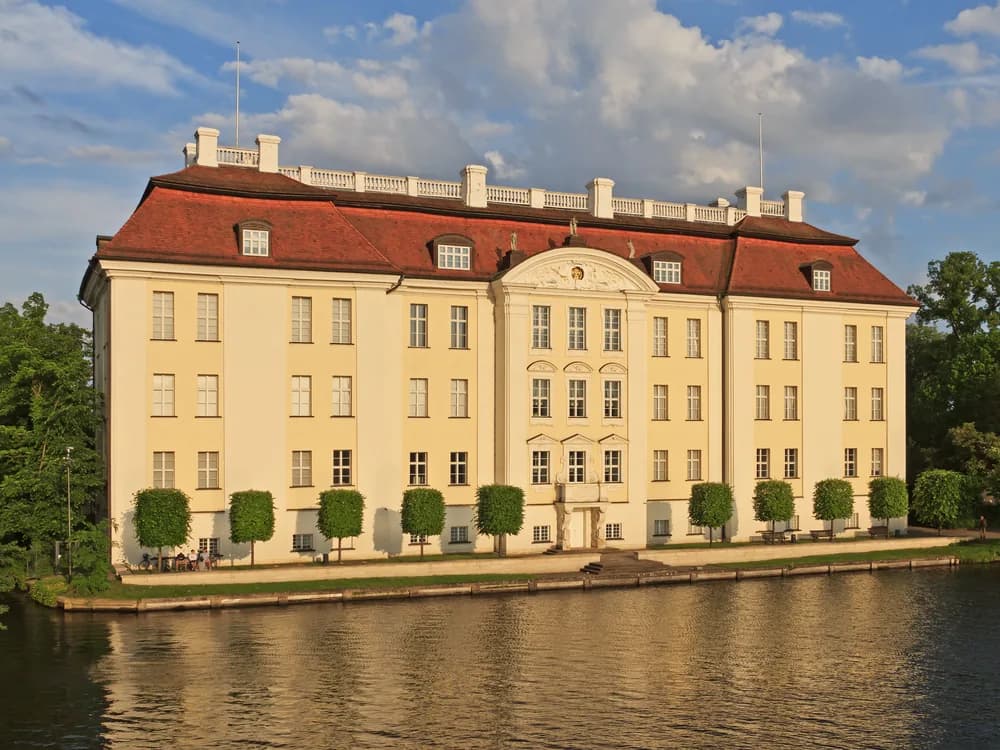
Built 1677 · Dutch Baroque; built 1677–1682 by architect Rutger van Langervelt for Prince Frederick of Brandenburg (later King Frederick I of Prussia); island location on the Spree-Dahme confluence; houses the Kunstgewerbemuseum (Museum of Decorative Arts) since 1963
Quick Facts
- Hours
- Closed Mondays. Shorter winter hours possible — check the Kunstgewerbemuseum site before visiting.
- Entry from
- €9
- Duration
- 1.5–2 hours
- Best time
- Year-round
- Nearest city
- Berlin
Highlights
- ✦A Dutch Baroque palace built 1677–1682 on an artificial island at the confluence of the Spree and Dahme rivers, one of the oldest surviving Hohenzollern buildings in Berlin
- ✦The setting for the 1906 'Captain of Köpenick' incident, when an unemployed cobbler in a second-hand uniform commandeered soldiers and robbed the town hall treasury — later immortalised in Carl Zuckmayer's satirical play
- ✦A near-intact 1680s Baroque chapel with original stucco decoration, among the best-preserved interiors of its kind in the Berlin region
- ✦Home to part of the Kunstgewerbemuseum since 1963, Germany's oldest museum of decorative arts, with collections spanning the 16th to 18th centuries
- ✦One of the most affordable palace tickets on this site, in one of Berlin's least-visited and most underrated outer districts
Skip the queue with a guided tour
Skip-the-line tickets & expert guides
Thirty minutes by S-Bahn from central Berlin, the city gives way to water, forest and the slower rhythms of the Köpenick district. Here, on an artificial island at the confluence of the Spree and Dahme rivers, stands a Dutch Baroque palace that most visitors to Berlin never find. The Palace of Köpenick is one of the oldest Hohenzollern buildings still standing in the city, a compact and elegant structure that has housed one of Germany's finest collections of decorative arts since 1963. It is also the stage for one of the most celebrated comic episodes in German history — an episode that says something pointed about the German relationship with authority and the uniform.
In October 1906, a 57-year-old unemployed cobbler named Wilhelm Voigt put on a second-hand captain's uniform, stopped a passing group of soldiers on a Berlin street, and ordered them — by the sole authority of the uniform — to accompany him to Köpenick. Once there, he marched into the town hall, formally arrested the mayor and the city treasurer, confiscated the municipal treasury (4,002 marks and 37 pfennigs, recorded with German precision), and then simply walked away. He was arrested ten days later, but the story delighted Berlin and reportedly amused even the Kaiser. The playwright Carl Zuckmayer turned the episode into Der Hauptmann von Köpenick (1931), a satirical masterpiece about German deference to authority that has remained in continuous production ever since. A statue of Voigt in his captain's uniform now stands in front of Köpenick's town hall, a permanent wink at the whole affair.
The palace on the island predates the town hall incident by more than two centuries. Prince Frederick of Brandenburg, who would later crown himself King Frederick I of Prussia, commissioned the current Baroque palace between 1677 and 1682, built by the Dutch architect Rutger van Langervelt. The island location was strategic rather than merely picturesque: Köpenick had been a Slavic settlement since the 9th century, and medieval German lords had maintained a fortress on or near this site from the 12th century onward. The Dutch Baroque style Frederick chose, similar to what he would later use at Oranienburg, reflects the strong pull of Dutch architectural taste on the Prussian court in the final decades of the 17th century, a generation before the more familiar French-influenced Baroque of Charlottenburg.
The palace's finest surviving interior is its chapel, which retains its original stucco decoration from 1682 to 1685 — one of the best-preserved Baroque chapel interiors anywhere in the Berlin region. The carved wooden panelling, the gallery, and the painted ceiling were largely spared the destruction that erased so much of Berlin's Baroque architectural heritage during the 20th century. The Gobelin Hall, named for its remarkable set of 17th-century Brussels tapestries, is the other standout room, its scale and decoration giving a sense of how the palace functioned as a genuine princely residence rather than a purely ceremonial backdrop.
Since 1963, the palace has housed part of the Kunstgewerbemuseum, the Museum of Decorative Arts, founded in 1867 as the oldest institution of its kind in Germany. The Köpenick branch focuses specifically on the Renaissance, Baroque and Rococo periods: furniture, silver, glass, ceramics and textiles drawn from the 16th through 18th centuries, displayed within the palace's own period rooms rather than in a purpose-built museum setting. The basement holds a smaller archaeological exhibition tracing the history of settlement on the island from its Slavic origins through to the Hohenzollern era. This is not a museum built for visitors chasing dramatic castle interiors; it rewards those curious about how the material culture of the aristocracy, and the prosperous bourgeoisie beneath them, developed across three centuries of craftsmanship.
The island setting itself is a large part of the appeal. The palace sits surrounded by the Spree on one side and the Dahme on the other, connected to the mainland by a stone bridge, with the wooded shoreline visible from the palace windows. The surrounding area — the Müggelsee lake, the Köpenick forest, and an old town quarter lined with gabled burgher houses — makes the palace a natural anchor for a half-day exploring one of Berlin's most undervisited outer districts, far removed from the tourist density of Mitte or Charlottenburg.
History
Prince Frederick of Brandenburg, the future King Frederick I of Prussia, commissioned the present palace at Köpenick in 1677, on an artificial island at the confluence of the Spree and Dahme rivers that had been a fortified settlement site since at least the 12th century. The Dutch architect Rutger van Langervelt completed the Baroque palace by 1682, in a style reflecting the strong influence of Dutch architecture on the Prussian court of the period, predating the more famous French-influenced Baroque of Charlottenburg Palace by roughly two decades.
The palace remained in Hohenzollern use through subsequent centuries, its chapel and Gobelin Hall surviving largely intact through the upheavals of the 19th and 20th centuries. In October 1906, the town's adjoining municipal offices became the unlikely setting for the 'Captain of Köpenick' incident, in which an impostor in a borrowed uniform briefly seized control of the town hall — an episode later dramatised by playwright Carl Zuckmayer. Since 1963 the palace has housed a branch of the Kunstgewerbemuseum, Germany's oldest museum of decorative arts, presenting Renaissance, Baroque and Rococo applied arts within the palace's historic rooms.
How to Visit
Getting there: Take the S-Bahn line S3 to Köpenick station, then walk about 15 minutes through the old town, or take tram 62 directly to the palace.
Tickets: GYG tour t388583 ($9) is among the most affordable palace tickets on this site, sold directly by GetYourGuide Tours & Tickets GmbH rather than the palace itself. Note that it is non-refundable, and that an audio guide is not included despite some third-party listings suggesting otherwise.
Don't miss: The 1680s chapel, with its original stucco decoration, and the Gobelin Hall's 17th-century Brussels tapestries.
Combine with: The old town quarter, the Müggelsee lake, and Köpenick forest make a natural half-day extension beyond the palace itself.
Frequently Asked Questions
In October 1906, an unemployed cobbler named Wilhelm Voigt put on a second-hand army captain's uniform, ordered a group of soldiers he encountered on a Berlin street to follow him by the sheer authority the uniform implied, and led them to Köpenick's town hall, where he arrested the mayor and treasurer and made off with the entire municipal treasury. He was caught ten days later but became a folk hero almost overnight, and the playwright Carl Zuckmayer immortalised the episode in his 1931 satire Der Hauptmann von Köpenick, still widely performed today as a commentary on German deference to uniformed authority.
Location
Schlossinsel 1, 12557 Berlin, Germany
Nearby Castles
Featured Tour
Berlin: Palace of Köpenick Entrance Ticket
Cancellation available · Instant confirmation
Tours & Tickets
Powered by GetYourGuide
Entry from
€9/ adult