
© Unsplash
Acrocorinth
Ακροκόρινθος
Greece · Corinthia / Peloponnese · Near Corinth
Built 500 · Ancient Greek / Byzantine / Frankish / Venetian / Ottoman
Quick Facts
- Hours
- Open daily. Extended hours in summer. Free entry. Hours and access occasionally affected by restoration work — verify before visiting.
- Entry from
- Free
- Duration
- 2–3 hours (including the uphill walk)
- Best time
- April to June and September to October — avoid the steep climb in summer midday heat
- Nearest city
- Corinth
Highlights
- ✦Continuously fortified for over 2,500 years — ancient Greek, Roman, Byzantine, Frankish, Venetian, and Ottoman layers all visible
- ✦At 575 metres, the views from the summit encompass the Gulf of Corinth, the Saronic Gulf, and — on clear days — the Acropolis of Athens
- ✦One of the largest fortified sites in Greece, with 3.5 km of walls enclosing the entire summit
- ✦Free entry — one of the most spectacular free archaeological sites in the Mediterranean
- ✦The ancient Temple of Aphrodite at the summit was one of the most famous sanctuaries in the ancient world
Skip the queue with a guided tour
Skip-the-line tickets & expert guides
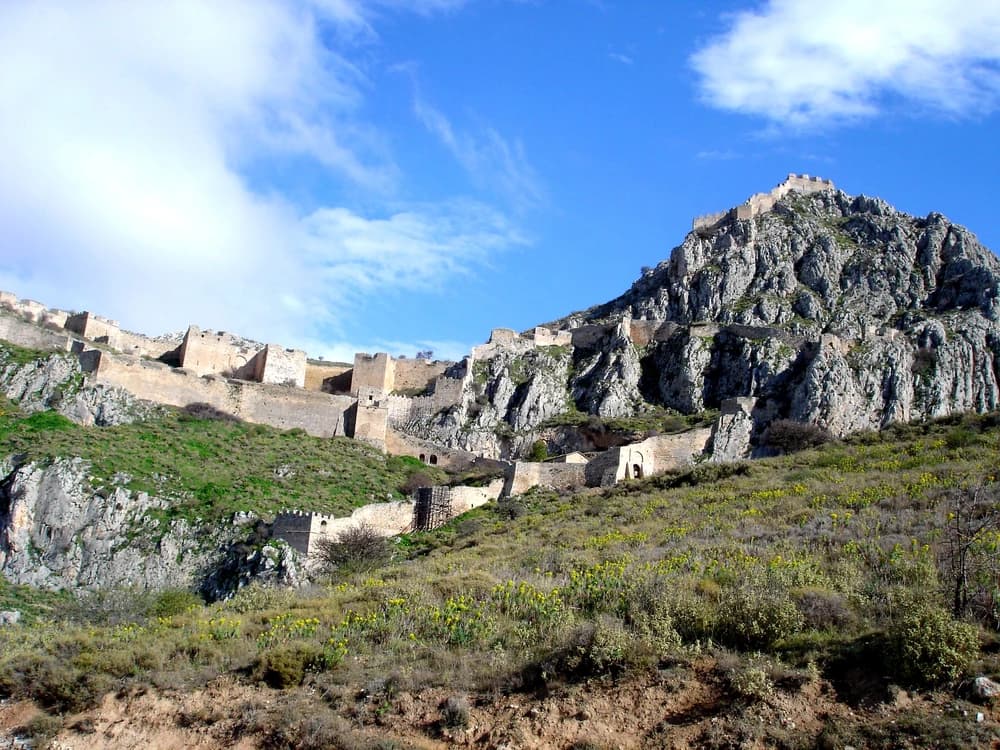
Acrocorinth is not, technically, a castle — it is a fortified summit, a 575-metre rock that rises almost vertically from the Corinthian plain and has been garrisoned, fought over, and built upon by every civilisation that has controlled this critical bottleneck of the Greek world for 2,500 years. Greeks, Romans, Byzantines, Crusaders (the Frankish Villehardouin family), Venetians, and Ottomans have all left their walls here, and the result is one of the most layered and genuinely impressive fortified sites in Europe — all of it free to enter.
The approach involves a steep drive on a winding road (a car or taxi is strongly recommended for the lower section) followed by a 15–20 minute uphill walk through three successive gateways — the outer Ottoman gate, the middle Frankish gate, and the inner Byzantine gate — each more imposing than the last and each representing a different chapter of the mountain's history. Inside the walls, the summit plateau of 25 hectares contains ruins from every period: ancient Greek walls, Byzantine cisterns, Frankish towers, Venetian bastions, and Ottoman-era buildings.
At the very summit, the foundations of the Temple of Aphrodite remain. In antiquity this was one of the most famous sanctuaries in the Mediterranean, allegedly served by a thousand sacred prostitutes (a claim repeated by ancient sources and probably exaggerated). The view from here is extraordinary: the Gulf of Corinth to the north, the Saronic Gulf to the east, the Corinth Canal visible as a thin slot in the isthmus below, and on clear mornings the Acropolis of Athens 80 kilometres away.
History
Acrocorinth's strategic position — controlling access between mainland Greece and the Peloponnese, commanding both the Corinthian and Saronic gulfs — made it the most fought-over citadel in Greek history. Ancient Corinth, one of the wealthiest cities of classical Greece, sat at its base, and whoever controlled the rock controlled the city and the isthmian trade routes.
The ancient Greeks built the first substantial fortifications, and Philip II of Macedon established a garrison here in 338 BC following the Battle of Chaeronea. After the Roman conquest of Greece in 146 BC, Acrocorinth changed hands repeatedly. The Byzantine Empire held it for centuries, building the extensive cistern system and inner walls that still partially stand.
In 1210, the Frankish Prince of Achaea, Guillaume de Champlitte's heir, captured Acrocorinth after a five-year siege. The Franks reinforced the outer walls and built the distinctive triple gateway still used as the main entrance today. Venice held it 1395–1458, adding the characteristic Venetian bastions at the western end. The Ottomans captured it in 1458 and held it until the Greek War of Independence. Today it is maintained as an open archaeological site.
How to Visit
Getting there from Athens: Ancient Corinth is 80 km west of Athens — about 1 hour by car on the A8 motorway, or 1.5 hours by train to Corinth station (then a taxi 5 km to Ancient Corinth and Acrocorinth). From Corinth town, a taxi to the base of Acrocorinth takes about 10 minutes. Many Athens day-tour operators include Acrocorinth as part of Corinth day trips.
The climb: From the car park at the base of the final approach, the walk to the summit takes about 15–20 minutes on a steep rocky path. Wear proper shoes — the terrain is uneven limestone. Bring water: there is no refreshment facility inside the walls. The three gateways on the approach are worth stopping at and examining.
Combine with: The Archaeological Museum and ruins of Ancient Corinth at the base of the hill (including the Temple of Apollo) are essential companions to the Acrocorinth visit. Allow half a day for both.
Frequently Asked Questions
By car: take the A8 motorway from Athens towards Patras, exit for Corinth (about 1 hour), then follow signs to Ancient Corinth and Acrocorinth (5 km from Corinth town, 10 km from the motorway exit). By public transport: take the train from Athens to Corinth (1.5 hours, runs regularly), then a taxi from Corinth station to the site (about €15–20 each way). Many Athens tour operators offer day trips to Corinth and Acrocorinth combined.
Location
Acrocorinth, 201 00 Archaia Korinthos, Greece
Nearby Castles
Tours & Tickets
Powered by GetYourGuide
Free Entry