
© Castles & Palaces
Avio Castle
Castello di Avio
Italy · Trentino · Near Rovereto
Built 1000 · Trentino medieval castle; early fortress documented from 1000 AD; expanded by the Castelbarco family in the 13th–14th centuries; the Guard's Tower contains a rare cycle of secular Gothic frescoes (14th century); FAI property since 1977
Quick Facts
- Hours
- Open Saturdays, Sundays and public holidays, March to November. Check the FAI calendar for occasional special weekday openings.
- Entry from
- €10
- Duration
- 1 hour
- Best time
- March to November (check FAI opening calendar)
- Nearest city
- Rovereto
Highlights
- ✦The first property ever acquired by the Fondo Ambiente Italiano, in 1977, marking the start of Italy's most prominent heritage conservation movement
- ✦A 14th-century fresco cycle in the Guard's Tower depicting knights in combat and tournament — one of the best-preserved secular fresco cycles surviving anywhere in Europe
- ✦Expanded substantially by the Castelbarco family, the dominant Trentino noble house controlling this stretch of the Adige valley
- ✦A commanding position above Sabbionara guarding one of the great Alpine trade and invasion routes, used by Romans, medieval emperors and Napoleon's armies alike
- ✦Views down the Adige valley over vineyard-covered slopes to the peaks beyond, distinct from the architecture of central or southern Italy
Skip the queue with a guided tour
Skip-the-line tickets & expert guides
The Adige valley south of Rovereto is one of the great Alpine passes — the route through which Romans, medieval emperors, Renaissance merchants and Napoleon's armies moved between the Po plain and the Alps. Castello di Avio guards the valley from a spur of rock above the village of Sabbionara, one of a chain of fortified positions that controlled movement through this strategic corridor. It is the oldest FAI property, the Italian National Trust's first acquisition in 1977, and contains one of the most remarkable medieval fresco cycles in northern Italy.
The castle's origins lie in the early 11th century, but its most significant architectural period came in the 13th and 14th centuries under the Castelbarco family, a Trentino noble house that dominated this section of the Adige valley. The Castelbarco lords expanded the castle substantially: new towers, an outer ward and, most importantly, the fresco decorations that are Avio's primary artistic significance. The Guard's Tower and the Soldiers' Tower both contain fresco cycles from this period.
The Guard's Tower at Avio contains a cycle of secular military frescoes painted in the 14th century, depicting knights in combat, tournaments and individual figures of soldiers. These are not religious images; they are images of the martial culture that supported the Castelbarco family's power, painted on the walls where that power was enforced. Secular fresco cycles of this period are rare anywhere in Europe, and in northern Italy this is among the best-preserved examples. The figures are painted with direct observation of contemporary armour, weapons and heraldic detail, making them valuable documents of 14th-century material culture as well as significant art.
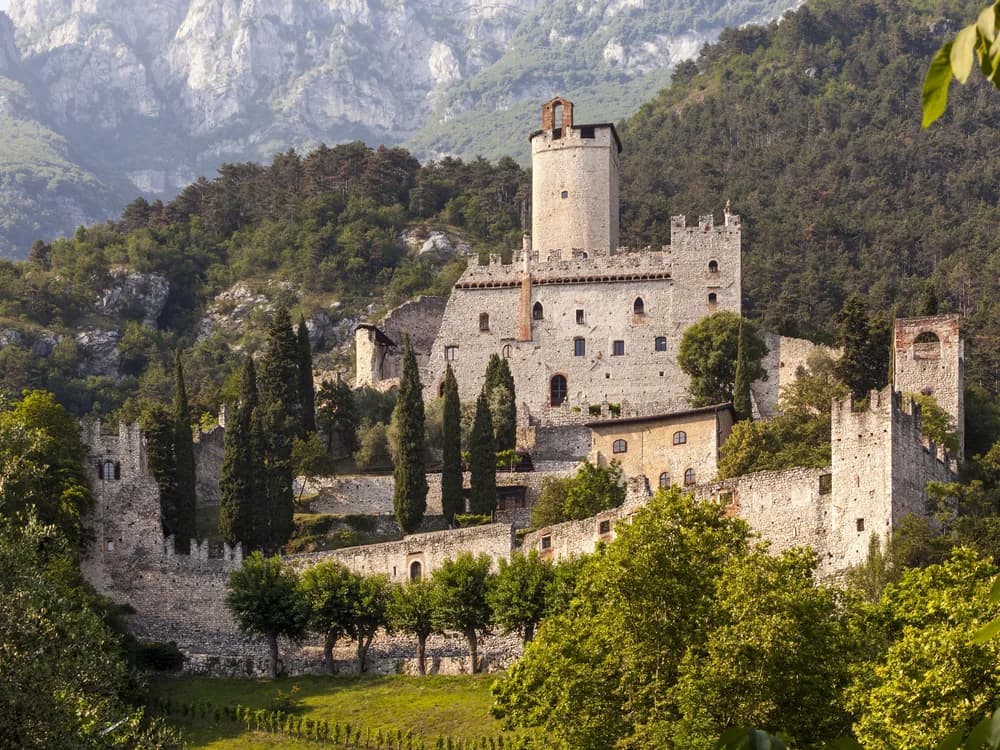
Trentino is culturally and historically distinctive: Italian-speaking and officially Italian since 1919, but historically part of the County of Tyrol, Habsburg territory, with an architecture, food culture and landscape that are simultaneously Alpine German and northern Italian. Avio sits at the southern edge of this cultural zone, closer to Verona and the Veneto than to Bolzano and the German-speaking north, but visibly within the Alpine architectural tradition. The castle's construction — grey stone, round towers, the valley setting — looks nothing like a central Italian castle; it looks precisely like what it is, a medieval Alpine fortress.
The Fondo Ambiente Italiano is Italy's equivalent of England's National Trust or France's Fondation du Patrimoine, a private charity that acquires and manages historic buildings and landscapes. Avio was FAI's first acquisition in 1977, marking the beginning of the Italian heritage conservation movement's most productive institution. The castle's fresco conservation, the restoration of its defensive fabric and the interpretive programme that now accompanies the visit are all products of nearly five decades of FAI management. Avio, together with Masino and Manta elsewhere in this site's inventory, is one of several FAI properties in northern Italy — one of the clearest arguments for visiting these lesser-known sites over the famous state museums.
History
A fortification at Avio is documented from around 1000 AD, controlling a strategic position above the Adige valley trade and invasion route. The Castelbarco family, the dominant noble house in this part of Trentino, expanded the castle substantially during the 13th and 14th centuries, adding new towers and an outer ward, and commissioning the secular fresco cycles in the Guard's Tower that remain the castle's principal artistic significance, depicting knights in combat and tournament scenes rendered with close attention to contemporary arms and armour.
The castle's military and administrative importance faded in subsequent centuries as the political control of the Adige valley shifted, eventually falling under Habsburg Tyrolean administration before becoming part of Italy in 1919. In 1977, the Fondo Ambiente Italiano acquired Avio as its first property, a foundational moment for the organisation that has since grown into Italy's leading independent heritage conservation charity, and the foundation has managed the site's restoration and public access ever since.
How to Visit
Getting there: Avio is 10km south of Rovereto, about 20 minutes by car. Rovereto sits on the main Trento–Verona rail line, about 25 minutes from Trento and 50 minutes from Verona. There is no direct public transport to the castle; a taxi from Avio village, 2km from the castle, is the easiest approach.
Opening days: The castle is open Saturdays, Sundays and public holidays from March to November; check the FAI calendar for occasional weekday openings.
Tickets: GYG tour t433954 is the entry ticket. As a newly listed activity with no reviews yet, it displays without a star rating.
The view down the Adige valley from the castle walls, with vineyards on the lower slopes and the peaks rising behind, justifies the visit independently of the frescoes.
Frequently Asked Questions
Castello di Avio was the very first property acquired by the Fondo Ambiente Italiano, in 1977, marking the founding moment of what has since become Italy's leading independent heritage conservation charity. The foundation's restoration of the castle's fresco cycles and defensive fabric set the template for its subsequent work at other properties, including Castello di Masino and Castello di Manta.
Location
Via al Castello 1, 38063 Sabbionara di Avio TN, Italy
Nearby Castles
Featured Tour
Avio: Sabbionara Castle Entry Ticket
Cancellation available · Instant confirmation
Tours & Tickets
Powered by GetYourGuide
Entry from
€10/ adult