
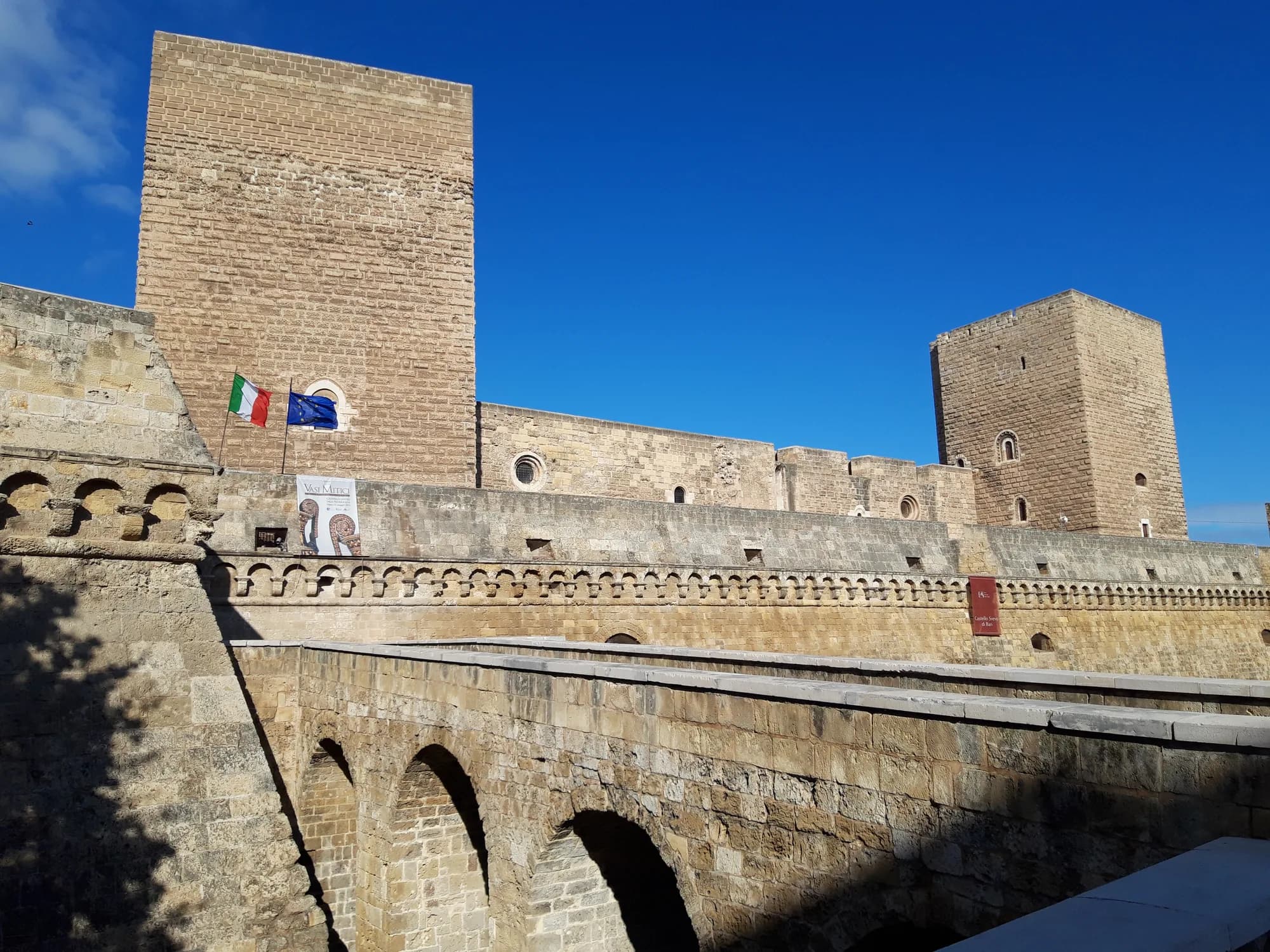
© Castles & Palaces
Norman-Swabian Castle Bari
Castello Normanno-Svevo di Bari
Italy · Puglia · Near Bari
Built 1131 · Norman origins 1131 under Roger II of Sicily; rebuilt 1233–1240 by Holy Roman Emperor Frederick II; the current structure is a mix of Norman square towers and Frederick II's inner keep; the outer bastions added by the Spanish (1532–1559); houses a national museum of medieval sculpture from Puglia churches; Frederick II made it his base for the Sixth Crusade
Quick Facts
- Hours
- Closed Mondays. Check the official site for any seasonal variation in closing time.
- Entry from
- €12
- Duration
- 1.5–2 hours
- Best time
- Year-round
- Nearest city
- Bari
Highlights
- ✦Founded in 1131 by Roger II of Sicily and substantially rebuilt between 1233 and 1240 by Holy Roman Emperor Frederick II, one of medieval Europe's most extraordinary rulers
- ✦Served as Frederick II's operational base for the Sixth Crusade (1228–1229), the only crusade to recover Jerusalem through negotiation rather than battle
- ✦Spanish viceroys of Naples added the outer bastions between 1532 and 1559, adapting the medieval keep for the era of artillery warfare
- ✦Houses a national museum of medieval sculptural fragments rescued from churches and cathedrals across Puglia
- ✦Set in Bari's Borgo Antico, directly facing the Adriatic on the same waterfront once used to launch ships toward the Holy Land
Skip the queue with a guided tour
Skip-the-line tickets & expert guides
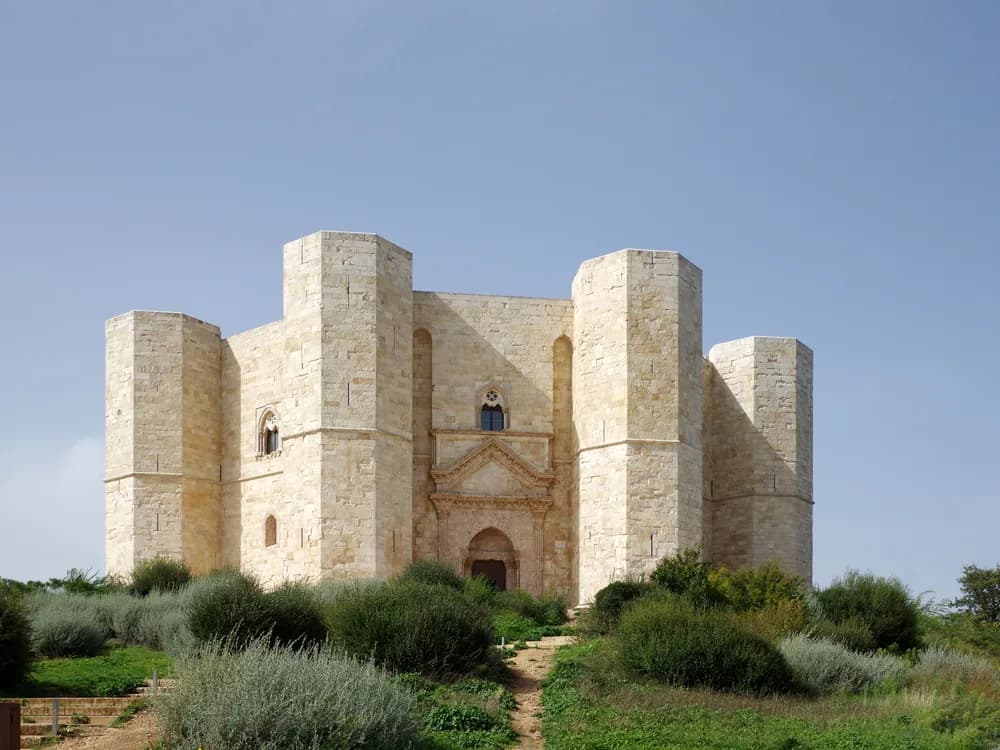
In the old city of Bari, at the point where the medieval Borgo Antico meets the waterfront and the Adriatic stretches east toward Albania, stands a castle that was built by Norman kings, rebuilt by a Holy Roman Emperor who thought himself something of a prophet, used by Spanish viceroys, and now guards one of the finest collections of medieval sculpture in southern Italy. The Castello Normanno-Svevo di Bari is not the most famous castle in Puglia — that title belongs to Castel del Monte, Frederick II's enigmatic octagonal fortress further inland — but it is the castle most entangled with the political and religious dramas of medieval Mediterranean history.
The castle was first built in 1131 by Roger II of Sicily, the Norman king who had consolidated control over southern Italy and was constructing a network of fortifications to secure his coastline. Bari was strategically critical: it had been the capital of the Byzantine catepanate of Italy, the principal Byzantine stronghold in the south, and its harbour served as the primary embarkation point for crusaders heading to the Holy Land. Roger's original castle was a comparatively simple rectangular enclosure with four square Norman towers, a typical defensive structure for its era and region.
The castle reached its present essential form under Frederick II, Holy Roman Emperor and King of Sicily, who rebuilt and expanded it between 1233 and 1240. Frederick remains one of the most extraordinary figures of medieval Europe: trilingual in Latin, Arabic and Greek, deeply interested in science, mathematics and falconry, in near-permanent conflict with the papacy, and possessed of an architectural vision that produced some of the most sophisticated buildings of the 13th century. The Bari castle served as his operational base for the Sixth Crusade, which he led in 1228 and 1229, arriving in the Holy Land while under papal excommunication and securing the return of Jerusalem to Christian control through negotiation rather than combat. It stands as the only crusade in the entire era to achieve its central objective without a battle.
Frederick's Pugliese castles, of which Bari is the most urban and Castel del Monte the most isolated, functioned as centres of cultural and intellectual life as well as military installations. At Bari and his other southern courts, Frederick hosted Arabic scholars, Jewish physicians and Provençal troubadours, assembling a cosmopolitan court culture unusual for its time and place. He personally wrote De Arte Venandi cum Avibus, On the Art of Hunting with Birds, a comprehensive scientific treatise on falconry that ranks among the most sophisticated works of natural history produced anywhere in medieval Europe. The castle's present-day museum reflects this intellectual complexity through its collection of medieval sculptural fragments drawn from churches and cathedrals across Puglia.
After the Norman-Swabian period, the castle passed through Angevin and Aragonese control before the Spanish viceroys of Naples undertook major modifications between 1532 and 1559, adding the outer bastions and reshaping the defensive perimeter for an age dominated by artillery. These additions, visible from outside as the low, angled walls surrounding the medieval keep, follow the same pattern of 16th-century military upgrade seen at Castel Sant'Elmo in Naples and other Spanish fortifications across the wider Kingdom of Naples.
The castle today houses a branch of Italy's national museum system, with a collection focused specifically on medieval sculptural fragments from Puglia: column capitals, portal reliefs, episcopal thrones and decorative stonework rescued from churches damaged, demolished or remodelled over the centuries. The collection draws on pieces from the Cathedral of Bari, from various Romanesque churches across the Murge plateau, and from private collections assembled over the past two centuries. It functions as much as a scholarly resource as a conventional tourist attraction, but the quality of the individual pieces, particularly the Romanesque capitals, is exceptional and rewards visitors willing to look closely rather than simply pass through.
History
Roger II of Sicily founded the castle at Bari in 1131 as part of a broader Norman programme of coastal fortification across southern Italy, replacing what had previously been the seat of Byzantine authority in the region. Holy Roman Emperor Frederick II substantially rebuilt and enlarged the castle between 1233 and 1240, transforming it into both a military stronghold and a base for his court's distinctive cosmopolitan culture, and using it as his operational headquarters in preparing the Sixth Crusade of 1228–1229, during which he negotiated the return of Jerusalem to Christian control without fighting a battle.
Following the end of Swabian rule in southern Italy, the castle passed through Angevin and Aragonese hands before the Spanish viceroys of Naples carried out significant modifications between 1532 and 1559, adding outer bastions designed to withstand contemporary artillery. The castle subsequently served various administrative and military functions before being converted into a museum, today presenting a national collection of medieval sculpture drawn from churches and cathedrals throughout the Puglia region.
How to Visit
Getting there: The Castello Normanno-Svevo is in Bari's old city, the Borgo Antico, a 10-minute walk from Bari Centrale station.
Tickets: GYG tour t1063460 covers general admission. With only 14 reviews, the listing falls below this site's display threshold for a star rating.
Combine with: A combined ticket with the nearby Pinacoteca Provinciale di Bari is available at the castle. For a fuller Puglia itinerary, pairing Bari with Castel del Monte, 70km inland and a UNESCO World Heritage Site, makes an efficient single-day route by car.
Frequently Asked Questions
Frederick II led the Sixth Crusade in 1228 and 1229, departing from southern Italy while under excommunication by the papacy for his delayed departure. Rather than seeking a military confrontation, Frederick negotiated directly with the Ayyubid Sultan al-Kamil, securing the return of Jerusalem, Bethlehem and Nazareth to Christian control through diplomacy. It remains the only major crusade of the period to achieve its central territorial objective without a significant battle, a reflection of Frederick's broader reputation as a ruler more interested in negotiation, science and cross-cultural exchange than in conventional medieval warfare.
Location
Piazza Federico II di Svevia, 70122 Bari, Italy
Nearby Castles
Featured Tour
Bari: Norman-Swabian Castle Entry Ticket
Cancellation available · Instant confirmation
Tours & Tickets
Powered by GetYourGuide
Entry from
€12/ adult