
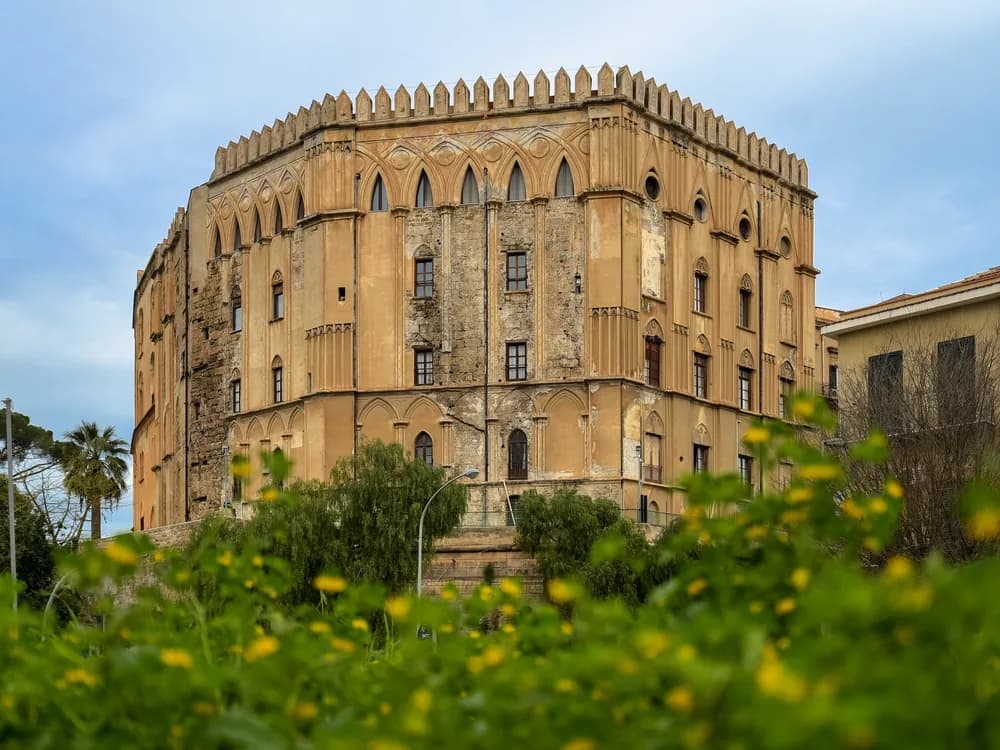
© Unsplash
Palace of the Normans
Palazzo dei Normanni
Italy · Sicily, Palermo · Near Palermo
Built 831 · Arab-Norman
Quick Facts
- Hours
- Cappella Palatina open Monday–Saturday 08:15–17:45, Sunday 08:15–13:00. The palace also serves as the seat of the Sicilian Regional Assembly; access to some areas limited on sitting days.
- Tickets from
- €15
- Duration
- 2 hours
- Best time
- Year-round
- Booking
- Required — book 3+ days ahead
- Nearest city
- Palermo
Highlights
- ✦UNESCO World Heritage Site as part of Arab-Norman Palermo
- ✦Cappella Palatina — considered the finest mosaic interior in the world
- ✦Oldest continuously used royal palace in Europe
- ✦Extraordinary fusion of Arab, Byzantine, and Norman architecture
- ✦Still serves as the seat of the Sicilian Regional Parliament
Skip the queue with a guided tour
Skip-the-line tickets & expert guides
The Palazzo dei Normanni is the oldest royal palace in Europe and one of the most remarkable buildings on earth — a layered monument to three civilisations built atop each other on a hill in central Palermo. Founded by the Emirate of Sicily in the 9th century, expanded by the Norman kings Roger II and William II in the 12th century, and used continuously ever since, the palace is now the seat of the Sicilian Regional Assembly. Its jewel is the Cappella Palatina — the private royal chapel completed in 1143 — whose interior is entirely covered in glittering Byzantine gold mosaics of extraordinary refinement, creating an effect described by visitors for nine centuries as overwhelming. The palace is a UNESCO World Heritage Site as part of the Arab-Norman Palermo designation, recognising the unique cultural synthesis of the Norman Kingdom of Sicily.
History
The site was fortified by the Phoenicians and later the Romans. The Aghlabid Arab emirs built the first palace here from 831. The Norman kings — Roger I and Roger II — conquered Sicily in the late 11th century and vastly expanded the palace, commissioning the Cappella Palatina in 1132 (completed 1143). Under Frederick II Holy Roman Emperor, the palace was a centre of European culture. It passed to Spanish and then Bourbon rule, and after Italian unification became the seat of the Sicilian parliament, a function it retains today.
How to Visit
The palace is in central Palermo, accessible by foot from most of the historic centre (15 minutes from Palermo Centrale station). Pre-booking online is strongly recommended as entry is timed. The surrounding UNESCO Arab-Norman itinerary includes the Cathedral of Palermo, La Martorana church, and the Cathedral of Monreale (9 km outside the city) — among the finest mosaic buildings in the world.
Frequently Asked Questions
The chapel's walls, ceiling, and apse are entirely covered in Byzantine gold mosaics created by craftsmen from Constantinople between 1132 and 1143, combined with a carved Arab muqarnas wooden ceiling — a combination found nowhere else on earth.
Location
Piazza del Parlamento 1, 90129 Palermo PA, Italy
Nearby Castles
Tours & Tickets
Powered by GetYourGuide
Entry from
€15/ adult