
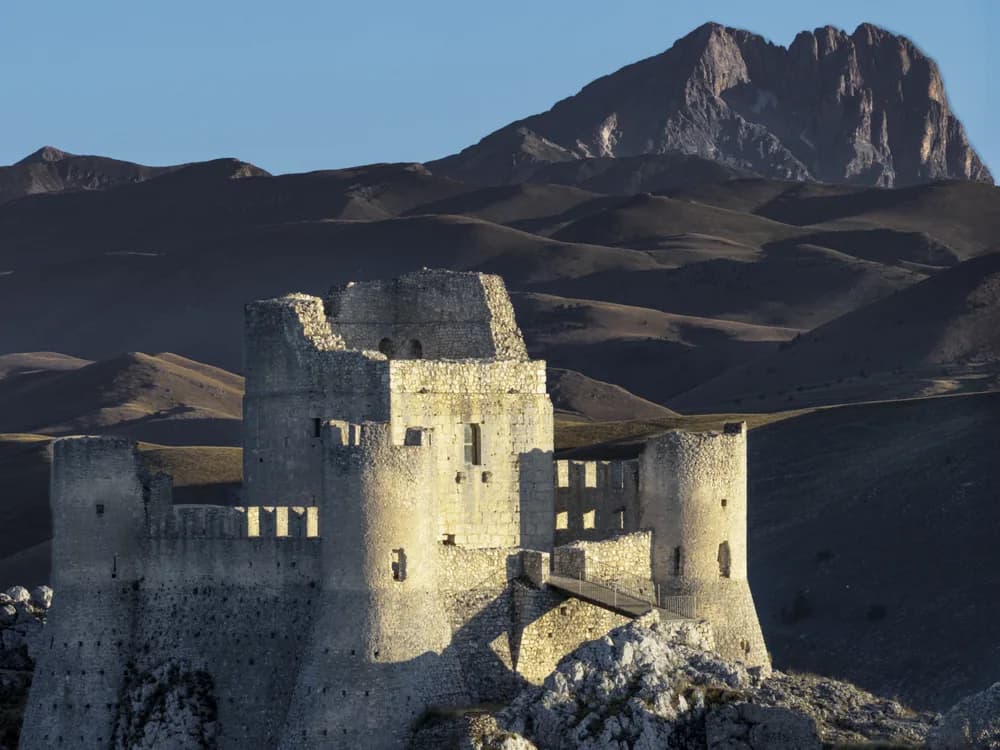
© Unsplash
Rocca Calascio
Rocca di Calascio
Italy · Abruzzo · Near L'Aquila
Built 1000 · Medieval Apennine fortress; central square tower (10th–11th century) expanded to full fortress with four circular corner towers in 1461 under the Piccolomini family
Quick Facts
- Hours
- The fortress itself has no gates and is accessible whenever the path is passable. The access road from the village of Calascio can close after heavy snow between November and April, and the municipality's small entry fee is collected informally on site during the open season, typically May to October.
- Entry from
- €3
- Duration
- 2–3 hours (includes 20-minute hike from the village)
- Best time
- May to June, September to October (snow possible November–April at 1,460m altitude)
- Nearest city
- L'Aquila
Highlights
- ✦The highest fortress in Italy at 1,460 metres above sea level, named one of the 15 most beautiful castles in the world by National Geographic
- ✦A central square watchtower built around 1000 AD, expanded in 1461 by the Piccolomini family — the same Abruzzo noble house that produced Pope Pius II — into a fortress with four circular corner towers
- ✦Filming locations for Ladyhawke (1985) and The Name of the Rose (1986, starring Sean Connery), whose directors found the treeless plateau and stone ruins an exact match for the medieval aesthetic they sought
- ✦Sweeping views of the Gran Sasso massif, at 2,912 metres the highest peak in the Apennines, and the vast high plateau of Campo Imperatore, nicknamed 'Italy's Little Tibet'
- ✦The octagonal Baroque church of Santa Maria della Pietà directly below the fortress, built in 1703 to commemorate a local military victory, its geometry deliberately echoing the four corner towers above
Skip the queue with a guided tour
Skip-the-line tickets & expert guides
At 1,460 metres above sea level, on the high plateau of the Abruzzo Apennines, stands the highest fortress in Italy. National Geographic named it one of the 15 most beautiful castles in the world. Sean Connery filmed here. Yet on a weekday in May, the entire ridge can belong to a single visitor — the Gran Sasso massif rising beyond, the medieval village of Calascio far below, and the silence of a mountain that has barely changed in five centuries.
The central square tower was built around 1000 AD as a watchtower guarding the routes across the plateau between the Kingdom of Naples and the Papal States, a position chosen for visibility rather than comfort. In 1461 the Piccolomini family — the same Abruzzo noble house that would produce Pope Pius II — expanded the watchtower into a proper fortress, adding four circular corner towers connected by a curtain wall around the original square keep. The combination of a square inner tower within a round-towered enceinte is architecturally unusual and visually striking, a design that reads clearly even from a considerable distance across the plateau.
That same year, 1461, brought a catastrophic earthquake that severely damaged the village of Calascio below the fortress. The Piccolomini rebuilt the village lower on the slope but kept the fortress itself standing above, and for a time the two settlements functioned together, watchtower and town. Then, in 1703, a second major earthquake struck, and this time the village was largely abandoned; the fortress, already isolated by its position, slipped into genuine obscurity. For long stretches of the following two centuries, Rocca Calascio was a local landmark rather than a destination — unmaintained, unvisited, and effectively forgotten outside the immediate region.
Its rediscovery began, improbably, with cinema. Ladyhawke, the 1985 fantasy film starring Rutger Hauer and Michelle Pfeiffer, used the site extensively, and The Name of the Rose, the 1986 adaptation of Umberto Eco's novel starring Sean Connery, filmed across the surrounding landscape. Both productions were drawn by the same quality: a treeless plateau, weathered stone ruins, and a mountain backdrop that delivered the medieval aesthetic directors had struggled to find intact elsewhere in Europe. Visitor numbers began climbing in the films' wake, and National Geographic's later designation of Rocca Calascio as one of the 15 most beautiful castles in the world cemented its reputation well beyond Italy.
The view from the towers justifies every part of that reputation. The Gran Sasso, at 2,912 metres the highest peak in the Apennines, dominates the skyline to the north; the vast plateau of Campo Imperatore, often called Italy's Little Tibet for its high-altitude bareness, stretches in every direction; and directly below the fortress stands the octagonal Baroque church of Santa Maria della Pietà, built in 1703 to commemorate a local military victory, its geometric form deliberately echoing the four corner towers rising above it. There is no road to the fortress itself — from the village of Calascio, reached by driving up from Castel del Monte, a 20-minute walk on a stone path climbs to the gate, a short hike that filters out casual visitors and preserves the site's genuine mountain atmosphere.
History
The earliest structure on the ridge above Calascio was a square watchtower built around 1000 AD, positioned to monitor movement across the high Apennine plateau along the border between the Kingdom of Naples and the Papal States. Its strategic value lay entirely in visibility and altitude rather than in controlling any single route, a watchtower in the most literal sense.
In 1461, the Piccolomini family — Abruzzo nobility who would shortly produce Pope Pius II — expanded the original tower into a full fortress, adding four circular corner towers connected by a curtain wall around the existing square keep. That same year, a severe earthquake struck the region and badly damaged the village of Calascio on the slope below; the Piccolomini rebuilt the settlement at a lower elevation while leaving the fortress itself standing on the ridge above. The arrangement held for roughly two and a half centuries, until a second major earthquake in 1703 struck the region again, this time prompting the largely complete abandonment of the village. With its civilian population gone, the fortress lost its remaining practical purpose and fell into a long period of genuine neglect, known locally but absent from any wider historical or tourist consciousness.
The fortress's modern rediscovery began with the film industry in the 1980s: Ladyhawke (1985) and The Name of the Rose (1986) both used the site and its surrounding landscape, drawn by the unspoiled medieval atmosphere of the treeless plateau and weathered stone ruins. Visitor interest grew steadily afterward, reaching a new level following National Geographic's recognition of Rocca Calascio as one of the 15 most beautiful castles in the world. The fortress and the surrounding Gran Sasso e Monti della Laga National Park are now managed jointly by regional and municipal authorities, with the small entry fee collected by the municipality of Calascio during the open season.
How to Visit
Getting there: The nearest large towns are L'Aquila, 55 kilometres away, and Sulmona, 50 kilometres away; both require a car, as there is no rail or scheduled bus service to the fortress itself. The drive from L'Aquila through the Gran Sasso e Monti della Laga National Park is spectacular in its own right and worth allowing extra time for. From the village of Calascio — reached by driving up from Castel del Monte — a 20-minute walk on an uneven stone path is the only way to reach the fortress, since no road serves it directly.
Timing and conditions: The site is typically accessible from May to October; winter snow at 1,460 metres can close the access road to the village entirely between November and April, so confirm conditions before planning a visit outside the warmer months. The municipality of Calascio collects a small entry fee of €3 for adults and €2 for children on site during the open season.
The guided trekking option: A private guided trekking tour extends the standard visit into a four-hour mountain experience covering the surrounding Campo Imperatore plateau as well as the fortress itself, with groups capped at six people for a genuinely personal pace. For a fuller day in the high Abruzzo, combine the fortress with Santo Stefano di Sessanio, a beautifully preserved medieval village 8 kilometres away that makes a natural second stop.
Frequently Asked Questions
Rocca Calascio sits at 1,460 metres above sea level on a ridge in the Abruzzo Apennines, making it the highest-altitude fortress in the country. Its elevated, treeless position was originally chosen for visibility across the surrounding plateau, and that same isolation is now part of its appeal — the fortress commands views of the Gran Sasso massif and the Campo Imperatore plateau that few lower-altitude castles in Italy can match.
Location
Calascio, 67020 Calascio AQ, Italy
Nearby Castles
Featured Tour
Rocca Calascio: Private Guided Trekking Tour
Cancellation available · Instant confirmation
Tours & Tickets
Powered by GetYourGuide
Entry from
€3/ adult