
© Unsplash
Kotor City Walls
Gradske zidine Kotora
Montenegro · Bay of Kotor · Near Kotor
Built 809 · Byzantine origins, extensively rebuilt in Venetian Gothic and Renaissance style between 1420 and 1797
Quick Facts
- Hours
- The ticket booth at the entry gate operates roughly 08:00–20:00, extended in peak summer. The walls themselves have no closing gate, but climbing after dark is inadvisable — the steps are uneven and unlit above the lower sections.
- Entry from
- €8
- Duration
- 2–3 hours (including the climb to Fort St. John)
- Best time
- April to June, September to October (avoid peak summer crowds)
- Nearest city
- Kotor
Highlights
- ✦Fort St. John (San Giovanni), 260 metres above sea level at the summit of the walls, reached by a 1,350-plus-step climb that ranks among the great physical experiences of the Adriatic coast
- ✦The Bay of Kotor itself — popularly called a fjord but technically a drowned river canyon, one of the southernmost in Europe, framed by near-vertical limestone mountains
- ✦A city that never fell to the Ottomans — virtually every other major town on the Adriatic surrendered, while Kotor's walls, cliff and Venetian garrison repelled repeated sieges
- ✦Three historic gates inscribed with Venetian lions — the Sea Gate (1555), the River Gate, and the North Gate — still the principal entrances to the Old Town
- ✦The Cathedral of Saint Tryphon (founded 1166), one of the finest Romanesque buildings on the Adriatic, standing inside a medieval street grid largely untouched since the Venetian period
Skip the queue with a guided tour
Skip-the-line tickets & expert guides
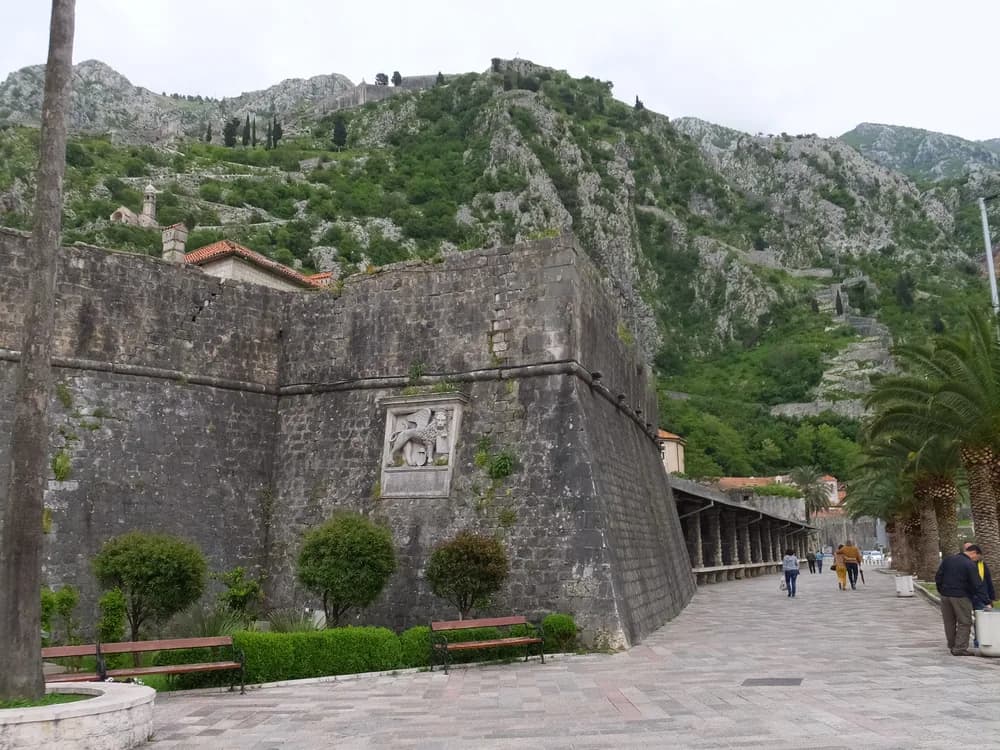
The city walls of Kotor are among the most dramatic fortifications in Europe — 4.5 kilometres of medieval stonework climbing a sheer limestone cliff from sea level to 260 metres above, culminating in Fort St. John at the summit. The climb, more than 1,350 steps in total, is not a pleasant stroll but a genuine ascent, and it is rewarded with a panorama over the Bay of Kotor, the terracotta rooftops of the Old Town directly below, and a fjord-like inlet framed by near-vertical mountains. The bay is often described as Europe's southernmost fjord, though technically it is a drowned river canyon, carved by a valley that flooded as sea levels rose after the last ice age rather than by glacial action — a geological detail that does nothing to diminish the drama of the view.
What makes Kotor's walls more than a scenic climb is the fact, almost unique on this coast, that the city behind them never fell. Virtually every comparable town along the Adriatic — Budva, Bar, the cities of the Dalmatian coast — surrendered to Ottoman forces at some point in the early modern period. Kotor's combination of sheer cliff, layered Venetian fortification, and a determined garrison turned back Ottoman sieges repeatedly across three centuries, leaving the Old Town below intact in a way few other Adriatic cities can claim. The medieval street grid, the Cathedral of Saint Tryphon, and the tightly packed lanes of the Old Town all survive substantially unaltered because Kotor was never sacked and never substantially rebuilt after the Venetian period.
The walls themselves carry Byzantine foundations dating to the 9th century, but their present scale and engineering belong to three centuries of Venetian rule, from 1420 to 1797, during which the fortifications were rebuilt, widened and extended into the form that climbs the cliff today. Three historic gates — the Sea Gate of 1555, the River Gate, and the North Gate — still mark the principal approaches to the Old Town, each carved with the winged lion of St. Mark, Venice's enduring signature on this corner of the Adriatic.
History
Kotor's fortifications have Byzantine origins dating to the 9th century, when the settlement first developed defensive walls at the head of the bay. The city's most transformative period began in 1420, when Kotor came under Venetian control — a relationship that would last, with brief interruptions, until 1797. Over those three and a half centuries, Venetian military engineers rebuilt and extended the walls repeatedly, widening them to withstand artillery and pushing the fortified perimeter up the cliff face to its current 4.5-kilometre extent, culminating in Fort St. John at the summit.
The defining historical fact of Kotor's walls is military rather than architectural: the city never fell to the Ottoman Empire. Ottoman forces besieged Kotor on several occasions through the 16th and 17th centuries, and each time the combination of the cliff, the layered Venetian walls, and the garrison's resolve held. This was a genuine rarity on the Adriatic coast, where Ottoman expansion absorbed most comparable port cities. Kotor's continued independence under Venetian and later Austrian rule meant its medieval core was never destroyed and rebuilt by a conquering power, leaving the Old Town's street grid and major monuments — including the Cathedral of Saint Tryphon, founded in 1166 and among the finest Romanesque buildings on the Adriatic, and the 1602 Clock Tower — substantially intact.
After the fall of Venice in 1797, Kotor passed to Austria, briefly to France, and then to Austria again, before becoming part of Yugoslavia in the 20th century and, since 2006, independent Montenegro. The Bay of Kotor, including the Old Town and its walls, was inscribed on the UNESCO World Heritage List in 1979 as the Natural and Culturo-Historical Region of Kotor, recognising the rare combination of natural landscape and continuous historic urban fabric.
How to Visit
The climb: The walls are accessed from inside the Old Town. The entry gate sits beside the Church of Our Lady of Remedy, a 14th-century chapel roughly halfway up the ascent — this is also where tickets are purchased. The full round trip to Fort St. John and back takes 1.5 to 2 hours at a steady pace. Go early morning or late afternoon: the midday climb in summer heat is genuinely strenuous, and there is little shade above the lower sections. Bring water; there is nowhere to buy any once you start climbing. The views from the fort — over the bay, the surrounding mountains, and the cypress-covered island of St. George with its Benedictine monastery — are among the finest anywhere on the Adriatic coast.
Getting there and tickets: Entry is €8 for adults and €4 for children, and the site is open year-round. The Old Town is entirely walkable from the cruise ship terminal and the main car parks outside the walls. Most visitors arrive on a day trip from Dubrovnik, either along the coast road or by boat via Perast, making Kotor one of the most popular half-day excursions from Croatia's southern coast.
Frequently Asked Questions
The full ascent to Fort St. John involves more than 1,350 steps and around 260 metres of elevation gain, taking roughly 45 minutes to an hour up at a steady pace, with the round trip totalling 1.5 to 2 hours. It is a genuine physical climb on uneven stone steps rather than a casual walk, and is best attempted in the cooler hours of the morning or late afternoon, especially in summer.
Location
Kotor Old Town, 85330 Kotor, Montenegro
Nearby Castles
Featured Tour
Kotor Old Town Walking Tour
Cancellation available · Instant confirmation
Tours & Tickets
Powered by GetYourGuide
Entry from
€8/ adult