
© Castles & Palaces
Royal Castle of Warsaw
Zamek Królewski w Warszawie
Poland · Masovian Voivodeship · Near Warsaw
Built 1596 · Polish Baroque; originally built 1596–1619 under Sigismund III Vasa when Warsaw became Poland's capital; expanded through the 17th–18th centuries; entirely destroyed by German forces September–October 1944; meticulously reconstructed 1971–1984 using original plans, inventories, and salvaged materials; listed on UNESCO Memory of the World register
Quick Facts
- Hours
- Closed Mondays. Reduced hours in winter. Sundays free entry to the permanent collection (subject to capacity).
- Entry from
- €12
- Duration
- 1.5–2 hours
- Best time
- Year-round
- Nearest city
- Warsaw
Highlights
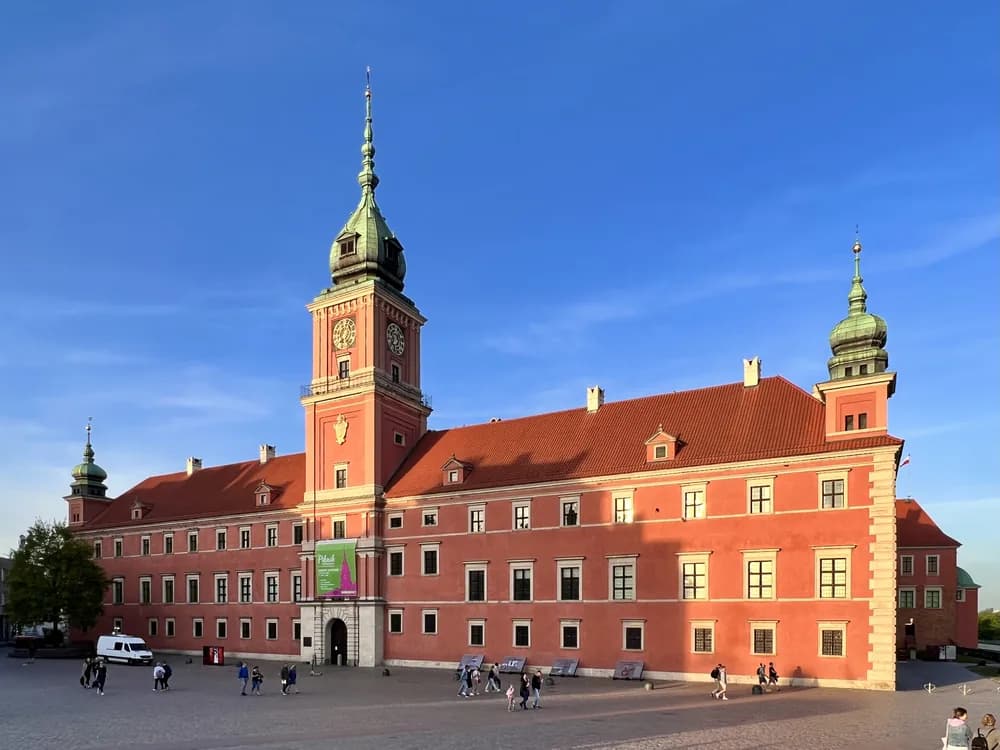
- ✦Occupies the eastern flank of Castle Square, the ceremonial centre of Warsaw's Old Town and the symbolic starting point of the Polish nation
- ✦The Canaletto Room, hung with 23 paintings by Bernardo Bellotto so topographically precise they were used as primary source documents during reconstruction
- ✦Entirely demolished by German demolition teams after the 1944 Warsaw Uprising, then rebuilt from 1971 to 1984 using salvaged fragments, paintings, and historical records
- ✦Reconstruction funded entirely by private donations from Polish citizens and the diaspora, after the Communist government refused state funding for a 'royal' symbol
- ✦Listed on the UNESCO Memory of the World register, recognising the castle's archives as a record of one of the 20th century's most significant heritage reconstructions
Skip the queue with a guided tour
Skip-the-line tickets & expert guides
Castle Square in Warsaw's Old Town is the ceremonial heart of Poland — the place where the nation begins, visually and historically. The Royal Castle occupies its eastern flank: a massive, irregular red-brick building with a clock tower that has told Warsaw's time since the 17th century. Except it hasn't. The castle that stands here today was rebuilt from rubble between 1971 and 1984. What visitors see is not a medieval survival but a deliberate act of national resurrection — stone by stone, painting by painting, ceiling by ceiling — one of the most extraordinary heritage reconstruction projects in European history.
A castle had stood on this site since the 14th century, when the Dukes of Mazovia maintained a stronghold above the Vistula River. When the Polish–Lithuanian Commonwealth transferred its capital from Kraków to Warsaw in 1596 under King Sigismund III Vasa, the Mazovian castle became the royal residence of one of the largest states in Europe. The architects Sigismund brought from Italy, principally Giovanni Trevano, transformed the medieval structure into a Renaissance and then Baroque palace complex over the following decades. By the early 18th century the result was a palace whose interiors could rival Versailles: the Marble Room, the Great Assembly Hall, the Canaletto Room, and the private apartments of Poland's last elected kings.
The most historically significant element of the Royal Castle's collection is the Canaletto Room, hung with 23 paintings by Bernardo Bellotto — known in Poland by his uncle's nickname, 'Canaletto' — commissioned by King Stanisław August in the 1770s. Bellotto was employed to document Warsaw's streets, squares, buildings and people with the precision of a topographic survey. The paintings are exact enough to be read almost as architectural drawings. When the castle was destroyed in 1944 and the decision was eventually made to reconstruct it, Bellotto's paintings became primary source documents: if a canvas showed a window arch at a particular height, the reconstruction followed it exactly. Art became architecture.
After the suppression of the Warsaw Uprising in September 1944, the SS systematically destroyed Warsaw, and the Royal Castle was not collateral damage but a deliberate target. German demolition teams mined and burned the building methodically, floor by floor, room by room, over several weeks. Before the destruction began, Polish museum workers had managed to remove many of the paintings, carved door frames, marble fireplaces and architectural fragments, hiding them in cellars and rural locations. These salvaged elements would later form the core of the reconstruction.
After the war, the Communist government initially refused to rebuild the Royal Castle, regarding it as a symbol of 'bourgeois' and monarchist Poland. The decision to reconstruct was taken only in 1971, after sustained public pressure and a popular fundraising campaign. The work was financed entirely by private donations from Polish citizens and the global Polish diaspora; the government withheld state funds specifically to distance itself from the project's royal associations. Roughly 3,000 craftsmen worked for 13 years. Salvaged original materials were incorporated wherever they had survived; missing elements were reconstructed using Bellotto's paintings, museum inventories, early photographs and historical plans. The castle reopened to the public in 1984.
The Royal Castle of Warsaw is listed on the UNESCO Memory of the World register, a designation recognising that the castle's archives document one of the 20th century's most significant acts of cultural preservation and reconstruction. The rooms look 17th- and 18th-century but were built in the 1970s and 1980s; the paintings in the Canaletto Room are originals hung in replica frames in a reconstructed room; the marble underfoot was quarried in 1975. None of this diminishes the visit — if anything, knowing the history makes it more affecting. This is what it looks like when a nation refuses to let its history disappear.
History
A fortified residence stood on the site of the Royal Castle from the 14th century, when it served the Dukes of Mazovia. Its transformation into a royal palace began in 1596, when King Sigismund III Vasa moved the capital of the Polish–Lithuanian Commonwealth from Kraków to Warsaw, commissioning Italian architects led by Giovanni Trevano to rebuild the structure as a residence fit for the seat of government. Successive monarchs expanded and redecorated the palace through the 17th and 18th centuries, culminating in the richly furnished Baroque and Rococo interiors, including the Canaletto Room, commissioned by King Stanisław August in the 1770s and hung with 23 topographically precise views of Warsaw by Bernardo Bellotto.
Following the suppression of the 1944 Warsaw Uprising, German forces deliberately and systematically destroyed the castle as part of the broader razing of Warsaw, though museum staff had already smuggled out many paintings, fittings and architectural fragments. The Communist government declined to rebuild the castle after the war, viewing it as a monarchist symbol, and reconstruction began only in 1971, funded entirely by private donations from Poles at home and abroad. The 13-year project, completed in 1984, used the salvaged originals together with Bellotto's paintings and historical records to recreate the castle's pre-war appearance in close detail, and its archives are now inscribed on the UNESCO Memory of the World register.
How to Visit
Getting there: The Royal Castle stands on Castle Square in Warsaw's Old Town, about 20 minutes by metro from Warsaw Central Station (Line 2 to Świętokrzyska, then a short walk).
Tickets: GYG tour t211323 (4.8★, 90 reviews, from $124) provides a licensed guide and skip-the-line access to the castle interior. Tour t411892 (4.7★, 1,678 reviews, from $26) is an Old Town walking tour covering the castle exterior and Castle Square — a more accessible entry point for visitors who only want the exterior and historical context.
Combine with: The surrounding Old Town is itself a UNESCO World Heritage Site (1980), reconstructed after 1944 on the same principles as the castle.
Frequently Asked Questions
Both, in a sense that makes it historically significant rather than diminished. The castle stood on this site from the 14th century and was developed into a major royal palace from 1596 onward, but the entire structure was deliberately destroyed by German forces in 1944. What stands today is a meticulous reconstruction built between 1971 and 1984, using salvaged original materials, museum inventories, historical photographs and Bernardo Bellotto's topographically precise 18th-century paintings of Warsaw as primary source documents. The reconstruction's documentation is itself listed on the UNESCO Memory of the World register.
Location
plac Zamkowy 4, 00-277 Warsaw, Poland
Nearby Castles
Featured Tour
Warsaw: Royal Castle Skip-the-Line Guided Tour
Cancellation available · Instant confirmation
Tours & Tickets
Powered by GetYourGuide
Entry from
€12/ adult