
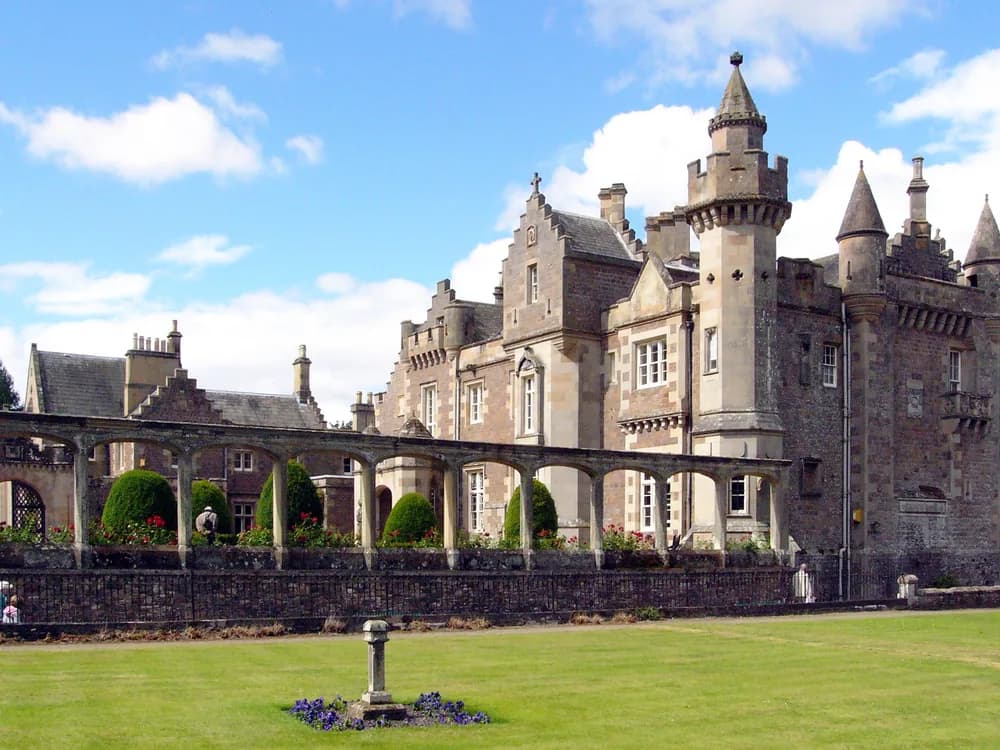
© Castles & Palaces
Abbotsford
Abbotsford House
Scotland · Scottish Borders · Near Galashiels
Built 1824 · Scottish Baronial Revival; designed by Sir Walter Scott himself with architect William Atkinson, 1817–1824; pioneering example of the Scottish Baronial style; the house that influenced a generation of Victorian Scottish architecture
Quick Facts
- Hours
- House open April to October. Grounds, gardens and café accessible year-round, with reduced winter hours. Check the official site for exact seasonal opening and closing dates.
- Entry from
- €17
- Duration
- 2 hours (house, chapel, and gardens)
- Best time
- April to October
- Nearest city
- Galashiels
Highlights
- ✦Designed by Sir Walter Scott himself, with architect William Atkinson, as the founding example of Scottish Baronial Revival architecture
- ✦A deeply personal museum collection including Rob Roy MacGregor's gun and broadsword, the crucifix Mary Queen of Scots carried to her execution, and Napoleon's blotter and pen case
- ✦Scott's own library, one of the finest private libraries in Scotland, preserved largely as he left it with his annotated source books
- ✦The house where Scott wrote himself into ill health attempting to clear £120,000 in debt after the 1826 collapse of his publishing house
- ✦A direct architectural ancestor of Balmoral Castle, built three decades later in the same Baronial vocabulary Scott pioneered here
Skip the queue with a guided tour
Skip-the-line tickets & expert guides
In 1811, Sir Walter Scott — the most famous writer in the world, author of the Waverley novels that had redefined European historical fiction, the man who had effectively invented the modern concept of Scotland as a romantic landscape — bought a small farm called Cartley Hall on the banks of the River Tweed. What he built there over the following thirteen years was not a house so much as a materialised imagination: every stone chosen, every room arranged, every architectural detail selected to create the environment of a medieval Scottish knight. Abbotsford is the physical autobiography of a man who lived more completely in the past than the present.
Scott had no architectural training but absolute conviction about what Abbotsford should look like. He worked with Edinburgh architect William Atkinson on the main building, completed in 1824, specifying Gothic arches here, baronial battlements there, corbelled turrets at the corners — the complete vocabulary of Scottish castle architecture assembled into a private house. He called it 'a romance in stone.' The result was the founding example of Scottish Baronial architecture, the style that would be adopted by Victorian builders across Scotland, from modest suburban villas to Balmoral Castle, which Queen Victoria would build thirty years later using the same aesthetic vocabulary Scott had pioneered.
Scott was a passionate and indiscriminate collector of Scottish historical objects, and Abbotsford holds one of the most personal museum collections in Britain: Rob Roy MacGregor's gun and broadsword, a lock of Bonnie Prince Charlie's hair, the crucifix Mary Queen of Scots carried to her execution, the keys of Loch Leven Castle where Mary was imprisoned, Napoleon's blotter and pen case, the Marquess of Montrose's sword. Each object was acquired because it touched history — Scott's history, Scottish history. The rooms are arranged not as museum cases but as a living collection, displayed exactly as Scott left them, the way a Victorian gentleman-scholar would have arranged his own curiosities.
The library at Abbotsford, its thousands of volumes arranged in Gothic shelving, is the spatial heart of the house. Scott assembled one of the finest private libraries in Scotland, read in five languages, corresponded with nearly every major literary figure in Europe, and used the library as the research centre for his historical novels. It still contains the majority of his original collection, including his own annotated copies of the books he drew on as sources.
In 1826, the publishing house of Constable & Company collapsed. Scott had borrowed heavily against future royalties and found himself liable for debts of £120,000, an enormous sum. Rather than declare bankruptcy, he resolved to write his way out of debt. The final years at Abbotsford were a heroic and ultimately futile attempt to clear his creditors through sheer literary output: he produced the nine-volume Life of Napoleon, the Tales of a Grandfather, and several more Waverley novels in rapid succession. He died at Abbotsford in 1832, the debt only partially cleared, his health broken by overwork. His creditors were eventually paid off from posthumous royalties within a few years of his death.
Abbotsford remained in the Scott family for nearly two centuries. In 2012, the Abbotsford Trust completed a major restoration and opened a new visitor centre that contextualises the house within Scott's literary legacy. The house itself is essentially unchanged from Scott's time — the layout, the collections and the library are all preserved as he left them. The chapel, built after Scott's death by his daughter Anne, contains family memorials.
It is difficult to overstate Scott's role in shaping modern Scotland's cultural self-image. Before Scott, the Highlands and the Scottish Borders were associated chiefly with poverty and instability. After the Waverley novels — Waverley (1814), Rob Roy (1817), The Heart of Midlothian (1818), Ivanhoe (1820) — Scotland became the most romanticised landscape in Europe. George IV's visit to Scotland in 1822, the first by a Hanoverian monarch, was largely organised and stage-managed by Scott himself. Abbotsford is where that entire transformation was conceptualised, written and physically expressed.
History
Sir Walter Scott purchased a small farm known as Cartley Hall on the banks of the River Tweed in 1811, and over the following thirteen years transformed it into Abbotsford, working with architect William Atkinson to design a house in the Scottish Baronial style he was largely inventing as he went, drawing on his deep knowledge of Scottish medieval architecture and history. The main building was completed in 1824, and Scott filled it with one of the most personal historical collections assembled by any private individual in Britain.
The collapse of his publishing house, Constable & Company, in 1826 left Scott liable for debts of around £120,000, and he spent his final years writing at an extraordinary pace in an attempt to clear them, producing major works including a nine-volume biography of Napoleon before his death at Abbotsford in 1832. The house remained in the Scott family for almost two hundred years afterward, with the Abbotsford Trust completing a major restoration and opening a new visitor centre in 2012 that preserves the house, library and collections substantially as Scott left them.
How to Visit
Getting there: Abbotsford is 3km west of Melrose in the Scottish Borders. Melrose is 72km south of Edinburgh, about 1 hour by car or 1 hour 30 minutes by bus. There is no direct rail service to Melrose; the Borders Railway runs to Tweedbank station, 2km from Abbotsford.
Tickets: GYG tour t66080 (5.0★, 11 reviews) covers full access to the house, chapel and garden.
Timing: The house is open April to October; the grounds and café remain accessible year-round.
Frequently Asked Questions
Sir Walter Scott designed Abbotsford himself, working with architect William Atkinson, drawing on his own deep knowledge of medieval Scottish buildings to create what became the founding example of Scottish Baronial Revival architecture. The style Scott pioneered here — battlements, corbelled turrets, Gothic detailing applied to a private residence — was subsequently adopted across Victorian Scotland, including by Queen Victoria for Balmoral Castle three decades later.
Location
Abbotsford, Melrose TD6 9BQ, United Kingdom
Nearby Castles
Featured Tour
Abbotsford: House, Chapel and Garden Ticket
Cancellation available · Instant confirmation
Tours & Tickets
Powered by GetYourGuide
Entry from
€17/ adult