

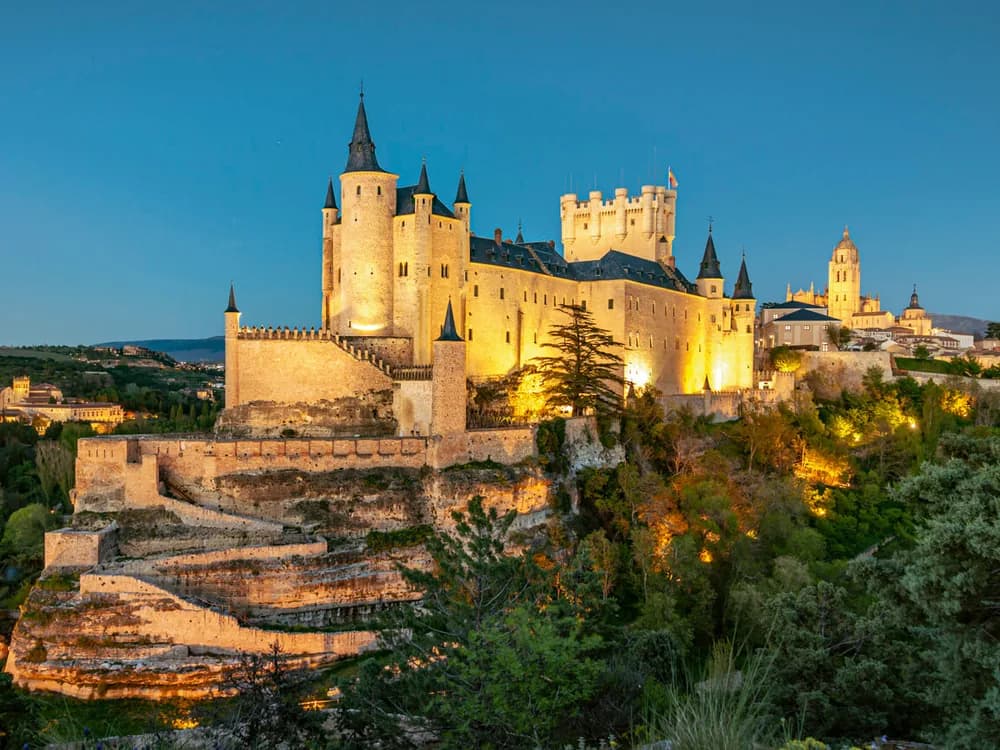
© Unsplash
Alcázar of Toledo
Alcázar de Toledo
Spain · Castile-La Mancha · Near Toledo
Built 1537 · Spanish Renaissance (Plateresque)
Quick Facts
- Hours
- June–September: open until 20:00. Closed Monday, 24–25 Dec, and 1 Jan. Entry to the permanent collection is free.
- Entry from
- Free
- Duration
- 2–3 hours
- Best time
- April to June or September to October — comfortable temperatures for Toledo's steep streets and the Alcázar's exposed northern terrace
- Nearest city
- Toledo
Highlights
- ✦The 1936 Civil War siege rooms — one of the most emotionally intense military history exhibits in Europe, presented without triumphalism
- ✦A Roman cistern with two millennia of continuous history visible beneath your feet, preserved in the castle's lower levels
- ✦The Charles V Courtyard — a masterpiece of Spanish Renaissance architecture by Alonso de Covarrubias, open to the sky at the building's heart
- ✦Views from the northern parade ground across Toledo's rooftops, the Tagus River gorge, and the plains of Castile stretching to the horizon
- ✦The National Army Museum's collection of medieval armour, Conquistador weapons, and an extraordinary room of swords belonging to figures from Spanish history
Skip the queue with a guided tour
Skip-the-line tickets & expert guides
The Alcázar of Toledo dominates the city from every direction — a massive square fortress perched on the highest point of the old city, visible from the main road approach twenty kilometres away. It has occupied this position continuously for over two thousand years, changing hands between Romans, Visigoths, Moors, and Christian kings, each leaving layers that the present building preserves underground while presenting a Renaissance face to the world above. The current structure was commissioned by the Holy Roman Emperor Charles V in 1537, designed by Alonso de Covarrubias in the Plateresque style, and is considered one of the finest Spanish Renaissance buildings in existence.
Since 2009, the Alcázar has housed the National Museum of the Spanish Army — one of the largest and most comprehensive military history collections in Europe, and, crucially, free to enter. The building provides an extraordinary setting for the exhibits: the Roman cistern beneath the courtyard is preserved exactly where it was discovered during excavations, the Arab walls of the Moorish alcázar are displayed in situ in the lower levels, and the Civil War rooms occupy spaces that were genuinely part of the 1936 siege. Walking through the collection is not simply a visit to a museum but an archaeology of the building itself.
Toledo as a city is itself a UNESCO World Heritage Site, inscribed in 1986 for its unique coexistence of Christian, Islamic, and Jewish architecture across its medieval streets. The Alcázar, at the highest point of this city of monuments, is both the most visible and the most historically layered of its landmarks.
History
The hilltop that the Alcázar occupies has been fortified since at least the 3rd century AD, when the Romans built a praetorium here — a military governor's compound whose cistern survives intact in the building's lower levels. Visigoths rebuilt it, the Moors transformed it into an alcázar (a fortified palace), and Alfonso VI of Castile captured it when he took Toledo in 1085. For the next four centuries it served as a royal residence: Alfonso X the Wise worked here, and it was familiar to most medieval Castilian monarchs.
The decisive moment in the building's architectural history came in 1537, when Emperor Charles I of Spain (Charles V of the Holy Roman Empire) ordered a complete reconstruction in the Spanish Renaissance style. His architect Alonso de Covarrubias created the current four-towered square plan with the magnificent central courtyard. The building was later damaged by fires and partially rebuilt under Philip II. By the 19th century it had been used as a military academy — the role that would define its most dramatic episode.
On 21 July 1936, at the outbreak of the Spanish Civil War, Colonel José Moscardó Ituarte barricaded approximately 1,200 Nationalist soldiers, civilians, and cadets inside the Alcázar against Republican forces. The 70-day siege that followed became one of the most legendary episodes of the war — including the famous telephone call in which Moscardó was told his son would be shot if the Alcázar did not surrender, and refused. The building was largely destroyed by the end of the siege. Franco's government rebuilt it in the 1940s–60s as a monument to its defenders. The Army Museum, which moved here from Madrid in 2009, has presented this history with more nuance than its predecessors.
How to Visit
Getting there: Toledo is 70 kilometres from Madrid and served by frequent high-speed AVE trains from Madrid Atocha (journey time: 33 minutes; trains run roughly every 30–60 minutes). From Toledo station it is a 1.5-kilometre walk uphill to the old city, or a short bus ride. The Alcázar is at the highest point of the old town — allow 20–30 minutes on foot from the main square, Plaza de Zocodover, following the streets uphill to the eastern end of the city.
At the museum: Entry to the permanent collection is free. The museum is large and the collection is dense — a focused visit using the highlights guide (available in English at the entrance) is more rewarding than attempting to see everything. Don't miss the Roman cistern in the basement, the Charles V Courtyard, the Civil War rooms, and the views from the northern terrace. The guided tour available on GetYourGuide ($23 per person) provides expert context for the Civil War rooms and the archaeological layers, which are difficult to interpret without background knowledge.
Combining with Toledo: The Alcázar pairs naturally with the Cathedral of Toledo (15 minutes' walk), the Church of Santo Tomé with El Greco's masterwork The Burial of the Count of Orgaz, and the medieval Jewish quarter below. Toledo is best visited as a full day from Madrid — arrive at opening time, have lunch in the old city, and take a late afternoon train back.
Frequently Asked Questions
Yes — the National Museum of the Spanish Army, which occupies the Alcázar, is free to enter for all visitors. This includes access to the permanent collection, the Roman cistern, the Charles V Courtyard, and all galleries. Some temporary exhibitions may carry an additional charge. Guided tours of the museum (sold separately through operators like GetYourGuide) are not free, but the self-guided visit is.
Location
Calle Unión s/n, 45001 Toledo, Spain
Nearby Castles
Featured Tour
Toledo Alcázar and Army Museum: Guided Tour
Cancellation available · Instant confirmation
Tours & Tickets
Powered by GetYourGuide
Free Entry