
© Castles & Palaces
Bellver Castle
Castillo de Bellver
Spain · Mallorca, Balearic Islands · Near Palma de Mallorca
Built 1300 · Gothic circular castle — one of only three circular castles in Europe
Quick Facts
- Hours
- Open Tuesday to Sunday. Summer hours (April–September): Tuesday–Saturday 09:00–20:00, Sunday 09:00–15:00. Winter hours (October–March): Tuesday–Saturday 09:00–18:00, Sunday 09:00–15:00. Closed Mondays. The rooftop terrace offers spectacular sunset views.
- Entry from
- €4
- Duration
- 1–2 hours
- Best time
- Year-round — stunning sunset views
- Nearest city
- Palma de Mallorca
Highlights
- ✦The circular design — one of only three circular castles in Europe, Bellver's unique form allowed defenders to cover every angle without blind spots, creating an architectural rarity of European significance
- ✦The inner courtyard — a perfect two-storey circular arcade of Gothic arches enclosing a central well, whose proportions and light create one of the most beautiful courtyard spaces in the Mediterranean
- ✦Panoramic views over Palma — from the rooftop and circular tower the entire Bay of Palma spreads below, with the city's cathedral, port and distant Tramuntana mountains visible on clear days
- ✦The Municipal History Museum — the castle houses the Museu d'Història de la Ciutat, with Greco-Roman sculpture from the collection of the humanist Cardinal Despuig and medieval archaeological finds
- ✦Sunset spectacle — the west-facing terraces make Bellver one of the finest sunset viewpoints on Mallorca, with the bay turning gold as the sun drops into the Mediterranean
Skip the queue with a guided tour
Skip-the-line tickets & expert guides
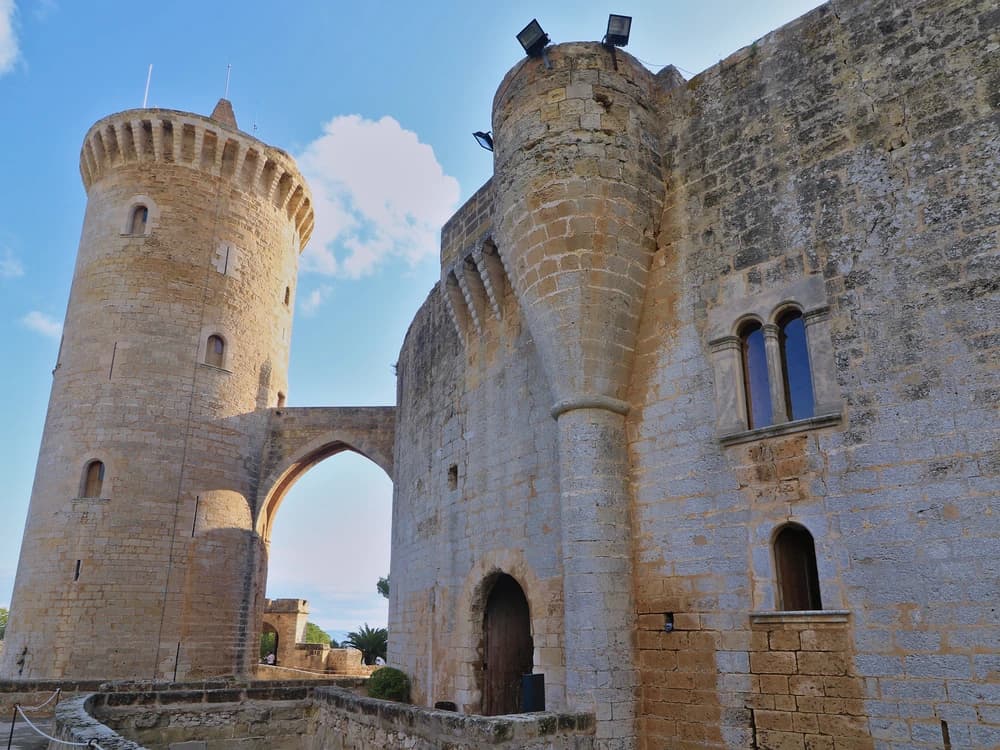
Bellver Castle is one of the most architecturally exceptional medieval fortresses in Europe — a perfectly circular Gothic castle perched on a pine-forested hill 112 metres above Palma de Mallorca, with breathtaking panoramic views over the entire Bay of Palma and the distant Serra de Tramuntana mountains. Built between 1300 and 1311 by the architect Pere Salvà for King Jaume II of Majorca, Bellver is one of only three circular castles in Europe — the others being Castel del Monte in Puglia and the Chateau d'Étampes near Paris — and its geometric perfection sets it apart from any other castle on the Balearic Islands.
The castle's design is as ingenious as it is beautiful. Three cylindrical towers are attached to the main circular body at equal intervals, with a fourth and larger keep — the Torre de l'Homenatge — connected to the main castle only by a narrow arched bridge at second-floor level, a device that created a final, virtually impregnable refuge. The inner courtyard is a model of Gothic grace: two storeys of semicircular arches, supported on slim columns, encircle a central well in a composition of perfect proportions that has inspired architects and artists for seven centuries.
Though built as a royal residence, Bellver functioned for much of its history as a prison. The humanist writer Gaspar Melchor de Jovellanos, one of the leading figures of the Spanish Enlightenment, was imprisoned here from 1802 to 1808, and his quarters are preserved as they were during his confinement. Today the castle houses the Municipal History Museum of Palma, with an excellent collection of classical sculpture and medieval artefacts, but the real reason to make the 3-kilometre climb from the city centre is the extraordinary combination of Gothic architecture and Mediterranean panorama.
History
Bellver Castle was commissioned by Jaume II of Majorca in 1300 and largely completed by 1311, making it an unusually rapid medieval construction. The Kingdom of Majorca — a short-lived independent realm created when James I of Aragon divided his territories between his sons in 1262 — was wealthy from Mediterranean trade, and Jaume II used that wealth to create not only Bellver but also the Palau de l'Almudaina palace and the La Seu cathedral in Palma. The three works together represent the high point of Gothic architecture in the western Mediterranean.
After the reincorporation of Majorca into the Crown of Aragon in 1349, Bellver lost its function as a royal palace and became primarily a military installation and prison. It held members of the Mallorcan royal family as prisoners after the re-conquest, and over subsequent centuries housed nobles, political prisoners and — most famously — the Enlightenment philosopher Gaspar Melchor de Jovellanos, who was imprisoned here without trial from 1802 to 1808 on the orders of the royal favourite Godoy. Jovellanos used his enforced isolation to write his Historia del Castillo de Bellver, still the definitive monograph on the building.
How to Visit
Getting there: Bellver Castle sits on a hill 3 kilometres west of Palma city centre. City bus No. 46 runs from Plaça d'Espanya to a stop near the castle entrance. Taxis from the city centre cost around €10–12. The energetic can walk from the seafront along the pine-shaded Passeig Bellver — a pleasant 40-minute stroll.
Tickets: Entry is inexpensive (€4 for adults) and tickets can usually be purchased at the door. Sundays are free for Palma residents. No advance booking required. The museum is included in the entry price.
Combine with: The waterfront Passeig Marítim promenade and Palma's extraordinary Gothic cathedral La Seu are the obvious companions. The old city centre — the Barri Gòtic of Palma — is excellent for an afternoon. The villages of Valldemossa and Deià in the Tramuntana mountains are a 30-minute drive.
Frequently Asked Questions
The circular design of Bellver Castle was both a military and aesthetic choice. From a military perspective, a circular plan eliminates the vulnerable corners found in rectangular castles, where enemies could shelter from defenders above; a circular wall means every point of the exterior is equally exposed and equally defensible. Aesthetically, the circle was associated with perfection in medieval thought, reflecting the cosmic geometry of Christian symbolism. Bellver's architect Pere Salvà combined these considerations with a two-storey circular arcaded courtyard that is one of the finest examples of Gothic spatial design in Spain.
Location
Carrer de Camilo José Cela, 07015 Palma, Illes Balears, Spain
Nearby Castles
Tours & Tickets
Powered by GetYourGuide
Entry from
€4/ adult