
© Unsplash
El Escorial
Real Sitio de San Lorenzo de El Escorial
Spain · Community of Madrid · Near San Lorenzo de El Escorial
Built 1584 · Herreran (Spanish Renaissance)
Quick Facts
- Hours
- April–September: Tue–Sun 10:00–20:00, last entry 19:00. October–March: Tue–Sun 10:00–18:00, last entry 17:00. Closed Mondays, Christmas Day, New Year's Day, and Good Friday. The site can be busy in summer — early morning visits recommended. The gardens are free to access.
- Entry from
- €15
- Duration
- 2–3 hours
- Best time
- April–June or September–October — comfortable temperatures; the gardens and surrounding mountains are at their best; avoid August crowds
- Nearest city
- San Lorenzo de El Escorial
Highlights
- ✦The Royal Pantheon beneath the basilica — the burial chamber of almost every Spanish monarch since Charles V, its octagonal black marble walls and gilt bronze urns forming one of the most remarkable royal mausoleums in Europe
- ✦The Royal Library — 45,000 volumes including manuscripts by Alfonso X and letters from Hernán Cortés, shelved spine-inward in a deliberate scheme to protect the page edges from light and dust
- ✦The Patio de los Reyes (Court of the Kings) — six oversized stone statues of Old Testament kings standing above the basilica entrance, the Herreran grid symmetry on full display
- ✦The austere Herreran architecture itself — a deliberate rejection of ornament that made El Escorial the defining building of Spanish imperial identity and Counter-Reformation piety
- ✦A setting in the foothills of the Sierra de Guadarrama, where UNESCO-listed architecture meets dramatic mountain landscape
Skip the queue with a guided tour
Skip-the-line tickets & expert guides
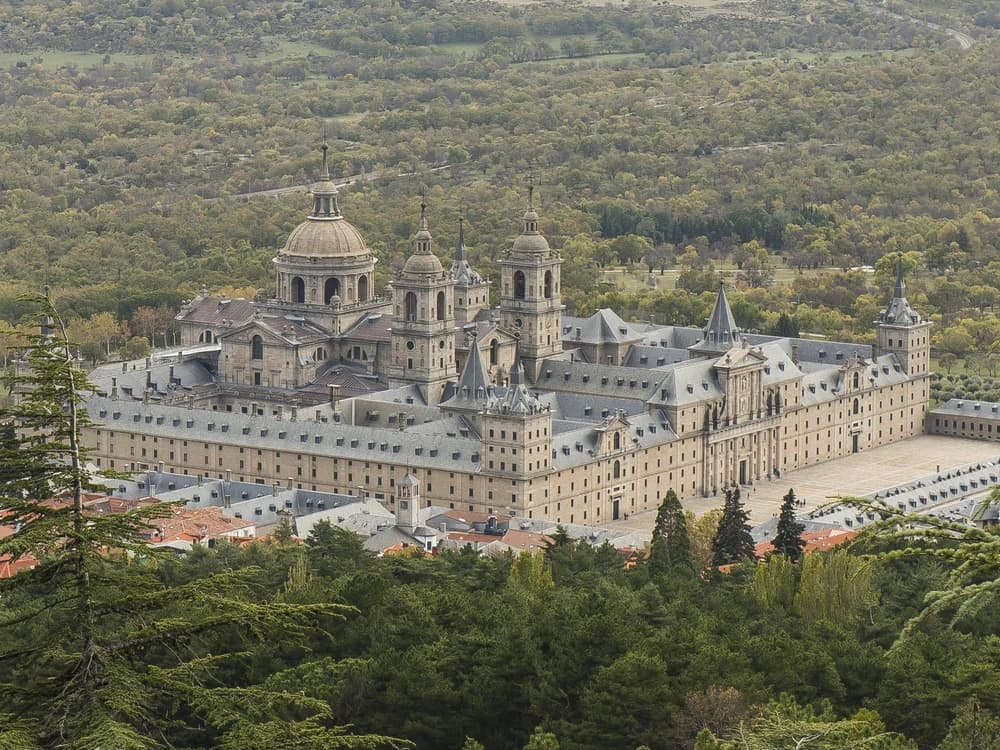
El Escorial is, by design, a building with almost nothing to look at on its surface. There is no applied ornament, no carved relief beyond strict geometric necessity, no colour beyond grey granite against grey sky. Every element of the façade is structural, and that absolute restraint was the entire point: Philip II commissioned a building that would express Spanish imperial and religious authority not through decoration but through sheer, disciplined scale — a statement so complete that it became known, almost immediately, as the eighth wonder of the world.
The building's purpose was equally totalising. El Escorial is simultaneously a working monastery, a royal palace, a basilica, one of the great libraries of Renaissance Europe, a royal mausoleum, and a school — six functions compressed into a single rigorously planned complex larger in floor area than the Vatican Palace. Philip II governed the largest empire the world had yet seen from a small, deliberately modest private cell here, positioned so he could see the high altar of the basilica from his bed. The contrast between the building's imperial scale and the king's personal austerity is, in many ways, the whole story of El Escorial.
Three spaces reward the most attention. The Royal Pantheon, reached by a marble staircase beneath the basilica, holds the remains of nearly every Spanish monarch since Charles V in an octagonal chamber of black marble and gilt bronze — a mausoleum of startling severity given the wealth it represents. The Royal Library, on the main floor, runs the length of an entire wing, its 45,000 volumes shelved spine-inward, their fore-edges and gilt titles facing outward instead — an unusual scheme that both protected the books and gave the room its singular visual rhythm. The Chapterhouses hold a smaller but excellent collection of paintings, including works by El Greco.
From the road approaching San Lorenzo de El Escorial, the building's grid plan is visible as a single coherent idea stamped onto the landscape — a vast grey rectangle set against the green and granite slopes of the Sierra de Guadarrama rising immediately behind it. Few buildings in Europe communicate their architectural logic so legibly from a distance.
History
Philip II commissioned El Escorial in 1563 in fulfilment of a vow made before the Battle of St Quentin, a decisive Spanish victory over the French fought on the feast day of St Lawrence — hence the basilica's dedication to that saint and the gridiron motif (referencing the saint's martyrdom) that recurs throughout the building's plan. The king appointed Juan Bautista de Toledo as initial architect, and after his death, Juan de Herrera took over and effectively defined the severe, geometrically disciplined style that has carried his name ever since: Herreran architecture.
Construction ran for 21 years, from 1563 to 1584, drawing artisans, masons, and artists from across Spain and Italy in a building campaign of extraordinary scale for its time. Philip II involved himself closely in the design at every stage, and the result reflects his personal religious intensity as much as any conventional notion of royal magnificence — austerity itself became the statement of power.
Successive Spanish monarchs continued to use El Escorial as a royal residence, retreat, and place of burial for centuries afterward. A serious fire in 1671 destroyed part of the library's collection, and Napoleonic troops looted artworks and treasures during the occupation of 1808, though the building itself survived largely intact through both that crisis and the Spanish Civil War centuries later. Restoration work through the 20th century returned much of the complex to public access, and in 1984 UNESCO inscribed the Monastery and Site of the Escorial as a World Heritage Site, recognising both its architectural significance and its role as a defining monument of the Spanish Renaissance and Counter-Reformation.
How to Visit
Getting there from Madrid: Bus line 661 or 664 departs from the Moncloa bus station roughly every 15–30 minutes and takes about an hour to reach San Lorenzo de El Escorial. By car, take the A-6 motorway northwest from Madrid and then the M-505, a drive of around 50 minutes. There is also a regional train (Cercanías) service from Atocha or Chamartín stations, though the station is a steeper uphill walk from the monastery itself.
Guided day trips vs independent travel: A GetYourGuide day trip from Madrid bundles transport and a guide, making logistics simple, especially when combined with a stop at the Valle de Cuelgamuros (formerly known as the Valley of the Fallen), about 9km away. Travelling independently by bus costs less and allows more flexible time on site, but requires managing your own return schedule.
What to see: Allow 2 to 3 hours to cover the Patio de los Reyes, the basilica, the Royal Pantheon, the Chapterhouses, and the Royal Library — the complex is large and the Pantheon stairs in particular reward unhurried time.
Around the site: The Casita del Príncipe gardens, a short walk from the main building, make a pleasant, less crowded detour. The town of San Lorenzo de El Escorial itself has a good selection of restaurants for lunch, and many visitors combine the monastery with the nearby Valle de Cuelgamuros for a fuller day trip from Madrid.
Frequently Asked Questions
El Escorial is a vast 16th-century complex near Madrid combining a Spanish royal palace, monastery, basilica, library, school, and royal mausoleum in a single severe Renaissance building. Commissioned by King Philip II and completed in 1584, it served as both a religious retreat and a working seat of government, and it remains the burial site of most Spanish monarchs since Charles V.
Location
Av Juan de Borbón y Battemberg, s/n, 28200 San Lorenzo de El Escorial, Madrid, Spain
Nearby Castles
Featured Tour
From Madrid: Escorial Monastery and the Valley of the Fallen
Cancellation available · Instant confirmation
Tours & Tickets
Powered by GetYourGuide
Entry from
€15/ adult