
© Castles & Palaces
Royal Palace of Olite
Palacio Real de Olite
Spain · Navarre · Near Olite
Built 1253 · Gothic palace architecture with Mudéjar decorative elements; primary construction under Charles III of Navarre 1388–1425; the most elaborate Gothic palace complex in medieval Spain
Quick Facts
- Hours
- Oct–Mar: 10:00–18:00, last entry 30 minutes before closing. Closed 1 Jan and 25 Dec. Hours can shift during the August Festival Medievales — check the official site before visiting.
- Entry from
- €6.5
- Duration
- 1–2 hours
- Best time
- April to June, September to October; the Festival Medievales (August) recreates medieval life in the old town
- Nearest city
- Olite
Highlights
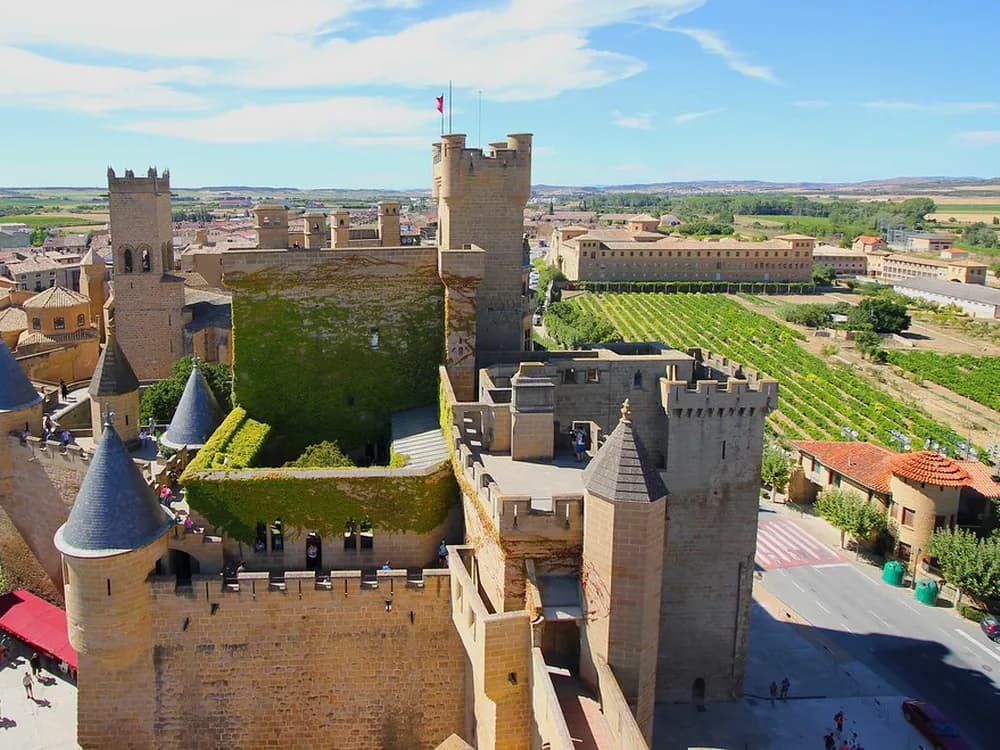
- ✦Twenty-three towers and turrets crammed onto a single hilltop, creating a skyline so dense it looks like a city stacked on top of a city
- ✦Built by Charles III 'the Noble' of Navarre, who grew up at the French royal court and set out to build something that could rival what he had seen in Paris
- ✦A private royal zoo once kept inside the walls — lions, ostriches, camels and a dromedary, kept as living proof of royal power and reach
- ✦Hanging gardens irrigated by an elaborate medieval hydraulic system, one of the most sophisticated engineering features of any Iberian Gothic palace
- ✦Climbable towers with sweeping views over the flat Navarrese plain and the medieval town of Olite below, one of the best-preserved in Spain
Skip the queue with a guided tour
Skip-the-line tickets & expert guides
The Royal Palace of Olite appears suddenly above the flat Navarrese plain — twenty-three towers, turrets and pinnacles packed so densely onto a single hilltop that the silhouette looks less like a palace than a city built on top of a city. It is the most extravagant Gothic palace complex in Spain, and there is nothing quite like it anywhere else in the country. For decades it remained almost unknown outside Navarre; that is changing quickly as word spreads of just how strange and spectacular the building actually is.
Navarre spent centuries as an independent kingdom, wedged between Castile, Aragon and France, its royal house bound to the French crown by repeated marriage and inheritance. Charles III, called 'the Noble', ruled from 1387 to 1425 and made Olite his capital, rebuilding the existing royal residence into the palace that stands today. He had grown up partly at the French royal court and returned home determined to build something that could compete with what he had seen in Paris — the result is arguably the most Francophile Gothic building ever raised on the Iberian Peninsula, closer in spirit to the Loire than to Castile.
At its medieval peak the palace was extraordinary by any European standard. Charles III kept a private menagerie inside the walls — lions, camels, ostriches, even a dromedary — exotic animals that functioned as living statements of royal wealth and international connection rather than mere curiosities. Hanging gardens, irrigated by an elaborate hydraulic system that lifted water to terraces built on top of vaulted chambers, softened the dense stone mass of the towers. Inside, contemporary chronicles describe painted halls, a private royal oratory, chambers hung with imported Flemish tapestries, and a library — the furnishings of a court that, though tiny compared to its neighbours, was among the most sophisticated in Europe.
That splendour did not survive intact. In 1813, during the Peninsular War, Spanish patriot forces deliberately set fire to the palace to keep it from falling into French hands, destroying most of the medieval interior and several of the towers in the process. What remained was a hollow shell that served through the 19th century as a prison and later a granary — an ignoble afterlife for a building that had once housed one of the most refined courts in Christian Iberia.
A major restoration begun in the 1930s and continued through the rest of the 20th century rebuilt several towers and reconstructed the main façades, working from medieval documents and the surviving fabric rather than free invention. The palace today is consequently a hybrid: some sections are authentic 15th-century stonework, others careful 20th-century reconstruction, and the join between the two is not always obvious to a visitor walking through. The museum inside traces this history with surviving fragments of the original decoration, and several towers can be climbed for sweeping views across the Navarrese plain. The adjoining Palacio Viejo, the 13th-century Old Palace that predates Charles III's rebuilding, is connected to the main complex and included on the same ticket.
History
The site held a royal residence from at least 1253, when the kings of Navarre first established a palace on the hill above Olite. The building reached its current extravagant form under Charles III 'the Noble', who reigned from 1387 to 1425 and rebuilt and vastly expanded the existing residence into a palace intended to rival the great Gothic courts of France, where he had spent part of his youth. Under his patronage, Olite briefly became the political and cultural capital of the kingdom of Navarre, hosting one of the most refined courts in Christian Iberia despite the kingdom's small size.
The palace's decline began long after the Navarrese monarchy itself had been absorbed into the Spanish crown. In 1813, during the Peninsular War, Spanish forces resisting the French occupation deliberately burned the palace to deny its use to Napoleon's army, destroying the bulk of the medieval interior and several towers. The ruin that resulted was put to humble use through the 19th century as a prison and a grain store, a stark contrast to its original purpose.
Restoration work began in the 1930s and continued intermittently through the 20th century, rebuilding towers and façades using medieval documentation and the surviving structure as a guide. The result blends authentic 15th-century fabric with careful modern reconstruction, and the palace now functions as a museum and a major draw for the Navarrese tourist circuit centred on Pamplona.
How to Visit
Getting there: Olite is 43km south of Pamplona by road, about 30 minutes' drive, with direct bus service connecting the two. Both GetYourGuide tours covering the palace (t1004381, t1034935) depart from Pamplona and combine it with other Navarrese monuments, making a car unnecessary for visitors based there.
The visit: Allow 1–2 hours for the museum, the climbable towers and the connected Palacio Viejo. The town of Olite below the walls is itself one of the best-preserved medieval towns in Spain, its Plaza de Carlos III el Noble ringed with wine bars that double as the town's social centre.
Wine note: Olite sits in the heart of the DO Navarra wine region, and its Garnacha and Tempranillo reds are among Spain's best-value wines. A tasting in town after the palace visit is a standard local recommendation and a natural way to end the day.
Frequently Asked Questions
Charles III 'the Noble', who rebuilt the palace into its current form between 1388 and 1425, had grown up partly at the French royal court and wanted Olite to rival the great Gothic palaces he had seen there. The result was an unusually dense cluster of twenty-three towers and turrets, designed to express royal magnificence rather than purely defensive need — closer in spirit to the châteaux of the Loire than to the more austere castles of Castile.
Location
Pl. de Carlos III el Noble, s/n, 31390 Olite, Navarra, Spain
Nearby Castles
Featured Tour
Medieval Route in Navarre: Olite, Ujué, Castillo de Javier, and Monasterio de Leyre
Cancellation available · Instant confirmation
Tours & Tickets
Powered by GetYourGuide
Entry from
€6.5/ adult