
© Castles & Palaces
Castello di Montebello
Castello di Montebello
Switzerland · Ticino · Near Bellinzona
Built 1300 · 14th–15th century Lombard military castle; two phases: inner castle (Schwyz family, 14th century) and outer ward with Venetian round towers (15th century); the best-preserved castle of the Bellinzona three; UNESCO World Heritage Site (2000)
Quick Facts
- Hours
- Open April to October with reduced winter hours; check the official Bellinzona UNESCO site for current seasonal opening times.
- Entry from
- €6
- Duration
- 1 hour
- Best time
- April to October (check seasonal opening hours)
- Nearest city
- Bellinzona
Highlights
- ✦The most architecturally complete of the three Bellinzona castles, with two clearly legible building phases spanning the 14th and 15th centuries
- ✦An inner keep built or substantially modified by the canton of Schwyz, one of the three founding cantons of the Swiss Confederation
- ✦Distinctive round Venetian-style towers added to the outer enclosure in the 15th century, reflecting newer Italian fortification theory
- ✦Home to the Civic Museum of Bellinzona, with archaeological material spanning prehistory through the medieval period
- ✦Sweeping views west to Castel Grande and east to Sasso Corbaro, making the logic of the unified UNESCO ensemble immediately legible
Skip the queue with a guided tour
Skip-the-line tickets & expert guides
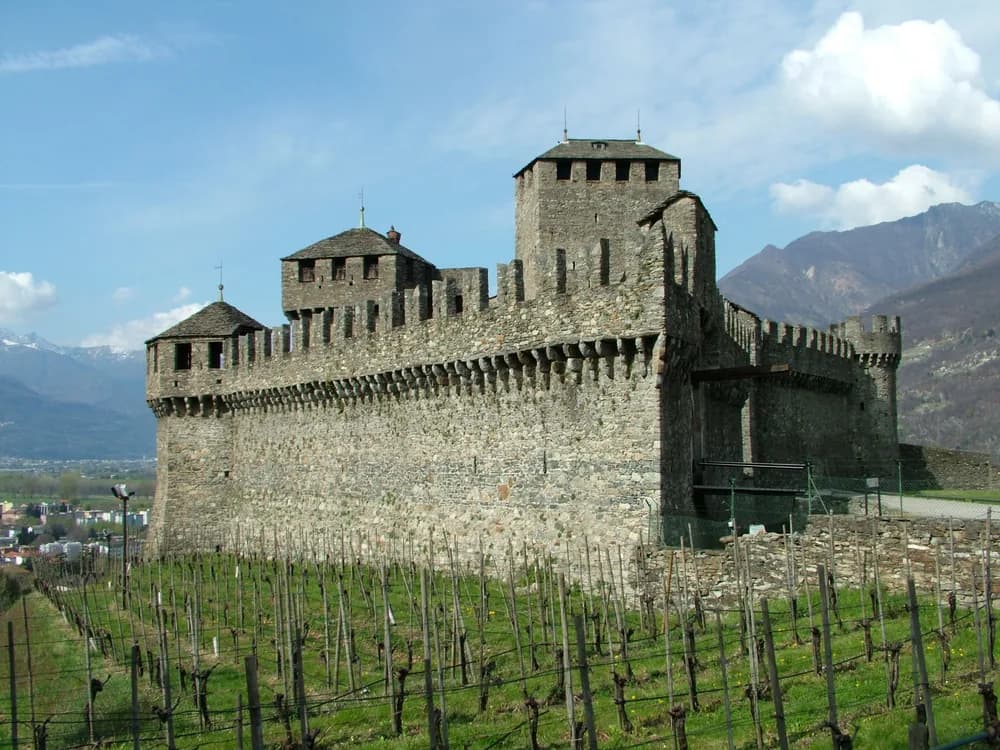
On the ridge above Bellinzona, halfway between the dominant mass of Castel Grande to the west and the solitary Sasso Corbaro to the east, Castello di Montebello is the most complete of the three Bellinzona fortifications. Its inner keep dates to the 14th century; its outer walls were added in the 15th century with the round towers and machicolations that make it so photogenic from the town below. It is the castle most visitors mean when they photograph 'a castle in Bellinzona': the silhouette against the Alps, the towers perfect in the blue sky of a Ticino autumn.
Montebello's earliest recorded owner was the canton of Uri, which controlled a tower here in the early 14th century. The inner castle, comprising the keep, curtain wall and square towers, was built or substantially modified by the canton of Schwyz, one of the three founding cantons of the Swiss Confederation, in the 14th century. After the Visconti of Milan retook Bellinzona later in the 14th century, the outer enclosure with its distinctive round Venetian towers was added in the 15th century, during the period of intense military competition for the Alpine passes. The two building phases are clearly legible: the inner keep is in the older Lombard military style, while the outer wall with its round towers reflects newer Italian Renaissance fortification theory.
The inner keep houses the Civic Museum of Bellinzona, which contains archaeological material from the Bellinzona area spanning prehistory through the medieval period. The museum is modest in scale but strong in local content: ceramics, weapons, architectural fragments and documentary material from the castle's long occupation. It functions as the primary interpretive context for all three Bellinzona castles.
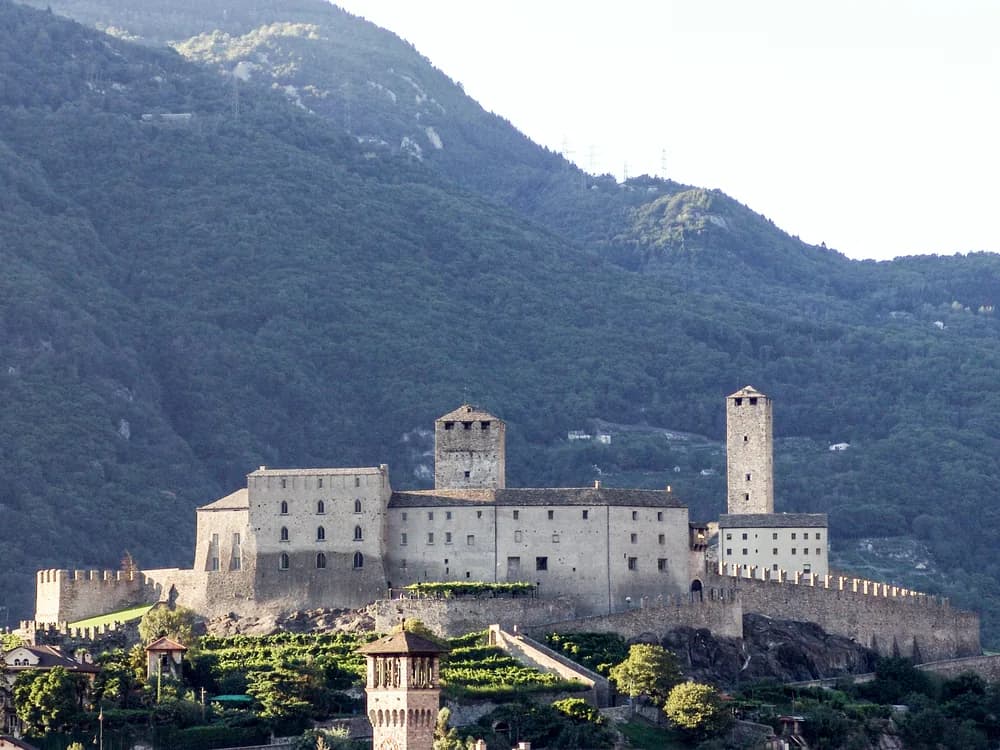
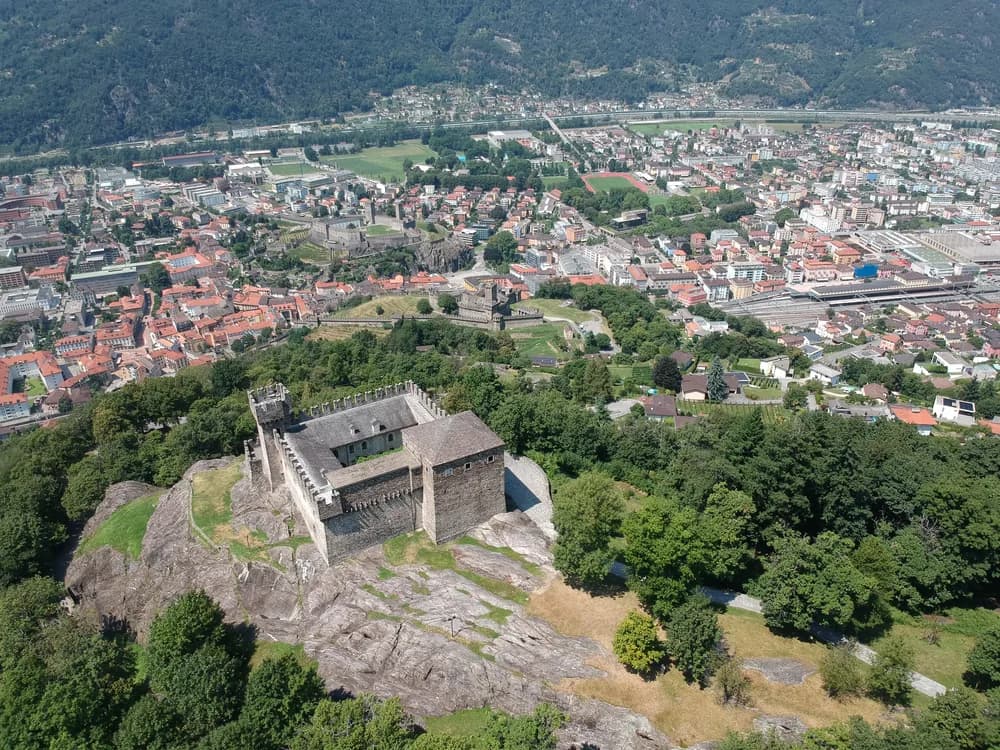
Montebello's inner courtyard, a roughly rectangular space framed by the keep on one side and the residential range on the others, is one of the most characteristic medieval castle spaces in Switzerland: rough stone, steps worn by centuries of foot traffic, iron hinges on ancient doors. The view from the castle walls looks west to Castel Grande, its large towers visible in silhouette, and east to Sasso Corbaro, the single tower on its higher ridge, with the Ticino valley running south toward Locarno and Lake Maggiore. Standing here, the logic of the UNESCO designation as a unified ensemble becomes immediately apparent: the three castles are clearly designed to support each other.
The murata, the great wall that once connected Castel Grande's western flank to the southern hillside, along with the separate wall connecting the three castles along the ridge, are partially preserved and visible from Montebello's position. These walls, built in the 14th and 15th centuries, would have blocked the valley floor and the lower hillsides, creating a defensive barrier that any army approaching from the south would have had to breach or circumvent entirely. The combination of three castles plus blocking walls made Bellinzona one of the most comprehensively defended positions in medieval Alpine Europe.
The three Bellinzona castles are best visited in sequence on the same day: Castel Grande first, the largest, with the museum; then Montebello, the most complete, with good views of Castel Grande; then Sasso Corbaro, the most solitary, with the best panoramic views. A combined ticket covers all three. Allow three to four hours total. The walk between Castel Grande and Montebello is 15 minutes uphill; the walk from Montebello to Sasso Corbaro is 20 minutes further up a steeper path.
History
The canton of Uri held an early tower at Montebello in the early 14th century, before the canton of Schwyz, one of the three founding cantons of the Swiss Confederation, built or substantially expanded the inner keep, curtain wall and square towers later in the same century. After the Visconti of Milan reasserted control over Bellinzona, they added an outer enclosure with distinctive round Venetian-style towers in the 15th century, reflecting the era's evolving theories of artillery fortification.
Like the other Bellinzona castles, Montebello passed to Swiss control with the Confederation's definitive capture of the town in 1503 and has remained Swiss territory since. In 2000, UNESCO inscribed Montebello together with Castel Grande and Castello di Sasso Corbaro as a single World Heritage Site recognising the three castles and their connecting walls as a unified example of late medieval military architecture. The castle's keep now houses the Civic Museum of Bellinzona, established to interpret the archaeological and historical record of the wider area.
How to Visit
Getting there: Bellinzona is well served by rail from Zürich, Lugano and Milan, as with the other two Bellinzona castles. Montebello is a 15-minute uphill walk from Castel Grande.
Tickets: GYG tour t1273588 is the entry ticket. The combined Bellinzona ticket, available at each castle's ticket office, is the most economical approach for visitors planning to see all three castles.
Sequence: The recommended visiting order is Castel Grande first, then Montebello, then Sasso Corbaro, allowing three to four hours in total.
Frequently Asked Questions
Montebello preserves two clearly distinguishable building phases: a 14th-century inner keep built in the older Lombard military style, and a 15th-century outer enclosure with round Venetian-style towers reflecting newer Italian fortification theory. Unlike Castel Grande, whose fabric has been more heavily altered by later interventions including a modern underground lift, Montebello's layered medieval structure remains unusually legible and intact, making it the clearest single example of the castle-building evolution across the whole UNESCO site.
Location
Via Convento 5, 6500 Bellinzona, Switzerland
Nearby Castles
Featured Tour
Bellinzona: Castello di Montebello Entry Ticket
Cancellation available · Instant confirmation
Tours & Tickets
Powered by GetYourGuide
Entry from
€6/ adult