
© Unsplash
Topkapi Palace
Topkapı Sarayı
Turkey · Istanbul · Near Istanbul
Built 1459 · Ottoman
Quick Facts
- Hours
- Closed Tuesdays. Winter hours (Nov–Mar): 09:00–16:45. Last entry 45 minutes before closing. The Harem section requires a separate ticket.
- Skip-the-line from
- €78
- Duration
- 2–4 hours
- Best time
- April–May and September–October for mild temperatures and manageable crowds; avoid July–August when queues are extreme
- Nearest city
- Istanbul
Highlights
- ✦The Harem — 400 rooms where Ottoman sultans lived with their wives, concubines and court, accessible via a separate ticket
- ✦The Treasury — home to the 86-carat Spoonmaker's Diamond, the Topkapi Dagger and the Throne of Shah Ismail
- ✦The Sacred Relics Chamber — containing the cloak, sword and footprint of the Prophet Muhammad, a living sacred space
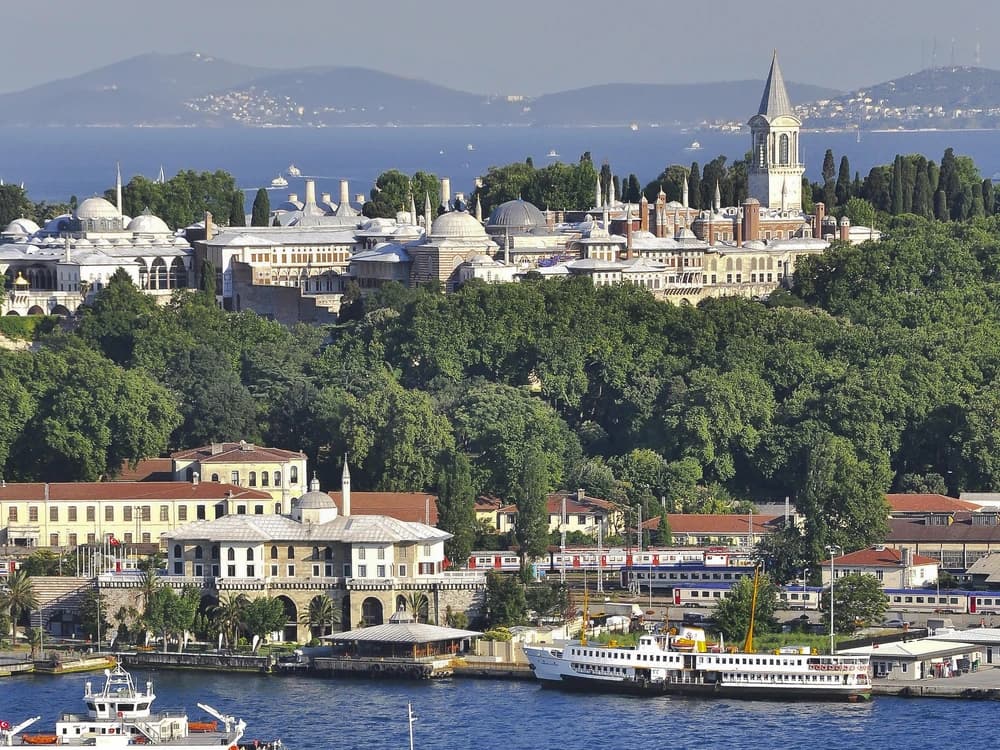
- ✦The view from the Fourth Courtyard — a terrace overlooking the Bosphorus, Golden Horn and Sea of Marmara simultaneously
- ✦The Imperial Council Hall (Divan) — where the Grand Vizier governed the Ottoman Empire for centuries
Skip the queue with a guided tour
Skip-the-line tickets & expert guides
Topkapi Palace occupies the easternmost tip of a promontory where the Bosphorus, the Golden Horn and the Sea of Marmara converge — a position that made it simultaneously the most defensible and the most symbolically charged site in Constantinople. Mehmed the Conqueror began construction in 1459, six years after he took the city from the Byzantines, and for the next four centuries the palace was not merely the residence of Ottoman sultans but the administrative heart of an empire stretching from the Balkans to Baghdad and from Algiers to Yemen.
The palace is not a single building but a walled city of 70 hectares containing hundreds of chambers, pavilions, gardens, mosques, kitchens and service buildings arranged around a sequence of four courtyards. At its peak it housed up to 4,000 people: the sultan and his family in the Harem, the court officials in the Enderun (inner palace), and the thousands of servants, soldiers, cooks, gardeners and bureaucrats who kept the imperial machine running.
The four courtyards open progressively, each more restricted than the last. The First Courtyard was accessible to any Ottoman subject; the Second to officials and petitioners; the Third to high court officials; the Fourth to the sultan himself. This spatial hierarchy encoded the Ottoman conception of power — the sovereign as the inaccessible source of all authority.
The Harem — a self-contained palace within the palace — houses 400 rooms where the sultan lived surrounded by his family. 'Harem' means simply 'forbidden': it was the private residential quarter, not the place of exotic fantasy imagined by European Orientalists. The power struggles within the Harem shaped Ottoman succession for centuries; the mother of the ruling sultan (the Valide Sultan) often exercised more political influence than the Grand Vizier.
History
Constantinople fell to Mehmed II on 29 May 1453, ending the Byzantine Empire after more than a thousand years. Mehmed immediately set about rebuilding the city as an Ottoman capital. He first built the Old Palace (Eski Sarayi) in what is now the area of Istanbul University, but decided within a decade that a new palace on the strategic promontory at the mouth of the Bosphorus was more appropriate for the capital of his expanding empire.
Construction of Topkapi began around 1459. The palace grew organically over the next century, with each sultan adding new structures. Suleiman the Magnificent (r. 1520–1566), at the height of Ottoman power, added the Treasury, the Harem and the Pavilion of the Holy Mantle. The Harem became the centre of palace life in 1541 when the powerful Hürrem Sultan (Roxelana), wife of Suleiman, moved there permanently.
The palace remained the official residence of Ottoman sultans until 1853, when Sultan Abdülmecid I moved the court to the newly built European-style Dolmabahçe Palace on the Bosphorus shore. Topkapi was used for state ceremonial occasions and as a treasury until the end of the Ottoman Empire in 1922.
The Turkish Republic opened Topkapi as a museum in 1924, a year after Atatürk abolished the sultanate. It was inscribed as a UNESCO World Heritage Site as part of the Historic Areas of Istanbul in 1985. Today it is one of the most visited museums in the world, receiving over 3.5 million visitors annually.
How to Visit
Getting there: Topkapi Palace is in the Sultanahmet district of Istanbul, walkable from the Blue Mosque and Hagia Sophia (5 minutes on foot). From Taksim Square, take the metro (M2) to Vezneciler or Haliç, then walk or take a tram. The Sultanahmet tram stop (T1 line) is the most convenient; it runs along the waterfront from the Galata Bridge. From the airport (IST), take the metro to Gayrettepe and then the M2 to the old city.
Tickets: The main palace entrance costs approximately 1,000 TRY (roughly €25–30 depending on exchange rate). The Harem requires a separate ticket, strongly recommended — the Harem is one of the most compelling parts of the palace and the tickets sell out by early afternoon in peak season. Buy tickets online at topkapipalace.gov.tr or through GYG skip-the-line options. Queues at the gate can be 45–90 minutes in July–August.
Skip the line: GYG offers several skip-the-line ticket + audio guide combinations that allow direct access. Strongly recommended in summer.
Highlights to prioritise: The Sacred Relics Chamber, the Imperial Treasury (for the Spoonmaker's Diamond and Topkapi Dagger), and the Harem. The view from the Fourth Courtyard terrace toward the Bosphorus at sunset is one of the great views in Istanbul.
Combine with: Hagia Sophia (10 minutes on foot), the Blue Mosque (10 minutes), the Basilica Cistern (5 minutes), and the Grand Bazaar (20-minute walk).
Frequently Asked Questions
Yes. The Harem section requires a separate ticket in addition to the main palace entry. Both tickets can be purchased at the gate or online. The Harem is one of the most historically significant and architecturally remarkable parts of the palace — a self-contained residential complex of 400 rooms — and the extra ticket is strongly worthwhile. Harem tickets can sell out by early afternoon in peak season, so buy online or arrive early.
Location
Cankurtaran Mah., 34122 Fatih/İstanbul, Turkey
Nearby Castles
Featured Tour
Topkapi Palace Fast-Track Skip-the-Line Access & Audio Guide
Cancellation available · Instant confirmation
Tours & Tickets
Powered by GetYourGuide
Entry from
€30/ adult