
Departing from Sarajevo
From Sarajevo: Mostar, Počitelj & Blagaj — Herzegovina Full Day
Three Ottoman-era fortified sites in the Neretva valley — a medieval bridge, a hillside citadel, and a Dervish monastery at the source of a river
From
€35/ person
Rating
★ 4.8(2,100)
Duration
Full day (11 hours)
Rating
4.8 ★ (2,100 reviews)
Languages
English
Group size
Max 20 people
About This Tour
Herzegovina — the southern part of Bosnia & Herzegovina — is one of the most concentrated landscapes of medieval and Ottoman heritage in the Balkans. The Neretva River valley contains three UNESCO-recognised or protected sites within 50 kilometres: Mostar, the Ottoman bridge city rebuilt after the 1993 war; Počitelj, the best-preserved Ottoman fortified settlement in the Balkans, clinging to a limestone cliff above the river; and Blagaj, where a 16th-century Dervish tekija (monastery) emerges from a cave at the source of the Buna river, with an Ottoman fortress on the cliff above. Add the medieval town of Konjic and the Kravica waterfalls, and this day from Sarajevo covers more concentrated history per kilometre than almost anywhere in Europe.
Highlights
- ✓Mostar's Stari Most (Old Bridge) — the 1557 Ottoman bridge destroyed in 1993 and rebuilt stone by stone by 2004, UNESCO World Heritage
- ✓Mostar Old Town — cobbled Ottoman bazaar streets, hammams, mosques, and Venetian-influenced merchant houses in continuous use since the 16th century
- ✓Počitelj — the best-preserved walled Ottoman settlement in the Balkans: citadel tower, mosque, clock tower, and traditional houses on a single limestone hillside
- ✓Blagaj Tekija — a 16th-century Dervish monastery built into the cliff at the source of the Buna river, one of the most remarkable architectural sites in the Balkans
- ✓Konjic's 17th-century Ottoman bridge over the Neretva
- ✓Expert guide covering Bosnia's medieval kingdoms, Ottoman conquest, and the 1990s war's impact on these heritage sites
Ready to book this tour?
Free cancellation · Instant confirmation
Itinerary
Head southwest from Sarajevo through the mountains toward the Neretva valley. The guide introduces Bosnia's complex heritage: the medieval Bosnian Kingdom (independent from both Serbia and Croatia), its conquest by the Ottomans in 1463, and the 400 years of Ottoman rule that shaped every town, fortress, and bridge in Herzegovina. The road follows the Neretva River gorge, where the limestone cliffs rise hundreds of metres above the jade-green water.
The first stop is Konjic, an Ottoman bridge town in the upper Neretva valley. The Old Bridge of Konjic — built in the 17th century, destroyed in the 1993–1995 war, and rebuilt in 2009 — is a nine-arch stone span over the fast-moving Neretva, designed for the same purpose as Mostar's bridge: controlling the river crossing on the route between the Adriatic and Sarajevo. The guide covers the specific destruction and reconstruction of Herzegovina's bridges during the war, and what their rebuilding means for the communities on either side.
Počitelj is unlike any other settlement in the Balkans: a complete Ottoman walled town frozen in the 15th–16th century, climbing a limestone cliff above the Neretva in a single tight cluster of towers, a mosque, a clock tower, a hammam, a caravanserai, and stone houses terraced up the hillside. The defensive citadel tower (Kula) at the top commands the entire Neretva valley. Počitelj was developed as a frontier garrison town after the Ottoman conquest of Bosnia and was one of the most important defensive positions on the road from the Adriatic to Sarajevo. Severely damaged in 1993, it has been partially restored and remains inhabited — one of the only continuously occupied Ottoman-era walled settlements in Europe.
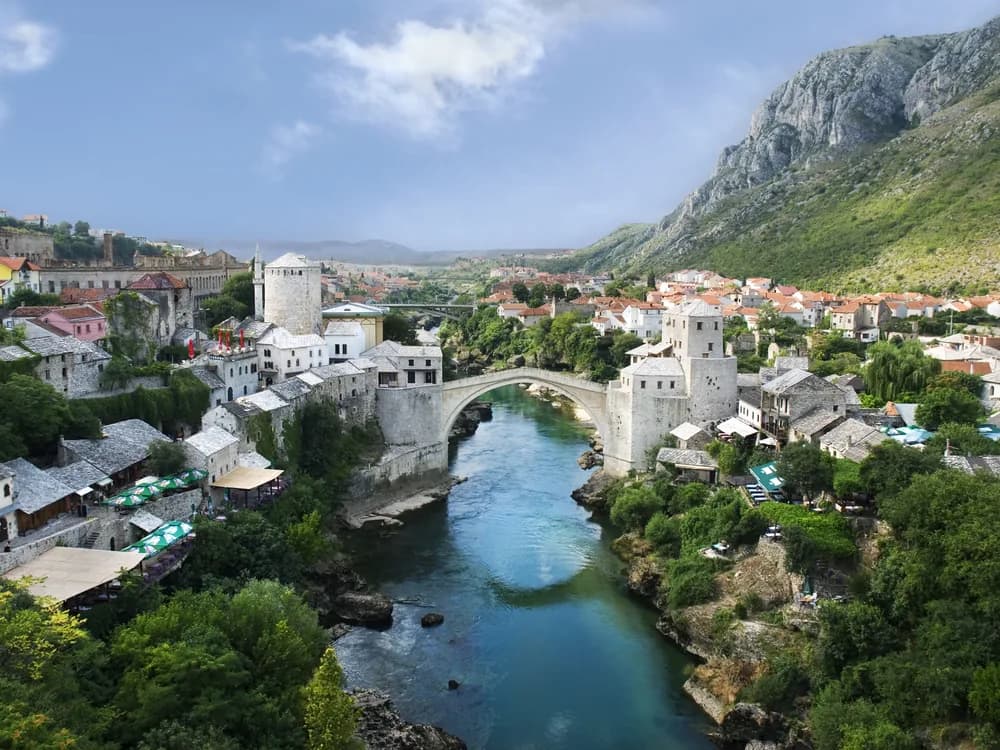
Mostar is the de facto capital of Herzegovina, built around the Ottoman bridge that gives the town its name (Mostari means 'bridge keepers'). Stari Most — the Old Bridge — was built in 1557 by the Ottoman architect Mimar Hayruddin, a student of Sinan, as a single bold arch of cut limestone across the Neretva. For 436 years it was the longest single-span stone bridge in the world. In November 1993, Croatian forces deliberately destroyed it with tank and artillery fire. After the war, international teams recovered the original stones from the river bed, quarried new stone from the same mountain, and rebuilt the bridge using 16th-century techniques — completed in 2004. Walk the bridge, the cobbled Kujundžiluk bazaar, and the Ottoman mosques and hammam that surround it.
The final stop is one of the most extraordinary architectural settings in the Balkans: the Blagaj Tekija, a 16th-century Dervish monastery (tekija) built into the mouth of a cave at the source of the Buna river, where the entire river emerges from a cliff face 200m high. The tekija dates from around 1520, built for the Bektashi Sufi order on a site considered sacred since the Middle Ages. Above the tekija on the cliff, the ruins of the medieval Stjepan-grad fortress guard the approach — the castle of the last Herzegovinian prince before the Ottoman conquest of 1466.
What's Included
- ✓Return transport from Sarajevo
- ✓Professional English-speaking guide
- ✓Počitelj guided visit
- ✓Mostar Old Town guided walk
- ✓Blagaj Tekija entry
- ✓Large group
Not Included
- ✗Kravica Waterfall entry (optional stop, approximately €3)
- ✗Blagaj Tekija interior (optional, small donation requested)
- ✗Lunch (free time in Mostar — many excellent restaurants in the Old Town)
- ✗Mostar diving show (divers jumping from the Old Bridge — separate fee)
Insider Tips
Wear modest clothing at Blagaj Tekija — shoulders and knees should be covered to enter the Dervish monastery
Mostar's Old Town is best in the morning before the day-tour crowds arrive from Dubrovnik — the tour's timing usually ensures you reach the bridge before the afternoon rush
Počitelj is worth the steep climb to the citadel tower at the top — the view of the Neretva valley from the battlements is exceptional
The 'Old Bridge divers' at Mostar jump from the bridge's apex into the Neretva (a 21-metre drop into fast-moving water) — they charge for photos, but watching is free from the riverbank
Frequently Asked Questions
Was the Old Bridge really deliberately destroyed?
Yes. On 9 November 1993, Croatian Defence Council forces subjected Stari Most to targeted artillery and tank fire for 60 hours until the 436-year-old structure collapsed into the Neretva. The International Criminal Tribunal for the former Yugoslavia later concluded it was a deliberate attack on cultural heritage. International teams subsequently recovered 60% of the original stones from the river bed; the bridge was rebuilt using these stones plus new limestone from the same quarry, completed in 2004 and inscribed on the UNESCO World Heritage List the same year.
What is a Dervish tekija?
A tekija (also written tekke) is a monastery or lodge of a Sufi Muslim brotherhood (tariqa). Sufi orders practise an inward, mystical form of Islam emphasising spiritual development through prayer, music, and physical disciplines including the sema (whirling). The Blagaj Tekija housed the Bektashi order — one of the most influential Sufi brotherhoods in the Ottoman Empire, closely associated with the Janissary corps — and remains an active place of spiritual practice today.
Is it safe to visit Bosnia & Herzegovina?
Bosnia & Herzegovina is a safe destination for tourists. The 1992–1995 war ended 30 years ago and the country has been at peace since. Sarajevo, Mostar and Herzegovina are welcoming, well-developed tourist destinations. Some rural areas still have unexploded ordnance warnings on forest land — stay on marked paths outside towns. The people are exceptionally hospitable and tourism is warmly received.
More Tours from Sarajevo
Powered by GetYourGuide
From
€35
per person
Free cancellation available on most dates · Secure booking
Meeting point
Sarajevo city centre — exact location confirmed at booking
From
€35/ person