
Departing from Munich
From Munich: Harburg Castle, Rothenburg & the Romantic Road
A castle that survived every war unscathed and the world's best-preserved medieval walled town — the Romantic Road at its finest
From
€55/ person
Rating
★ 4.5(2,800)
Duration
Full day (10.5 hours)
Rating
4.5 ★ (2,800 reviews)
Languages
English
Group size
Max 55 people
About This Tour
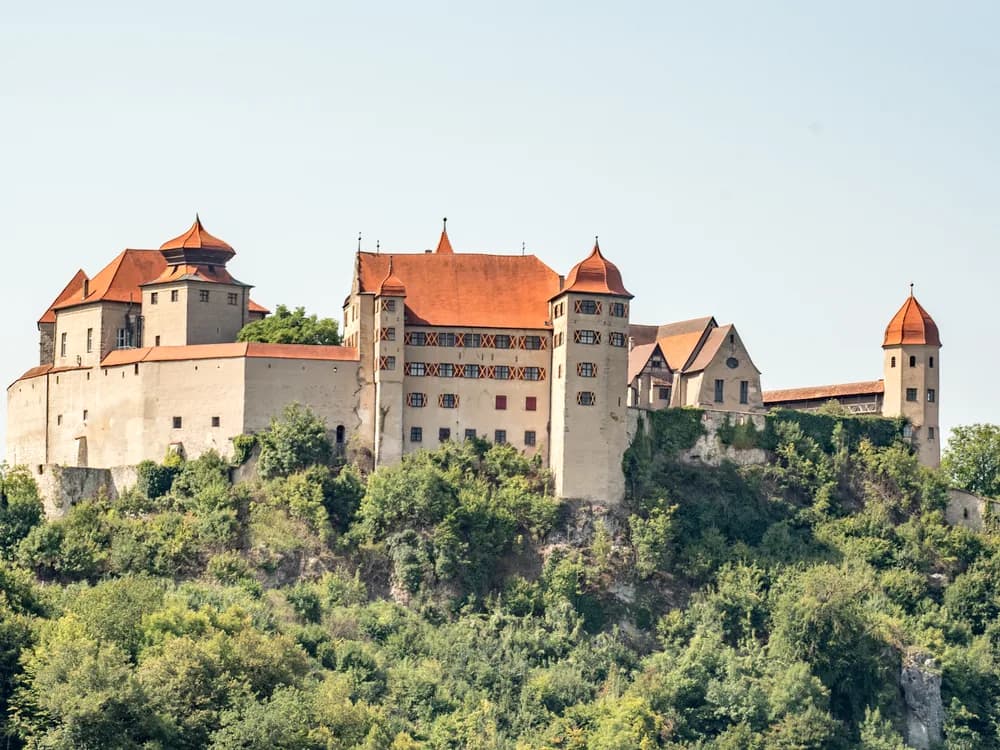
The Romantic Road is Germany's most famous scenic route — a 350-kilometre corridor of medieval walled towns, baroque churches and hilltop castles connecting Würzburg in the north to Füssen (and Neuschwanstein) in the south. This day trip from Munich covers the two greatest highlights: Harburg Castle and Rothenburg ob der Tauber. Harburg Castle is a remarkable outlier in European castle history — a fully intact medieval complex of towers, halls and courtyards that has never been seriously damaged by war, siege or fire in over 800 years of continuous habitation. While almost every comparable German castle was destroyed in the Thirty Years War, the Napoleonic Wars or World War II, Harburg survived unscathed, still owned by the family (the House of Oettingen-Wallerstein) who have held it since 1731. Rothenburg ob der Tauber is the world's best-preserved medieval walled town — its complete circuit of walls, towers and gates dating from the 13th to 17th centuries still intact, the streets within so unchanged that it has been used repeatedly as the model for European medieval towns in film and animation.
Highlights
- ✓Harburg Castle — one of the best-preserved medieval castles in Germany, never destroyed in 800+ years, still inhabited by the same family
- ✓Harburg village — a perfectly preserved medieval village clustered beneath the castle rock above the Wörnitz River
- ✓Rothenburg ob der Tauber — the world's most intact medieval walled town, complete circuit of 14th-century walls and towers
- ✓The Night Watchman of Rothenburg — the town's famous evening guide character (if timing permits)
- ✓The Romantic Road — the scenic corridor connecting Bavaria's greatest medieval towns
- ✓St James's Church in Rothenburg — the Holy Blood Altar by Tilman Riemenschneider, the greatest wood-carving in Germany
Ready to book this tour?
Free cancellation · Instant confirmation
Itinerary
Head north from Munich through Bavaria on the Romantic Road — the scenic route that connects Bavaria's greatest medieval towns from Füssen in the south to Würzburg in the north. The guide introduces the concept of the Romantic Road: established as a tourist route in 1950 to revive postwar tourism, it follows the path of Roman roads and medieval trade routes through a landscape that escaped the worst of World War II bombing. The contrast with other German historic centres destroyed in the war — Dresden, Cologne, Nuremberg — makes Rothenburg's survival all the more extraordinary.
Harburg Castle rises from a sandstone spur above the Wörnitz River — a compact but remarkably complete complex of keep, towers, great hall, chapel, residential buildings and outer ward that has been continuously inhabited since 1150. The castle's extraordinary survival record is due partly to geography (it was never on a major military axis) and partly to diplomatic skill: its owners consistently managed to be on the winning side, or to negotiate successfully with occupying forces, through every conflict from the Thirty Years War to World War II. The Hohenstaufen emperors used it, Gustavus Adolphus of Sweden probably stayed here during the Thirty Years War, and the House of Oettingen-Wallerstein has owned it since 1731. The guide takes visitors through the original rooms — the great hall, the prison tower, the Romanesque chapel and the treasury — all furnished with original contents spanning 800 years.
Rothenburg ob der Tauber sits on a plateau above the Tauber River, its complete circuit of medieval walls enclosing a town that looks almost exactly as it did in the 16th century. The walls — 2.4 kilometres of covered rampart walkway, punctuated by 42 towers and 6 major gates — are entirely walkable, giving a direct experience of medieval defensive architecture that almost no other European city can match. The guide covers the town's most famous story: the Master Draught of 1631, during the Thirty Years War, when Imperial General Tilly threatened to execute the entire town council unless someone could drink a 3.25-litre (nearly 6 pint) tankard of wine in one draught. Former Mayor Nusch reportedly achieved this feat, saving the town — the story is re-enacted daily by the town's clock mechanism on the Rathaus tower. Visit St James's Church to see the Holy Blood Altar by Tilman Riemenschneider (1505) — widely considered the greatest limewood carving in existence.
What's Included
- ✓Return luxury coach from Munich
- ✓Professional English-speaking guide
- ✓Harburg Castle entry and guided tour
- ✓Snacks and drinks on the coach
- ✓Small group section
Not Included
- ✗Lunch (free time in Rothenburg — the Ratskeller restaurant in the town hall is recommended)
- ✗St James's Church entry (~€3 — highly recommended)
- ✗Tips for guide and driver
Insider Tips
Walk the full circuit of Rothenburg's walls — the covered rampart walkway is entirely free and gives a perspective on medieval defence unavailable almost anywhere else in Europe
The Holy Blood Altar in St James's Church is Tilman Riemenschneider's masterpiece — better than anything in a German museum and completely in situ, exactly as it was carved in 1505
Rothenburg's Christmas Market (late November–December) is considered the finest in Bavaria — the town transforms and the medieval streets are lit by thousands of candles
Schneeballen (snowballs) — deep-fried dough pastry in a ball, dusted with powdered sugar — are Rothenburg's specific traditional sweet. They are sold everywhere and are genuinely good.
Frequently Asked Questions
What is the Master Draught story?
In 1631, during the Thirty Years War, Imperial General Tilly captured Rothenburg and condemned the town council to death for having supported the Protestant side. According to local legend, Tilly offered to spare the councillors if any one person could drink a 3.25-litre (nearly 6 pint) tankard of Franconian wine in a single draught without stopping. Former Mayor Georg Nusch, then over 60 years old, volunteered, accomplished the feat, saved the council — and slept for three days afterward. The story is re-enacted daily by the Ratstrinkstube clock mechanism on the market square.
Why does Rothenburg look so medieval?
Rothenburg's preservation is partly due to economic decline: after the Thirty Years War devastated the town and its trade, Rothenburg never had the prosperity for major reconstruction that destroyed medieval neighbourhoods in more successful German cities. The town remained essentially frozen in the 17th century. When discovered by 19th-century Romantic painters and later by American tourists, its intact medieval character was considered extraordinary. In World War II, Rothenburg escaped bombing largely because an American general arranged its surrender before the artillery barrage began.
What is Harburg Castle and why is it so well preserved?
Harburg Castle is a 12th-century fortress that has never been seriously damaged — no siege, no major fire, no wartime destruction — in over 800 years. This is exceptional: virtually every comparable German castle was destroyed in the Thirty Years War (1618–1648), during which Imperial and Swedish armies systematically demolished fortifications across Germany. Harburg's preservation is due to geography (off the main military routes), diplomacy (its owners consistently managed to accommodate occupying forces) and continuous ownership (it has been in the same family since 1731, ensuring ongoing maintenance).
More Tours from Munich
Powered by GetYourGuide
From
€55
per person
Free cancellation available on most dates · Secure booking
Meeting point
Munich city centre — exact departure point confirmed at booking
From
€55/ person