
Departing from Athens
From Athens: Mycenae, Nafplio & Palamidi Fortress
From the Bronze Age citadel where Agamemnon ruled to the Venetian fortress that loomed over Greece's first modern capital — 3,000 years of fortified history in a single day
From
€65/ person
Rating
★ 4.7(3,200)
Duration
Full day (10 hours)
Rating
4.7 ★ (3,200 reviews)
Languages
English
Group size
Max 50 people
About This Tour
The Argolis peninsula in the northeastern Peloponnese contains the most concentrated sequence of fortifications in European history — Bronze Age, Classical, Byzantine, Frankish, Venetian, and Ottoman, all within 50 kilometres of each other. This day from Athens visits the two unmissable: Mycenae, the citadel of the legendary King Agamemnon, leader of the Greeks at Troy, whose Lion Gate and cyclopean walls have stood since 1350 BC; and Nafplio, the most beautiful town in the Peloponnese, dominated by the Palamidi Venetian fortress — one of the largest and most impressive Baroque military constructions in Europe — where the first Greek parliament met after independence in 1821. Between them, the classical theater of Epidaurus and the medieval city of Nafplio complete a journey through 3,500 years of Greek history.
Highlights
- ✓Mycenae — the Bronze Age citadel of Agamemnon, with the Lion Gate (1250 BC) and cyclopean walls still standing after 3,300 years
- ✓Treasury of Atreus — a 14th-century BC corbelled beehive tomb of extraordinary engineering, the largest Bronze Age structure in Greece
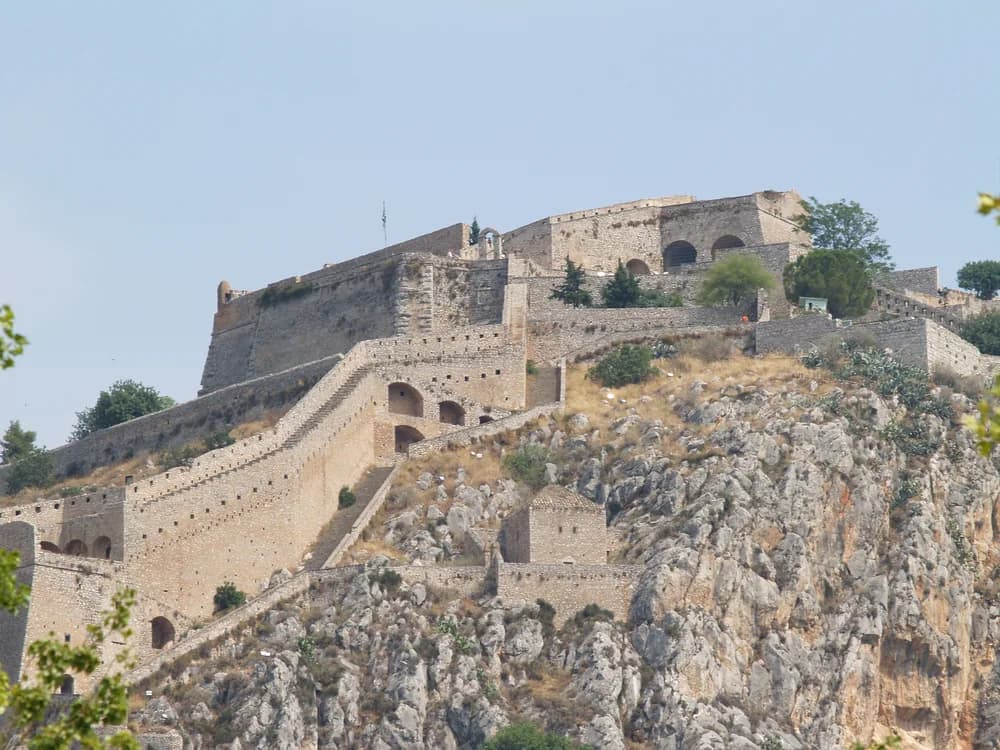
- ✓Palamidi Fortress — the Venetian fortress above Nafplio (1711–1714), 216 steps above the sea, one of the finest Baroque military structures in Europe
- ✓Nafplio Old Town — the first capital of independent Greece (1821–1834), with Venetian, Ottoman and Neoclassical architecture intact
- ✓Acronauplia — the Byzantine-Frankish castle on the headland below Palamidi, occupied continuously since the Bronze Age
- ✓Epidaurus ancient theater — the best-preserved classical Greek theater in existence, with legendary acoustics
Ready to book this tour?
Free cancellation · Instant confirmation
Itinerary
Head southwest from Athens through the Corinth Canal crossing — where a 6km canal cut in 1893 separates mainland Greece from the Peloponnese — and into the Argolis plain. The guide introduces the Bronze Age civilisation of Mycenae: the culture that Homer described in the Iliad and Odyssey, rediscovered by Heinrich Schliemann in 1876 when he found gold masks, shaft graves, and the Lion Gate exactly where the ancient sources said the city of Agamemnon stood.
The citadel of Mycenae was the capital of the most powerful kingdom in the Aegean from approximately 1600 to 1100 BC — the culture that Homer calls the Achaeans, who launched the Trojan War. The Lion Gate (c. 1250 BC) is the oldest monumental sculpture in Europe: two carved lions flanking a central column above the gate lintel, still standing in the massive cyclopean walls built from limestone blocks weighing up to 100 tonnes. Inside: the grave circles where Schliemann found the gold death masks he mistakenly called 'the Mask of Agamemnon', the palace with its megaron (throne room), and the secret cistern that supplied the citadel during siege. The Treasury of Atreus — a 50m-long dromos passage leading to a corbelled beehive chamber 14m high — is the largest and most perfectly engineered Bronze Age structure in Greece.
The sanctuary of Epidaurus was the most important healing centre of the ancient Greek world — pilgrims came from across the Mediterranean to be cured by Asclepius, the god of medicine. The 4th-century BC theater is one of the most perfectly preserved ancient structures in existence: 14,000 seats arranged in 55 rows with acoustics so precise that a whisper on the stage floor is audible in the top row. It is still used for summer performances. The guide covers the sanctuary's role as the ancient world's equivalent of a spa hospital and explains why Greek theaters were always built in the same relationship to the landscape.
Nafplio was the first capital of the newly independent Greek state (1821–1834), before the capital moved to Athens. It is also the most beautiful and best-preserved historic town in the Peloponnese — a dense grid of Venetian, Ottoman, and Neoclassical buildings on a headland overlooking the Argolic Gulf. Dominating it from above is the Palamidi fortress, built by the Venetians between 1711 and 1714 when they reconquered the Peloponnese from the Ottomans. The fortress consists of eight semi-independent bastions connected by walls spread across the 216m summit, designed by French military engineer Lasalle. 999 steps (now 857 after steps were removed) connect it to the town below. Walk the bastions, the baroque gateways, and the views across the gulf that made this the most strategic point in the Eastern Mediterranean.
What's Included
- ✓Return transport from Athens
- ✓Professional English-speaking guide
- ✓Mycenae archaeological site entry
- ✓Epidaurus entry
- ✓Nafplio Old Town guided walk
Not Included
- ✗Palamidi Fortress entry (optional, €8 — the climb is the main experience)
- ✗Lunch (free time in Nafplio — excellent tavernas in the old town)
- ✗Mycenae Archaeological Museum (optional, on site)
Insider Tips
Climbing Palamidi's 857 steps in midsummer heat is demanding — wear light clothing, start early, and bring water. The view from the top basilica fort justifies every step
Nafplio's old town rewards an hour's independent exploration — the Venetian loggia on Syntagma Square, the palm-lined waterfront, and the Bourtzi island castle (reached by small boat) are all unmissable
The acoustics at Epidaurus really are extraordinary — if your guide offers a demonstration, move to the top row before they speak
Book months in advance for July–August — this is one of the most popular day trips from Athens
Frequently Asked Questions
Did King Agamemnon really live at Mycenae?
The historical reality behind the Trojan War remains debated, but the Bronze Age palace at Mycenae was definitely real and definitely powerful. Schliemann's 1876 excavations found gold masks, weapons, and jewelry of extraordinary richness in the shaft graves. Whether the king buried under the 'Mask of Agamemnon' was the historical Agamemnon or a predecessor, Mycenae was unquestionably the dominant power in the Aegean around 1400–1200 BC — exactly the period Homer sets his story.
Why is Nafplio considered the most beautiful town in the Peloponnese?
Nafplio has an unusually intact historic centre because it was Greece's first capital (1821–1834) and received investment in public buildings, squares, and infrastructure during the country's founding decade. The Venetian occupation (1388–1540, 1686–1715) left a remarkable legacy of fortifications, fountains, and architecture. Unlike most Greek towns, Nafplio was never significantly developed in the 20th century, preserving the 18th–19th century streetscape almost completely.
What are cyclopean walls?
Cyclopean masonry refers to the construction technique used at Mycenae and other Bronze Age citadels, where massive limestone blocks — some weighing up to 100 tonnes — are fitted together without mortar, using only their weight and precise cutting for stability. The name comes from the ancient Greeks themselves, who believed walls of such scale could only have been built by the Cyclopes (the mythological one-eyed giants). Modern engineering analysis confirms the walls have remained standing for 3,300 years with no significant failure.
More Tours from Athens
Powered by GetYourGuide
From
€65
per person
Free cancellation available on most dates · Secure booking
Meeting point
Athens city centre — exact location confirmed at booking
From
€65/ person