
Departing from Bari
From Bari: Castel del Monte & Trani – Puglia's Two Medieval Masterpieces
The world's most mysterious castle and a cathedral built into the sea — Frederick II's two UNESCO masterpieces in Puglia
From
€35/ person
Rating
★ 4.6(830)
Duration
Full day (7 hours)
Rating
4.6 ★ (830 reviews)
Languages
English
Group size
Max 20 people
About This Tour
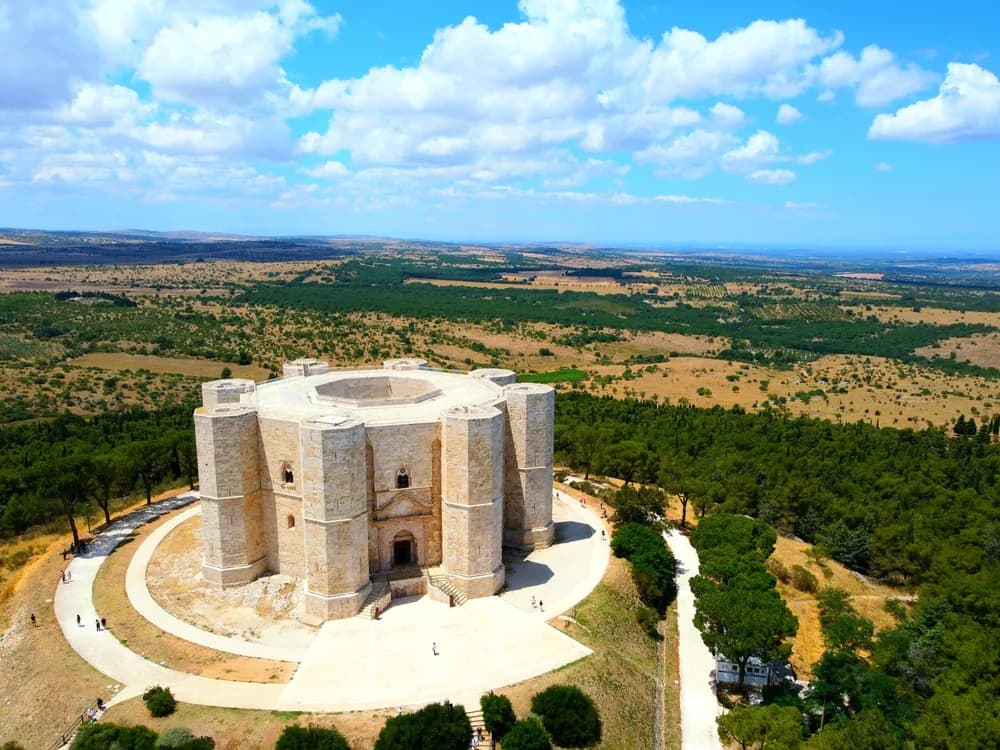
Castel del Monte is one of the most extraordinary buildings in medieval Europe — and nobody fully understands why it was built. Emperor Frederick II Hohenstaufen, King of Sicily and Holy Roman Emperor, ordered its construction around 1240 on a hilltop in Puglia. The result is a perfect octagon with octagonal towers at each corner, built with a mathematical precision and an integration of astronomical alignments that has generated centuries of scholarly debate. It was neither a residence (too small), nor a fortress (no water source or defensive earthworks), nor a hunting lodge (no stables or kennels). Frederick himself called it 'a crown on the head of Apulia'. UNESCO listed it in 1996. The afternoon visit to Trani completes the day: a medieval port city built entirely of pale golden limestone, where the Cathedral of San Nicola Pellegrino stands directly on the sea wall — its Romanesque towers rising from the Adriatic as if the cathedral has sailed in from the horizon.
Highlights
- ✓Castel del Monte (UNESCO) — Frederick II's perfect octagonal castle, one of the most mysterious and mathematically precise buildings of the Middle Ages
- ✓The eight-sided enigma — eight towers, eight rooms per floor, eight-sided interior courtyard, precise solar alignments at the equinoxes
- ✓Trani Cathedral — a Romanesque masterpiece built on the seafront, its white limestone towers reflected in the Adriatic
- ✓Trani old town — a medieval port of pale golden limestone, fishing boats and Byzantine architecture
- ✓Frederick II — the most extraordinary ruler of medieval Europe, speaking six languages and writing the first scientific study of falconry
- ✓Puglia's unique landscape — red earth, silver olive groves, trulli (conical stone houses) and the endless Adriatic coast
Ready to book this tour?
Free cancellation · Instant confirmation
Itinerary
Castel del Monte stands alone on a limestone hilltop 540 metres above sea level — visible for miles across the Puglia plain, with no town, village or other building nearby. The octagonal plan is mathematically perfect: eight sides, eight towers, eight trapezoidal rooms on each of the two floors, eight sides to the interior courtyard. Every measurement is a multiple of eight. The solar alignments are precise: at the spring and autumn equinoxes, sunlight enters specific windows and illuminates specific rooms in a pattern that cannot be accidental. The guide covers Frederick II — arguably the most remarkable ruler of medieval Europe: Holy Roman Emperor, King of Sicily and Jerusalem, fluent in Arabic, Greek, Latin, French, German and Italian, who conducted his crusade via negotiation rather than battle (recovering Jerusalem through a treaty that horrified the Pope) and wrote the first scientific study of falconry, 'De Arte Venandi cum Avibus'. What the castle was actually for remains unknown.
Trani is one of the most beautiful medieval port cities in southern Italy — built entirely of the warm golden limestone unique to this part of Puglia, its medieval streets and seafront unchanged since the Crusader era. The Cathedral of San Nicola Pellegrino was built between 1094 and 1197 directly on the sea wall, its western facade facing the Adriatic and its tower reflected in the harbour waters. The cathedral is one of the finest examples of Apulian Romanesque architecture: its bronze doors, cast in 1175 by Barisano da Trani, are among the most important medieval metalwork in Italy. The guide covers Trani's extraordinary medieval history: a major Crusader embarkation port where Frederick II departed for the Holy Land in 1228, and a city with a significant Jewish community whose 13th-century synagogue (now the Church of Santa Anna) is the oldest standing synagogue in Europe.
What's Included
- ✓Return transport from Bari
- ✓Professional English-speaking guide
- ✓Castel del Monte skip-the-line entry
- ✓Small group (max 20)
Not Included
- ✗Lunch (free time in Trani)
- ✗Trani Cathedral entry (donation suggested, ~€2)
- ✗Tips for guide and driver
Insider Tips
Castel del Monte on its solitary hilltop is one of the most photogenic medieval sites in Italy — arrive early for the best light before the heat builds
The octagonal shape of Castel del Monte supposedly inspired Umberto Eco's 'The Name of the Rose' — the labyrinthine library in the novel is modelled on it
Trani is best in the early morning or late afternoon when the light turns the limestone golden — the seafront cathedral at sunset is extraordinary
Puglia's cuisine is among Italy's finest: in Trani, try orecchiette with cime di rapa, fresh sea urchin pasta, and the local white wines
Frequently Asked Questions
What was Castel del Monte actually built for?
Nobody knows — and that is part of what makes it so extraordinary. The standard theories are: a hunting lodge (but there are no stables, kennels or water sources); a fortress (but there are no defensive earthworks, moat or garrison facilities); a residence (but the rooms are too small and inconvenient); an astronomical observatory (the solar alignments are precise but insufficient for systematic observation); or a symbolic monument expressing Frederick's fusion of Christian, Islamic and Classical learning. Frederick's own description — 'a crown on the head of Apulia' — suggests it was primarily a statement of imperial power and cultural synthesis. UNESCO describes it as 'a unique piece of medieval military architecture.'
Who was Frederick II?
Frederick II (1194–1250), Holy Roman Emperor and King of Sicily, was arguably the most extraordinary ruler of medieval Europe. Born in Sicily, he grew up at the crossroads of Norman, Arab and Byzantine cultures and spoke six languages fluently. He recovered Jerusalem from the Muslims through diplomatic negotiation in 1229 (the Sixth Crusade) without fighting a single battle — an act for which Pope Gregory IX excommunicated him. He was a scientist, writer, architect and falconer; his treatise on falconry, 'De Arte Venandi cum Avibus', is the first scientific study of birds written in the medieval West. His contemporaries called him 'Stupor Mundi' — the Wonder of the World.
What is special about Trani Cathedral?
The Cathedral of San Nicola Pellegrino in Trani is one of the finest Romanesque cathedrals in southern Italy, notable for its direct relationship with the sea — it was built on the seafront with its apse overlooking the Adriatic and its reflection visible in the harbour. Its bronze doors (1175) by Barisano da Trani are masterpieces of medieval metalwork. The cathedral is built over an earlier 6th-century church dedicated to Santa Maria della Scala, which is itself built over a hypogeum containing the crypt of San Leucio — three layers of Christian architecture on the same site, the earliest dating to the 5th century.
More Tours from Bari
Powered by GetYourGuide
From
€35
per person
Free cancellation available on most dates · Secure booking
Meeting point
Bari city centre — exact departure point confirmed at booking
From
€35/ person