
Departing from Siena
From Siena: San Gimignano, Volterra & Monteriggioni – Tuscany's Three Fortified Towns
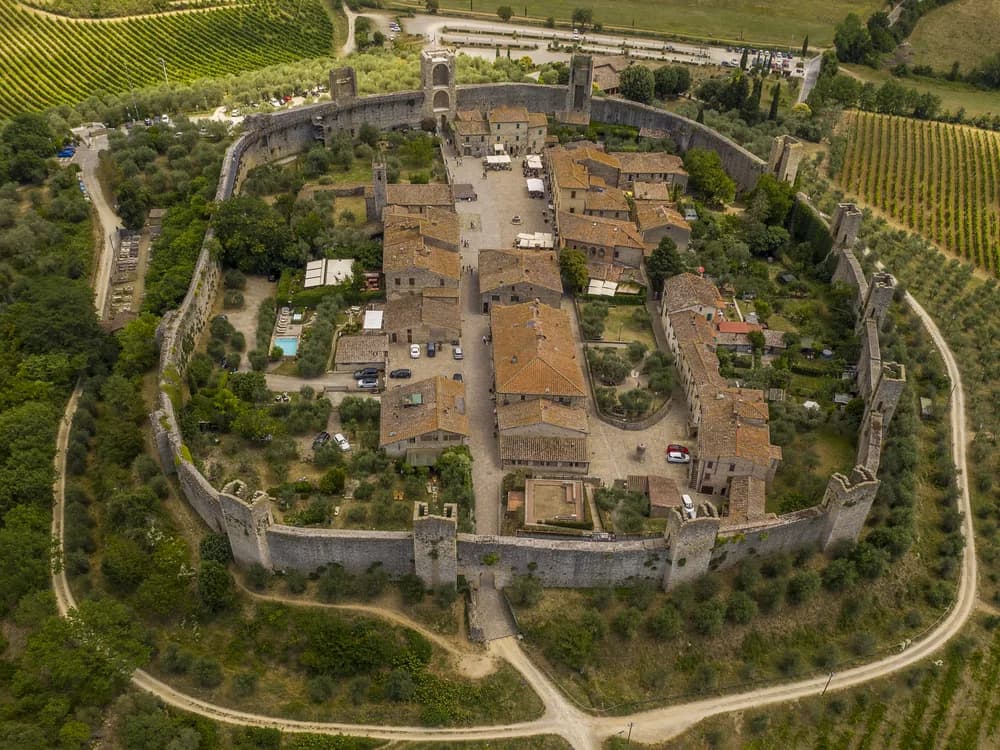
A ring fortress, 14 medieval towers and an Etruscan hill-city — the most concentrated fortification circuit in Tuscany
From
€60/ person
Rating
★ 4.6(480)
Duration
Full day (8 hours)
Rating
4.6 ★ (480 reviews)
Languages
English
Group size
Max 14 people
About This Tour
Within a 40-kilometre triangle of Tuscan hills lie three of the most perfectly preserved medieval fortified towns in Italy — each a completely different type of fortification. Monteriggioni is a ring fortress: a circular curtain wall with 14 towers, built by Siena in 1213 as a military outpost against Florence, still so intact that Dante used it as a simile for the giants of Hell in the Divine Comedy. San Gimignano is a tower city: a medieval Manhattan of 72 private towers (14 still standing), built by rival noble families competing for height as a display of wealth and power, crowning a hill above the Elsa valley. Volterra is an Etruscan hill-city: occupied continuously since the 8th century BC, with Etruscan walls, Roman theatre, medieval Palazzo dei Priori and the 14th-century Medici Fortress dominating its ridge above two deep river valleys. Three different eras of fortification, three different political cultures, all within an afternoon's drive of each other.
Highlights
- ✓Monteriggioni — Dante's ring fortress, a perfectly intact circular wall with 14 towers unchanged since 1213
- ✓San Gimignano (UNESCO) — 14 surviving medieval towers from the original 72, built by rival noble families competing for height
- ✓San Gimignano's Rocca (fortress) — the 14th-century Florentine citadel with the finest panoramic view of the tower skyline
- ✓Volterra — an Etruscan hill-city with 2,800 years of continuous fortification, Etruscan gates still in use today
- ✓Volterra's Medici Fortress — the 14th-century citadel on Volterra's highest point, still used as a prison until 1985
- ✓Alabaster workshops in Volterra — the city's craftsmen have worked the local alabaster stone since Etruscan times
Ready to book this tour?
Free cancellation · Instant confirmation
Itinerary
Monteriggioni fortress was built by the Republic of Siena between 1213 and 1219 as a military outpost to defend against Florentine expansion — a pure ring fortress with 14 towers spaced along a circular curtain wall, designed for no purpose other than to stop an army. The village inside the walls was populated by soldiers and their families. The fortification is so intact that when Dante Alighieri (a Florentine who would have recognised it) described the giants of Hell in the 31st Canto of the Inferno, he compared their heads emerging from the pit to the towers of Monteriggioni emerging from the hilltop: 'as on its circular ramparts Monteriggioni crowns itself with towers'. The guide explains the military rivalry between Siena and Florence — two city-states that fought 17 wars in 200 years — and what Monteriggioni was designed to resist.
San Gimignano's UNESCO skyline of 14 medieval towers is one of the most recognisable in Italy — but the towers were not built for military defence. They were built by rival noble families as symbols of power, wealth and status: the taller your tower, the more important your family. At the peak of tower construction in the 13th century, San Gimignano had 72 towers, creating a skyline that contemporaries compared to a hedgehog. The guide explains the political system that produced this competition: the Guelph-Ghibelline factional conflict that divided every Italian city between partisans of the Pope and partisans of the Holy Roman Emperor, making family strongholds both a political statement and a practical necessity. San Gimignano is also famous for its Vernaccia wine — one of Italy's oldest white wines, referenced by Dante — and for its extraordinary cycle of 14th-century frescoes in the Collegiate Church.
Volterra's Etruscan walls — built in the 4th century BC and partially surviving to this day — are among the oldest standing fortifications in Italy. The Porta all'Arco, an Etruscan gate of the 4th century BC, is still the main entrance to the old city: three volcanic stone heads (Etruscan deities) carved 2,400 years ago still watch over the gateway. The guide covers 2,800 years of continuous fortification: Etruscan walls, Roman forum, medieval bishop's palace, the 14th-century Medici Fortress (which served as a maximum-security prison until 1985 and is not open to visitors). The alabaster workshops of Volterra have operated continuously since Etruscan times — the translucent stone, quarried from the nearby hills, was used for Etruscan funeral urns and is now worked into lamps, sculptures and bowls by craftsmen using techniques unchanged for centuries.
What's Included
- ✓Return transport from Siena
- ✓Professional English-speaking guide
- ✓Monteriggioni fortress entry
- ✓San Gimignano guided walk
- ✓Alabaster workshop visit in Volterra
- ✓Small group (max 14)
Not Included
- ✗San Gimignano tower entry — Torre Grossa (~€6)
- ✗Collegiate Church frescoes entry (~€4)
- ✗Lunch (free time in San Gimignano)
- ✗Tips for guide and driver
Insider Tips
Monteriggioni is best photographed from outside the walls — the full circle of towers against the Tuscan hills is more impressive from the road below than from inside
Climb Torre Grossa in San Gimignano (the tallest surviving tower, now a museum) for the best view of the remaining towers and the Val d'Elsa below
San Gimignano's gelato is legitimately excellent — the shop Gelateria di Piazza won the World Gelato Championship and is worth the queue
Volterra's alabaster shops are clustered near the Palazzo dei Priori — genuine hand-carved pieces versus factory imports are immediately distinguishable by the irregular translucency of the stone
Frequently Asked Questions
Why did Dante compare the giants of Hell to Monteriggioni?
In Canto XXXI of the Inferno, Dante describes the giants who guard the ninth circle of Hell as so enormous that only their upper bodies are visible above the rim of the pit. He compares this to Monteriggioni, whose towers appear to rise from the hilltop like the giants' heads emerging from the abyss. It is one of the most specific geographical references in the entire Divine Comedy — Dante, as a Florentine soldier, had personally observed Monteriggioni from the enemy side during the wars between Florence and Siena.
Why did medieval families build such tall towers?
The tower-building competition in San Gimignano was driven by the Guelph-Ghibelline factional conflict — the division of Italian cities between supporters of the Pope (Guelphs) and supporters of the Holy Roman Emperor (Ghibellines). In a city divided between factions, noble families needed both a military strongpoint (the tower could be defended from within) and a visible statement of power and wealth. Height was status: the taller your tower, the more powerful you appeared. Some towers were also used practically — silk was draped from upper windows to dry, grain was stored in them, and they served as watch-posts.
Is Volterra worth visiting compared to San Gimignano?
Volterra is arguably the more rewarding of the two for those interested in medieval and ancient history. It has fewer tourists than the very popular San Gimignano, older fortifications (the Etruscan gate and walls predate anything in San Gimignano by 1,500 years), an extraordinary Etruscan museum with 600 funeral urns, and active alabaster workshops. The Medici Fortress on the hilltop, though not open to visitors, adds a dramatic skyline. Many visitors who go expecting San Gimignano's towers come away finding Volterra more impressive.
More Tours from Siena
Powered by GetYourGuide
From
€60
per person
Free cancellation available on most dates · Secure booking
Meeting point
Siena — exact departure point confirmed at booking
From
€60/ person