
Departing from Skopje
From Skopje: Ohrid — Samuel's Fortress & Lake Ohrid
The capital of a medieval empire on the shore of the oldest lake in Europe — Byzantine churches, a 10th-century fortress, and a city that has been continuously inhabited for 2,400 years
From
€30/ person
Rating
★ 4.8(750)
Duration
Full day (9 hours)
Rating
4.8 ★ (750 reviews)
Languages
English
Group size
Max 15 people
About This Tour
Lake Ohrid has existed for between one and three million years — one of the oldest lakes on Earth, and the only lake in the world to have been designated a UNESCO World Heritage Site for both its natural and cultural significance simultaneously. On its northern shore, the city of Ohrid was continuously inhabited from the 7th century BC and served as the capital of Tsar Samuel's empire (the First Bulgarian Empire) at the height of its power around 1000 AD. Samuel's Fortress, built on the hilltop above the city on foundations that go back to the 4th century BC, enclosed the entire upper town within its walls. Thirty-six Byzantine and medieval churches survive in Ohrid today — more per square metre than anywhere else in the Balkans. This day from Skopje is one of the most rewarding heritage journeys in the region.
Highlights
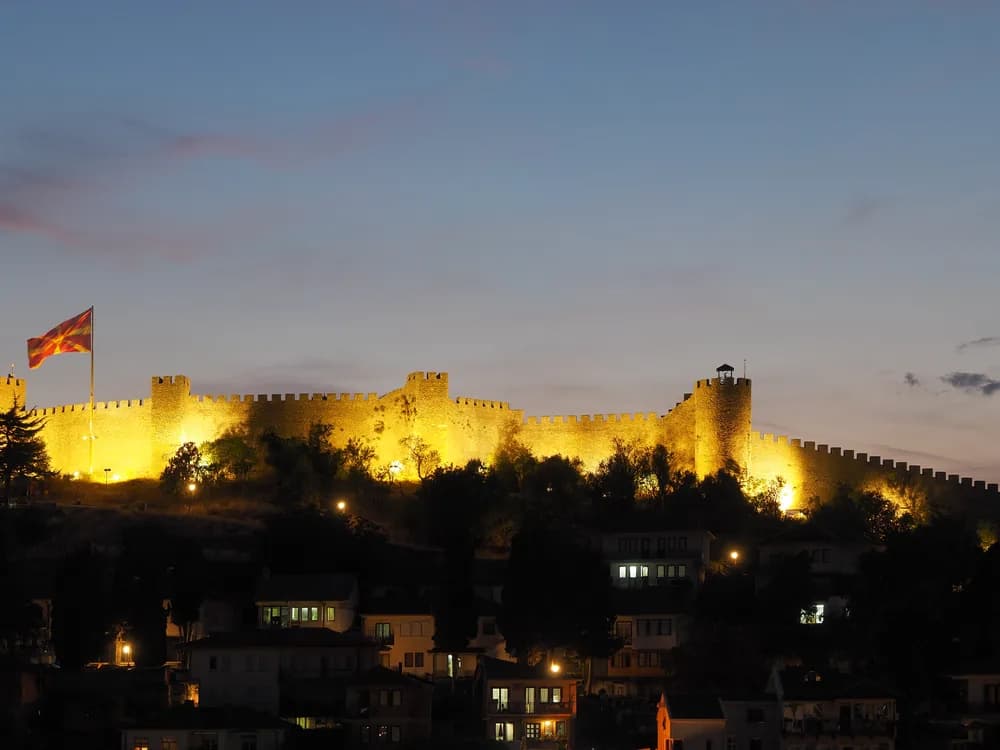
- ✓Samuel's Fortress (10th century) — Tsar Samuel's capital citadel, on Hellenistic foundations from the 4th century BC, commanding Lake Ohrid
- ✓Lake Ohrid — 1-3 million years old, UNESCO World Heritage (natural and cultural), 288 metres deep, 17 endemic species found nowhere else on Earth
- ✓Church of Saint Sofia (11th century) — one of the finest examples of Byzantine architecture in North Macedonia, with remarkable surviving frescoes
- ✓Ancient Theater of Ohrid (2nd century BC) — a Hellenistic theater still used for summer performances, with the lake as its backdrop
- ✓Ohrid Old Town — 36 Byzantine and medieval churches in a single hillside town: more Byzantine ecclesiastical architecture per square metre than anywhere in the Balkans
- ✓Saint John at Kaneo — the 13th-century Byzantine church on a cliff above the lake, one of the most photographed images in North Macedonia
Ready to book this tour?
Free cancellation · Instant confirmation
Itinerary
Head southwest from Skopje across the Macedonian highlands toward Ohrid. The guide introduces the history of the region: the ancient Macedonian kingdom that gave birth to Alexander the Great (who was born 150km to the north at Pella); the Roman conquest; the Byzantine Christianisation; and the extraordinary medieval moment when Tsar Samuel (997-1014) moved the capital of his Bulgarian Empire to Ohrid, making this lakeside town briefly the centre of the largest state in the Balkans.
Samuel's Fortress (Samoilova Tvrđina) crowns the hill above Ohrid at 860m — the highest point of the old city. The site was first fortified by the Illyrian Enchelei tribe in the 4th century BC; the Macedonian kings reinforced it; the Romans rebuilt it; and in the late 10th century Tsar Samuel enclosed the entire upper city within his curtain walls and towers. Samuel (r. 997-1014) was the Tsar of the First Bulgarian Empire and one of the most powerful rulers in the medieval Balkans, extending his territory across most of the western Balkans before being defeated by the Byzantine Emperor Basil II at the Battle of Kleidion in 1014. Basil blinded 15,000 of Samuel's soldiers (leaving one eye to every hundredth man to guide the others home); Samuel died of shock when he saw them. The fortress walls are mostly intact and the view over the lake from the battlements is extraordinary.
Walk down from the fortress through the old town, passing the Ancient Theater (2nd century BC, rebuilt in the Hellenistic period, still used for summer performances — one of the few ancient theaters in continuous use in the Balkans), the Church of Saint Sofia (11th century, one of the finest examples of Byzantine architecture in North Macedonia, with original fresco cycles from multiple periods), and the steep lanes of the old bazaar toward the lake shore. The Church of Saint John at Kaneo — perched on a cliff above the lake's western shore, accessible by a steep path — is the most photographed building in North Macedonia: a small 13th-century Byzantine church on an octagonal plan, with the deep blue of Lake Ohrid 30 metres below.
Lake Ohrid is between 1 and 3 million years old — one of the oldest lakes on Earth, and by far the oldest in Europe. Its extraordinary age has allowed 17 endemic animal species to evolve in isolation, including the Ohrid trout and several endemic snails found nowhere else on Earth. The lake is 288 metres deep, 30km long, and shared between North Macedonia and Albania. UNESCO designated it a World Heritage Site in 1980 for both natural and cultural significance — the only lake in the world to receive dual designation. Walk the lakeside promenade, which passes Roman ruins, medieval churches, and Byzantine-era boat harbours, with the Albanian mountains visible across the water.
What's Included
- ✓Return transport from Skopje
- ✓Professional English-speaking guide
- ✓Samuel's Fortress entry
- ✓Church of Saint Sofia entry
- ✓Ancient Theater of Ohrid guided visit
- ✓Small group (max 15)
Not Included
- ✗Lunch (free time in Ohrid old town — Ohrid trout from the lake is the local speciality)
- ✗Saint Naum Monastery (optional extension, 30km south of Ohrid at the Albanian border)
- ✗Boat ride on Lake Ohrid (optional, seasonal)
Insider Tips
Try the Ohrid trout (pastrmka) for lunch — it's specific to Lake Ohrid's endemic species and the flavour is unlike any other trout; it's listed as a protected delicacy and quantities are limited
Saint John at Kaneo church is a short walk from the main old town but requires descending a steep path — the view from the cliff edge is worth every step
Ohrid is extremely popular in July-August with Balkan tourists — consider visiting in May-June or September when the old town is quieter and the lake is still warm enough to swim
The Ohrid Summer Festival (July-August) uses the Ancient Theater for open-air performances — check the programme if visiting in summer
Frequently Asked Questions
Why is Lake Ohrid so old?
Lake Ohrid is a tectonic lake — formed by the gradual sinking of the Earth's crust along a fault line rather than by glacial or volcanic processes. Tectonic lakes form much more slowly and persist for millions of years rather than thousands. Lake Ohrid began forming between 1 and 3 million years ago and has maintained stable conditions ever since, allowing endemic species to evolve over geological time. Most European lakes are glacial in origin and only 10,000-15,000 years old.
What happened to Tsar Samuel?
In 1014, Byzantine Emperor Basil II (known as 'Bulgaroktonos' — the Bulgar-Slayer) defeated Samuel's army at the Battle of Kleidion in the Struma valley. He captured approximately 15,000 prisoners and ordered them blinded — except for every hundredth man, who was left one eye to lead the others back to Samuel. When Samuel saw his blinded army returning, he suffered what Byzantine chroniclers describe as a stroke or cardiac episode and died two days later. Basil earned his grim epithet.
Is Ohrid safe to visit?
Ohrid and North Macedonia are safe and welcoming tourist destinations. The country has been stable since the 2001 conflict and is a candidate for EU membership. Ohrid itself is one of the most visited destinations in the western Balkans and has well-developed tourism infrastructure. English is widely spoken in the tourism sector.
More Tours from Skopje
Powered by GetYourGuide
From
€30
per person
Free cancellation available on most dates · Secure booking
Meeting point
Skopje city centre — exact location confirmed at booking
From
€30/ person