
Departing from Bratislava
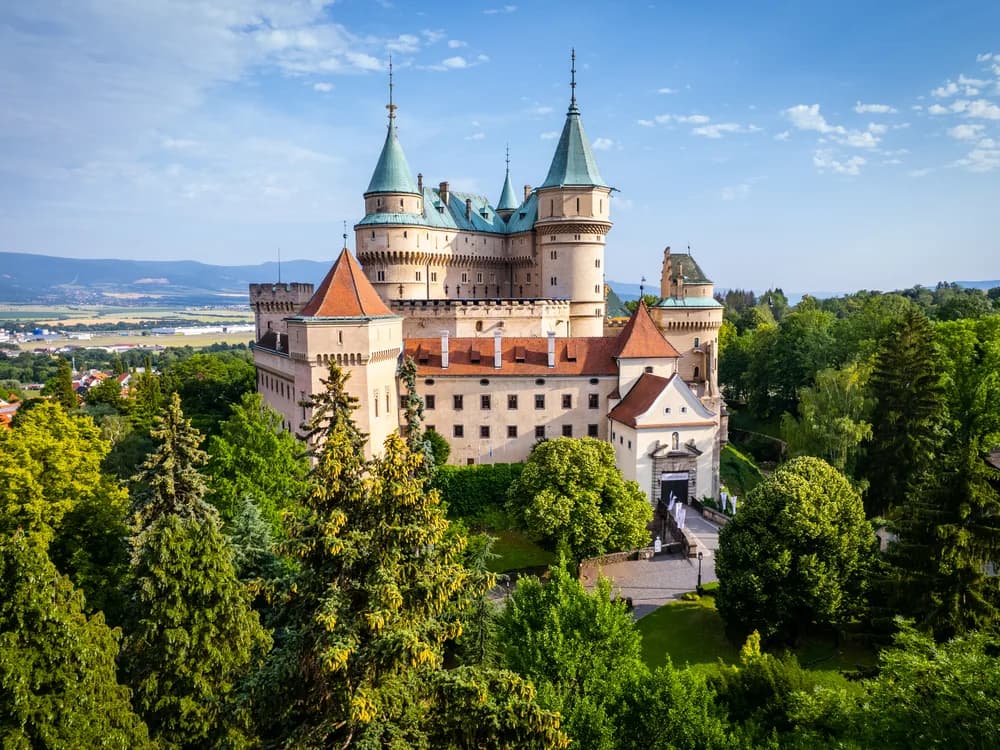
From Bratislava: Slovakia's Most Beautiful Castles – Bojnice & Trencin
A fairy-tale neo-Gothic castle and a hilltop fortress built over a Roman legionary camp — Slovakia's two greatest castles in one day
From
€80/ person
Rating
★ 4.6(185)
Duration
Full day (10 hours)
Rating
4.6 ★ (185 reviews)
Languages
English
Group size
Max 8 people
About This Tour
Slovakia has more castle sites per square kilometre than almost any country in Europe — the result of centuries of invasion pressure from Mongols, Ottomans and rival feudal lords that forced every strategic hilltop to be fortified. This tour visits the two most spectacular: Bojnice Castle, whose neo-Gothic towers and moat make it the most photographed castle in Slovakia, and Trencin Castle, a hilltop fortress built over a Roman legionary camp, with a 2nd-century Latin inscription carved by legionaries still visible in the cliff below. Bojnice's history spans 900 years — from a wooden Slavic fort to a medieval stronghold to its extraordinary transformation in the 1890s by Count Ján Pálffy, who spent 20 years and a fortune making it look like a Loire Valley château. Trencin occupies the site of a Roman outpost called Laugaricio, where in AD 179 the 2nd and 4th legions of Marcus Aurelius carved an inscription recording their victory over the Germanic Quadi tribe — the northernmost Roman inscription ever found.
Highlights
- ✓Bojnice Castle — Slovakia's most photographed castle, a neo-Gothic masterpiece on a limestone cliff above a moat
- ✓Trencin Castle — a hilltop fortress over a 2,000-year Roman camp, with a genuine Roman legionary inscription in the cliff below
- ✓The AD 179 Roman inscription at Trencin — the northernmost piece of Latin writing ever found, carved by the 2nd Legion
- ✓The legend of Ctibor and Omaija at Trencin — a medieval love story involving a magical well and a Turkish concubine
- ✓Bojnice's extraordinary interior — Hungarian Renaissance halls, a Gothic chapel built over a natural cave, and Pálffy family portraits
- ✓The Bojnice International Ghost Festival — held every April, the castle claims to be one of the most haunted in Europe
Ready to book this tour?
Free cancellation · Instant confirmation
Itinerary
Head northeast from Bratislava through the Small Carpathian mountains and across the Váh River valley. The guide introduces Slovakia's extraordinary castle density — over 180 castle sites for a country of 5 million people — and explains the political geography that created them: centuries of Mongol invasion (1241), Ottoman expansion (the Ottomans occupied southern Slovakia for 150 years), and competition between Hungarian noble families for control of the Váh corridor, the main route into the kingdom.
Trencin Castle occupies a limestone cliff above the Váh River that has been continuously fortified for at least 2,000 years. Below the castle wall, in the rock face, an inscription carved in AD 179 by soldiers of the 2nd and 4th Legions of Marcus Aurelius records a military victory over the Germanic Quadi tribe — the most northerly Roman inscription ever found, proof that the Romans temporarily pushed beyond the Danube at this point. The guide covers the castle's extraordinary history: Trencin was the seat of Máté Csák, the 'king of the Váh', who controlled northern Hungary almost independently in the 14th century; and the famous love story of Ctibor and Omaija — a Turkish concubine kept prisoner in the castle, whose lover was promised she would be freed when he dug a well through solid rock, a task that took years and which he completed.
Bojnice Castle is the most visited and most photographed castle in Slovakia — and one of the most romantic in Central Europe. There has been a castle on this limestone cliff above the Nitra Valley since at least the 12th century, but Bojnice's extraordinary appearance is entirely the creation of Count Ján Pálffy, who inherited the estate in 1882 and spent 20 years and his entire fortune transforming it into a Loire Valley château. He studied French castles personally and brought in French craftsmen. He died in 1908, the year before work was completed, and never saw it finished. The interior is remarkable: Hungarian Renaissance halls, a Gothic chapel built directly over a natural cave (whose spring feeds the moat), and a collection of European art including works attributed to Raphael's school. The cave beneath the chapel was a place of pre-Christian worship — Bojnice's layers run from pagan cave sanctuary to medieval castle to neo-Gothic fantasy.
What's Included
- ✓Hotel pickup and drop-off in Bratislava
- ✓Private vehicle with driver
- ✓Professional English-speaking guide throughout
- ✓Trencin Castle entry
- ✓Bojnice Castle guided interior tour
- ✓Small group (max 8)
Not Included
- ✗Lunch (free time in Trencin or Bojnice town)
- ✗Tips for guide and driver
Insider Tips
Bojnice holds an International Ghost Festival every April — theatrical ghost tours, a medieval market and performances. Book well ahead.
The Roman inscription at Trencin is set into the cliff below the castle wall — ask your guide to point it out specifically, it is easy to miss
Trencin's medieval old town beneath the castle hill is one of Slovakia's finest — worth 30 minutes extra to walk the main square
Slovakia is excellent value compared to Austria or Czech Republic next door — the same quality of medieval experience at a fraction of the price
Frequently Asked Questions
What is the Roman inscription at Trencin?
The inscription, carved in AD 179, records: '855 soldiers of the 2nd Legion and the 4th Legion, wintering at Laugaricio, under the command of Marcus Valerius Maximianus.' It was carved into the cliff face directly below where the medieval castle would later be built, recording a Roman military camp on the north bank of the Danube — the frontline of the Roman Empire at its greatest extent. It is the northernmost Roman inscription ever discovered.
Who was Count Pálffy and why did he build such an extraordinary castle?
Count Ján Pálffy (1829–1908) was a Hungarian aristocrat who inherited the Bojnice estate in 1882. An art collector and Francophile, he decided to transform the existing medieval castle into something resembling the great châteaux of the Loire Valley. He spent 20 years and his entire personal fortune on the project, designing many details himself and bringing in French craftsmen. He died in 1908, the year before the reconstruction was completed, having never seen it finished.
Is Bratislava a good base for Slovak castle tourism?
Yes — Bratislava sits at the convergence of three countries (Austria, Hungary, Slovakia) and within 2 hours of some of Central Europe's finest castles. Bojnice and Trencin are both reachable in a day trip; Spiš Castle (the largest castle ruin in Central Europe, UNESCO) is 4 hours away; and the Small Carpathians immediately north of Bratislava contain a dozen more medieval fortresses including Červený Kameň and the ruins of Devín, where the Danube meets the Morava.
More Tours from Bratislava
Powered by GetYourGuide
From
€80
per person
Free cancellation available on most dates · Secure booking
Meeting point
Hotel pickup in Bratislava — address confirmed at booking
From
€80/ person