
Departing from Istanbul
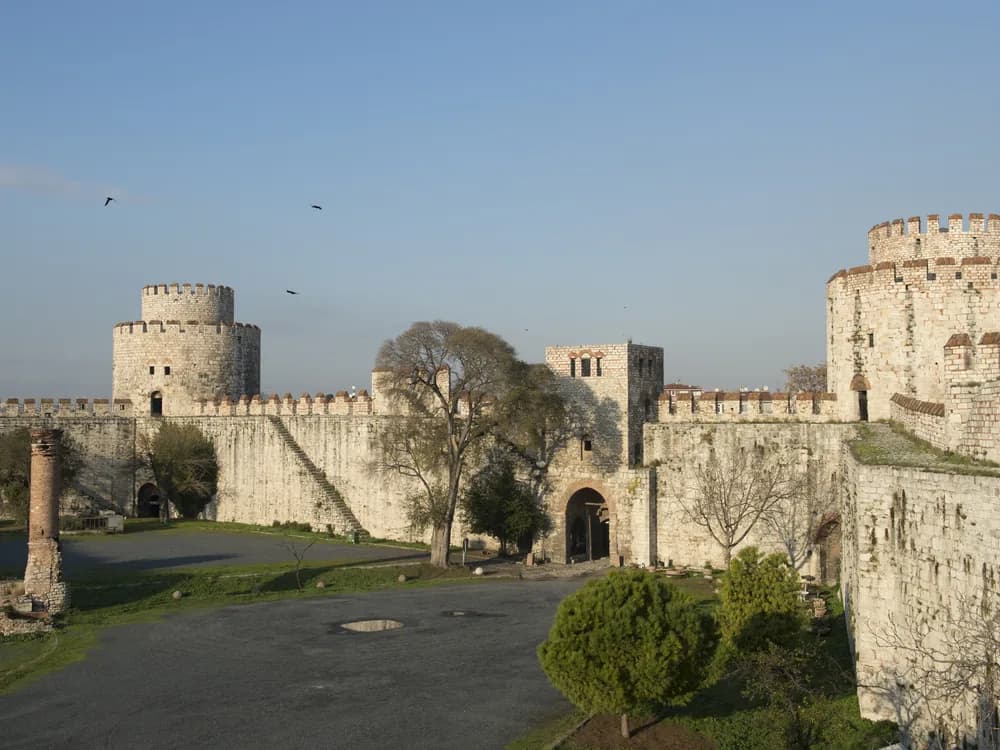
Istanbul: Theodosian Walls, Yedikule Fortress & the Golden Gate
The most formidable land fortification in European history — the walls that defended Constantinople for a thousand years, and the seven-towered fortress built where they finally fell
From
€35/ person
Rating
★ 4.8(240)
Duration
Half day (4 hours)
Rating
4.8 ★ (240 reviews)
Languages
English
Group size
Max 10 people
About This Tour
The Theodosian Walls of Constantinople are the defining military architecture of the ancient world — a triple system of walls and moats stretching 22 kilometres across the European shore of the Bosphorus, built in 412 AD and never successfully breached for over a thousand years. Twenty-three sieges failed against them. Arab armies besieged the city twice and withdrew. The Crusaders arrived and sailed around them by sea. The Bulgars, Avars, Umayyads, Abbasids, and Rus all turned back. It was not until 29 May 1453 — 1,041 years after the walls were built — that Sultan Mehmed II brought cannons powerful enough to breach them. This tour walks the surviving sections of the most impregnable fortress in European history, and visits Yedikule — the Seven Towers fortress that Mehmed II built into the walls, incorporating the Golden Gate through which Byzantine emperors had entered the city for centuries.
Highlights
- ✓Theodosian Walls (412 AD) — the triple defensive system that held Constantinople for 1,000 years against 23 sieges
- ✓Yedikule Fortress — the Seven Towers castle built by Mehmed II in 1457, incorporating the Byzantine Golden Gate
- ✓The Golden Gate — the Roman triumphal arch built by Emperor Theodosius I in 388 AD, through which emperors entered Constantinople after military victories
- ✓The site of the 1453 breach — walk the exact section of wall where Mehmed's cannons finally broke through on 29 May 1453
- ✓The Blachernae Palace ruins — the Byzantine imperial palace of the 11th-14th centuries, abandoned after 1453
- ✓Expert guide covering the full history of Constantinople from Constantine's founding in 330 AD to the Ottoman conquest
Ready to book this tour?
Free cancellation · Instant confirmation
Itinerary
The Theodosian Walls were built between 408 and 413 AD during the reign of the child emperor Theodosius II, designed by the Praetorian Prefect Anthemius. The system is triple-layered: an inner wall 12 metres high and 5 metres thick with 96 towers every 70 metres; a lower outer wall; an outer terrace; and a 20-metre-wide moat. The total depth of the defences was nearly 60 metres. The walls were built using a technique that alternated courses of stone with courses of brick in distinctive red-and-white banding. Walk the surviving southern section, examining the construction technique, the posterns (small gates for sorties), and the inscriptions recording imperial repairs over ten centuries. The guide covers the 23 failed sieges and explains why the walls held so long.
Yedikule — the 'Fortress of Seven Towers' — was built by Mehmed II between 1457 and 1458 by adding three new towers to the existing Byzantine Golden Gate complex, which itself incorporated the two flanking towers of the Theodosian Walls. The Golden Gate was originally a free-standing Roman triumphal arch built by Emperor Theodosius I in 388 AD to commemorate his victory over the usurper Magnus Maximus. As Constantinople grew, the Theodosian Walls were built on either side of the arch, incorporating it as the ceremonial main gate of the city. Byzantine emperors processed through it after military victories for a thousand years. Mehmed sealed the Golden Gate in 1453 and turned the complex into a fortress and treasury — later used as a prison for foreign ambassadors and deposed sultans. Several inscriptions and prisoner carvings survive on the tower walls.
The final section of the walk covers the northern end of the Theodosian Walls, where two critical events occurred. The Blachernae Palace — the Byzantine imperial residence from the 11th century — stood at the northern end of the walls, where the land walls meet the Golden Horn sea walls. Some of the palace structures survive, including the 'Anemas Prison' tower and the Palace Wall. Nearby, at the Edirnekapı sector, the walls were at their weakest point — the Lycus valley depression — and it was here on 29 May 1453 that Mehmed's Hungarian-made cannon ('Orban') created the breach through which Ottoman troops poured, ending the Byzantine Empire after 1,123 years.
What's Included
- ✓Professional English-speaking guide
- ✓Yedikule Fortress entry
- ✓Small group (max 10)
Not Included
- ✗Transport to and from the walls (the tour starts at Yedikule — accessible by Metro)
- ✗Lunch (multiple options near Yedikule)
Insider Tips
Wear sturdy shoes — the walk along the walls involves uneven terrain, grass-covered ruins, and some scrambling over wall sections
The Theodosian Walls are not a tourist-managed site with barriers and smooth paths — they are genuine ruins in a residential area. The rawness is part of the experience
The best photography of the walls is from the outside (west) looking east toward the towers — the internal view shows more construction detail but the exterior gives the full defensive scale
The Chora Church (Kariye Mosque) is a 10-minute walk from the northern section of the walls and contains the finest surviving Byzantine mosaics — recommended if time permits
Frequently Asked Questions
Why were the Theodosian Walls never successfully breached for a thousand years?
The combination of triple-layer depth, tower density (a tower every 70m), sea wall protection on two sides, and the extreme difficulty of supplying a siege army in the 5th-15th centuries made Constantinople essentially impregnable by pre-gunpowder siege methods. Attackers could not concentrate force at a single point because the towers provided interlocking defensive fire, and the moat prevented undermining. The walls were also continuously maintained and repaired by Byzantine emperors. It was the development of large-calibre artillery in the 15th century — specifically the Hungarian engineer Orban's cannon, which could fire a 600kg stone ball — that finally made them vulnerable.
What happened on 29 May 1453?
After a seven-week siege, Sultan Mehmed II's forces finally breached the Theodosian Walls at the Lycus valley section (near the Edirnekapı gate) in the early hours of 29 May. The last Byzantine emperor, Constantine XI Palaiologos, died fighting in the breach — his body was never conclusively identified. Mehmed entered Constantinople through the Golden Gate on the same day, ending the Eastern Roman (Byzantine) Empire that had continued in unbroken succession since Constantine founded the city in 330 AD — 1,123 years.
Can you walk on top of the Theodosian Walls?
In several sections, yes — the walls are accessible and unmanaged, allowing visitors to climb and walk along the top. This is an unusual experience compared to most European heritage sites: there are no barriers, handrails, or safety restrictions, but also no interpretive boards or managed viewing areas. The rawness of access is part of what makes the Theodosian Walls extraordinary — you can touch 1,600-year-old stonework with no intermediary.
More Tours from Istanbul
Powered by GetYourGuide
From
€35
per person
Free cancellation available on most dates · Secure booking
Meeting point
Yedikule Fortress entrance, Fatih district, Istanbul — accessible via Metro (M1A, Yedikule stop)
From
€35/ person