
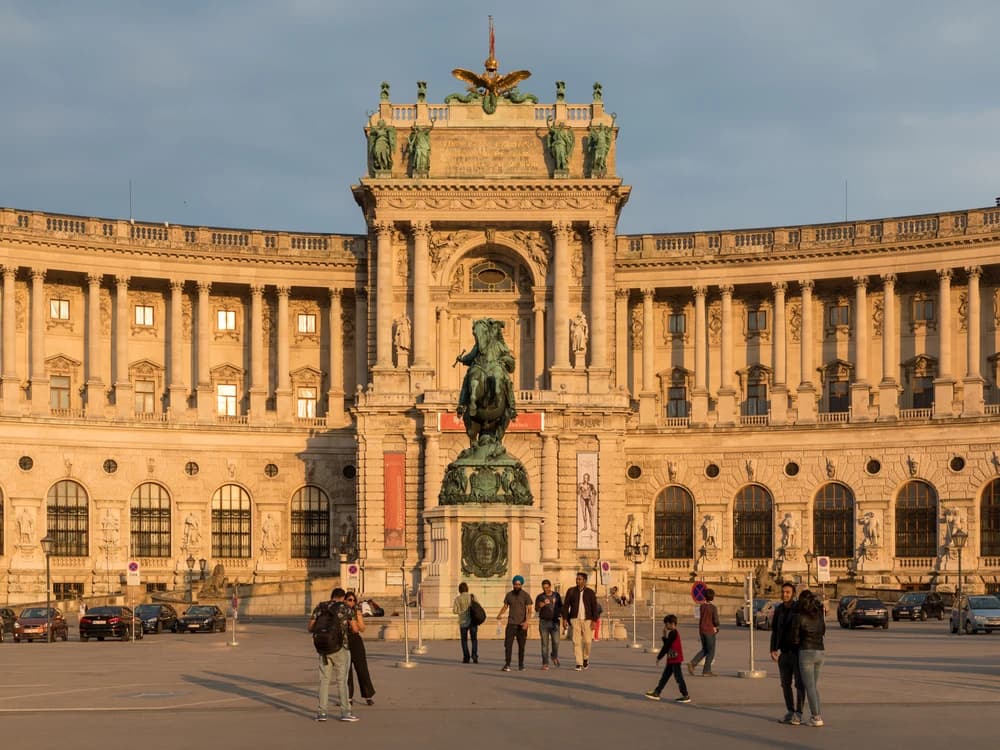
© Unsplash
Hofburg Palace
Hofburg
Austria · Vienna · Near Vienna
Built 1279 · Gothic, Renaissance, Baroque, Neoclassical
Quick Facts
- Hours
- September–June: daily 09:00–17:30. July–August: daily 09:00–18:00. Last entry 1 hour before closing. Spanish Riding School performances and training sessions run on a separate schedule — check spanischehofreitschule.com.
- Entry from
- €18
- Duration
- 2–3 hours
- Best time
- Year-round; late November to December for Vienna's famous Christmas markets in the palace forecourt
- Nearest city
- Vienna
Highlights
- ✦The Sisi Museum — the most personal portrait of Empress Elisabeth ever assembled, from her obsessive fitness equipment and travelling cosmetics case to the sash she wore when an anarchist's blade ended her life in Geneva in 1898
- ✦The Imperial Apartments of Emperor Franz Joseph — his famously austere iron military bed and the desk where he worked 18-hour days sit in stark contrast to the gold and crystal of the state rooms surrounding them
- ✦The Imperial Silver Collection — 20,000 pieces of Habsburg tableware, including a ceremonial dining service for 1,200 guests and the longest formal table setting reassembled anywhere in Europe
- ✦The Spanish Riding School in the Winter Riding School hall — Lipizzan horses performing classical equitation in an unbroken Baroque tradition dating to 1572, the oldest institution of its kind in the world
- ✦The Michaelerplatz entrance — a great triumphal arch leading straight through the palace complex to Heldenplatz and the Ringstrasse beyond
Skip the queue with a guided tour
Skip-the-line tickets & expert guides
The Hofburg is not a single palace but a living city within Vienna, and that is precisely what sets it apart from Versailles or even its own sister palace, Schönbrunn. The office of the Austrian Federal President still occupies one wing. The National Library holds another. The Spanish Riding School trains its Lipizzaner stallions in a third. Walking through the Sisi Museum or the Imperial Apartments means moving through a building that is simultaneously a 13th-century fortress, a Baroque residence, a Neoclassical monument, and a functioning seat of government — a palace that never stopped being used.
No figure haunts the Hofburg more thoroughly than Empress Elisabeth, known to history as Sisi. She despised court protocol, spent much of her reign fleeing Vienna for Hungary, Madeira, and Corfu, and has nonetheless become Austria's most commercially potent historical figure — her face sold on mugs, chocolates, and tourist posters across the city. The Sisi Museum complicates that image deliberately. Alongside the idealised official portraits, it displays her obsessive exercise regime, her extreme dieting, her travelling vanity case, and the deeply unhappy woman behind the romanticised myth. Few palace museums anywhere are this candid about the gap between image and person.
The Imperial Apartments tell a different but related story. Franz Joseph was born in this palace in 1830, worked within its walls for 68 years, and died here in 1916 as the empire he embodied fought the war that would end it. His rooms are furnished with almost shocking restraint — an iron field bed, a plain washstand, a desk piled with paperwork — set within a building whose state rooms blaze with gilt and crystal chandeliers. The contrast is the point: a working monarch's private austerity inside a structure built entirely for ceremonial display.
Step outside onto Heldenplatz, the great open square at the palace's western end, and the building's weight in modern history becomes unavoidable. It was here, in March 1938, that Hitler addressed a crowd of some 200,000 to announce the Anschluss. The Hofburg cannot and does not try to escape that history; it simply absorbs it, as it has absorbed seven centuries of additions, abdications, and reinventions before.
History
The Habsburgs began building at this site in 1279, the founding date of the Hofburg as a dynastic seat, shortly after establishing Vienna as their capital. What started as a modest medieval fortress grew, over the following seven centuries, through the addition of a new wing under nearly every reigning emperor, each building in the architectural language of his own era. The result is the most architecturally incoherent major palace in Europe — and one of its most fascinating: Gothic vaults sit beside Baroque stucco, which sits beside Neoclassical marble, with no attempt at stylistic unity across the complex.
The last great addition, the Neue Burg wing, was not completed until 1913 — one year before the First World War set in motion the collapse of the empire the palace had been built to house. Franz Joseph died at the Hofburg in 1916, having reigned for 68 years, and his successor Karl I signed his abdication from the palace in November 1918, handing the building over to the newly declared Austrian republic.
That transfer began the Hofburg's extraordinary postwar afterlife. Rather than becoming a static monument, it remained at the centre of a functioning capital: today it houses the Austrian presidency, the National Library's state hall, the Spanish Riding School, multiple museums, and the convention centre that hosts diplomatic summits, all within the same walls that once held the Habsburg court.
How to Visit
Getting there: The most dramatic approach is on foot through the Michaelertor arch from Michaelerplatz. The U3 metro stops at Herrengasse, a 3-minute walk from the palace gates. The Hofburg is also a 10-minute walk from the State Opera and the Ringstrasse museums, making it easy to combine with a wider day in central Vienna.
Tickets: The main combined ticket — Sisi Museum, Imperial Apartments, and Imperial Silver Collection — costs €18 for adults and €8 for children aged 6–18, and covers the essential Habsburg experience in one route. The Spanish Riding School requires a separate advance booking for performances, which sell out months ahead. The National Library's Baroque state hall (Prunksaal) has its own separate ticket and entrance.
Practical tips: Arrive before 10:00 to get ahead of the tour groups that build steadily from mid-morning. The Imperial Silver Collection is frequently skipped by rushed visitors — allocate an extra 30 minutes for it, the table settings are extraordinary. The palace's courtyards are free to walk through at any time and give a good sense of the complex's scale even without a ticket. Combine with Schönbrunn on the same day only if you start early — both are substantial visits in their own right.
Frequently Asked Questions
The standard combined ticket covers the Sisi Museum, the Imperial Apartments of Franz Joseph and Elisabeth, and the Imperial Silver Collection — three connected sections accessed via a single route. It costs €18 for adults and €8 for children aged 6 to 18. The Spanish Riding School, the National Library's Prunksaal, and the Hofburg's other museums (including the Treasury) require separate tickets.
Location
Michaelerkuppel, 1010 Vienna, Austria
Nearby Castles
Featured Tour
Vienna: Skip-the-Line Sisi Museum, Hofburg and Gardens Tour
Cancellation available · Instant confirmation
Tours & Tickets
Powered by GetYourGuide
Entry from
€18/ adult