
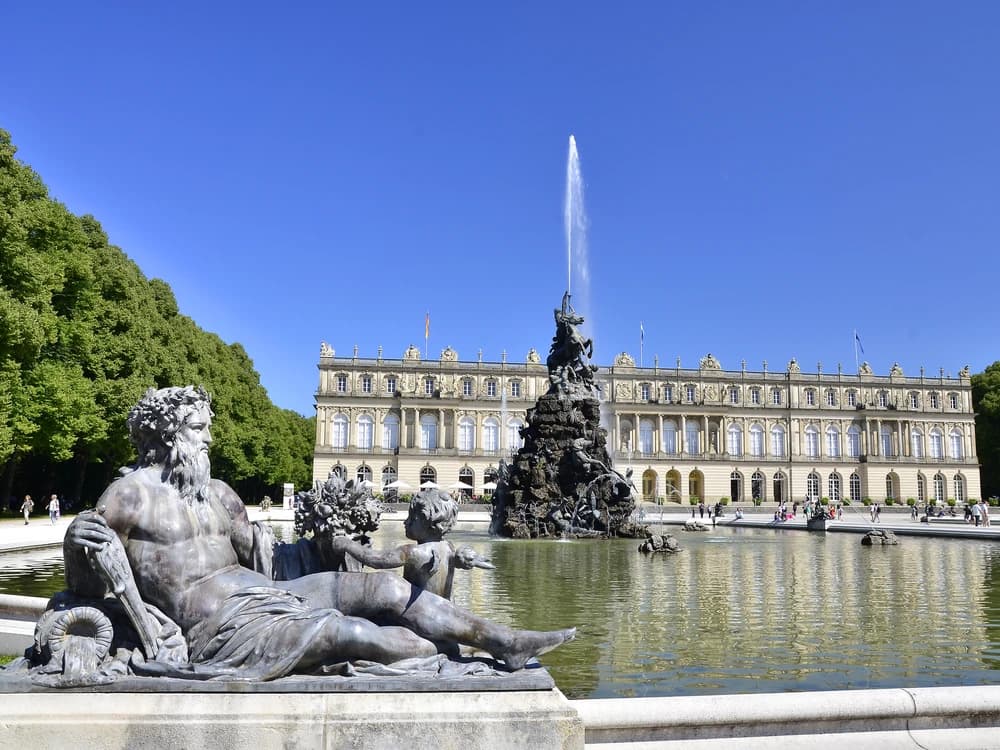
© Unsplash
Herrenchiemsee Palace
Schloss Herrenchiemsee
Germany · Bavaria · Near Prien am Chiemsee
Built 1878 · French Baroque Revival
Quick Facts
- Hours
- April–October: daily 09:00–18:00. November–March: daily 09:40–16:15, guided tour only. Last entry 40 minutes before closing. Access is by boat only — check Chiemsee-Schifffahrt's last sailing time before visiting.
- Entry from
- €10
- Duration
- 3–4 hours
- Best time
- May to October — palace open fully, gardens at their best; summer evening candlelit tours of the Hall of Mirrors are a signature experience
- Booking
- Required — book 7+ days ahead
- Nearest city
- Prien am Chiemsee
Highlights
- ✦The Hall of Mirrors — 98 metres long, an exact copy in every measurement of the Galerie des Glaces at Versailles, lit by 2,000 candles for the palace's legendary evening tours — the most dramatic room interior in Bavaria
- ✦The Marble Staircase — white Carrara marble, gilded bronzes, and a trompe-l'oeil ceiling painted to open onto a cloudless sky, the most spectacular entrance stair in Germany
- ✦The palace's haunting incompleteness — Ludwig died after just nine days in residence, and the unfinished north wing's raw stonework stands metres from rooms of elaborate gold ornament, a monument to obsession interrupted
- ✦The formal garden and Grand Canal — a reduced version of Versailles's Le Nôtre layout, with a 70-metre fountain jet, the highest in Bavaria, visible across the lake on calm days
- ✦The approach by boat across Lake Chiemsee — the only way to reach the island, with the palace appearing through pine trees from the water unlike the arrival at any other German palace
Skip the queue with a guided tour
Skip-the-line tickets & expert guides
Herrenchiemsee is the most ambitious palace King Ludwig II ever attempted, built to be larger and more faithful to Versailles than anything else in Europe — and yet he spent a total of nine days there and died before it was finished. The Hall of Mirrors, the building's centrepiece and an exact 98-metre copy of Versailles's Galerie des Glaces in every dimension, was used precisely twice in Ludwig's lifetime. No other royal building so completely separates the scale of its ambition from the reality of its use.
Ludwig's obsession with Louis XIV was not eccentricity so much as political displacement. His real power had been stripped away by Bismarck's new German Empire in 1871, reducing the Bavarian king to a ceremonial figure within a larger federal structure. Louis XIV was not a historical curiosity to Ludwig but a blueprint for a kind of absolute, divinely sanctioned kingship that no longer existed anywhere in Europe. Building an exact copy of the Sun King's most famous room was, for him, the only way left to inhabit that kind of monarchy, even if only inside his own walls.
The experience of reaching Herrenchiemsee is unlike arriving at any other palace in Germany. There is no road, no formal drive, no visible modernity at all — just a 20-minute boat crossing across Lake Chiemsee to a pine-covered island, with the palace gradually emerging through the trees rather than appearing at the end of an avenue. That approach adds a real sense of remoteness and improbability that no photograph of the building's facade quite captures.
In summer, the palace's evening candlelit tours of the Hall of Mirrors replace electric lighting with 2,000 individual candles — a single change that transforms a museum visit into something close to the experience Ludwig intended. The shimmer of candlelight across mirrored walls and gilded stucco is the closest most visitors will ever come to seeing a Baroque state room exactly as it was designed to be seen.
History
Ludwig II purchased the island of Herrenchiemsee in 1873 specifically for this project, expelling the Augustinian monastery that had occupied it. His court architect Georg von Dollmann produced the first designs that same year, closely following the layout of Versailles's north and south wings with the Hall of Mirrors as the structural and symbolic centrepiece. Construction began in 1878 and continued without pause until Ludwig's death in 1886.
The enormous and ever-rising cost of the project contributed directly to Ludwig's formal deposition. In June 1886, the Bavarian state declared him mentally unfit to rule; he was found dead in Lake Starnberg three days later, in circumstances that have never been fully explained. At the time of his death, only the central block of Herrenchiemsee was complete — the planned north wing remains an unfinished shell to this day, standing in stark contrast to the finished state rooms beside it.
The palace opened to the public in 1907, and tourism arrived almost immediately, drawn by the same combination of grandeur and tragedy that had defined Ludwig's other building projects. It has operated continuously as a visitor attraction ever since. The island's older Augustinian monastery church, known as the Altes Schloss (Old Palace), predates Ludwig's building by centuries and remains open to visitors — it houses original Carolingian-era manuscripts and the Constitutional Hall where Bavaria's first constitution was drafted in 1818.
How to Visit
Getting there: Take the regional train from Munich to Prien am Chiemsee, about 1 hour. From Prien station, the narrow-gauge Chiemseebahn railway runs to the boat jetty at Stock in around 15 minutes (about €3). From Stock, Chiemsee-Schifffahrt boats sail to Herreninsel in roughly 20 minutes (around €9 return). From the island jetty, it's a 15-minute walk through parkland to the palace itself.
Tickets: The palace can only be visited on a timed guided tour; tickets cost €10 for adults and are free for under-18s. A combined ticket covering the Old Palace museum and garden alongside the main palace tour is the best-value option. Book online to secure a slot, particularly in July and August, when tours can sell out days ahead.
Practical tips: The GetYourGuide day trip from Munich is the simplest option for visitors without a car — it handles all the train, narrow-gauge railway, and boat connections and includes guided palace access. Independent visitors should check the Chiemsee-Schifffahrt boat schedule before leaving Munich, since the last boats back from the island typically depart around 18:00. Arrive on an early boat to secure a morning tour slot. The garden and the view from the island jetty back across the lake are free to enjoy regardless of whether you have a palace ticket.
Evening candlelit tours: Available on selected dates from May to October, these Hall of Mirrors tours by candlelight sell out weeks in advance and must be booked directly through the palace administration rather than as a standard day-trip add-on.
Frequently Asked Questions
Take a regional train from Munich to Prien am Chiemsee, about an hour's journey. From there, the narrow-gauge Chiemseebahn railway connects to the boat jetty at Stock, and a Chiemsee-Schifffahrt ferry takes around 20 minutes to reach Herreninsel island, from which it's a 15-minute walk to the palace. A guided day trip from Munich is the simplest option, as it bundles all the train, railway, and boat connections into a single booking.
Location
Herreninsel, 83209 Herrenchiemsee, Germany
Nearby Castles
Featured Tour
From Munich: Herrenchiemsee Palace and Boat Trip Day-Tour
Cancellation available · Instant confirmation
Tours & Tickets
Powered by GetYourGuide
Entry from
€10/ adult