
© Unsplash
Doge's Palace
Palazzo Ducale
Italy · Veneto · Near Venice
Built 1340 · Venetian Gothic
Quick Facts
- Hours
- April–October: 09:00–19:00, last entry 18:00. November–March: 09:00–17:00, last entry 16:00. Closed 25 December and 1 January. Book tickets online in advance — walk-up queues can exceed 2 hours in summer.
- Entry via GYG
- €40
- Duration
- 2–3 hours
- Best time
- October to April — fewer crowds, lower prices, and atmospheric winter Venice light
- Booking
- Required — book 14+ days ahead
- Nearest city
- Venice
Highlights
- ✦The Bridge of Sighs — the most photographed bridge in Venice, its enclosed marble span connecting the palace's interrogation rooms to the prisons across the canal
- ✦The Sala del Maggior Consiglio — the Great Council Chamber, home to Tintoretto's Paradise, the largest oil painting in the world
- ✦The Arco Foscari and the Gothic courtyard — a gilded triumphal arch framing one of the most photogenic inner spaces in Venice
- ✦The Secret Itineraries route through the Doge's private chambers, the torture room, and the cramped lead-roofed prison cells
- ✦Seven centuries as the formal seat of the Republic of Venice's government, courts, and ceremonial state apparatus
Skip the queue with a guided tour
Skip-the-line tickets & expert guides
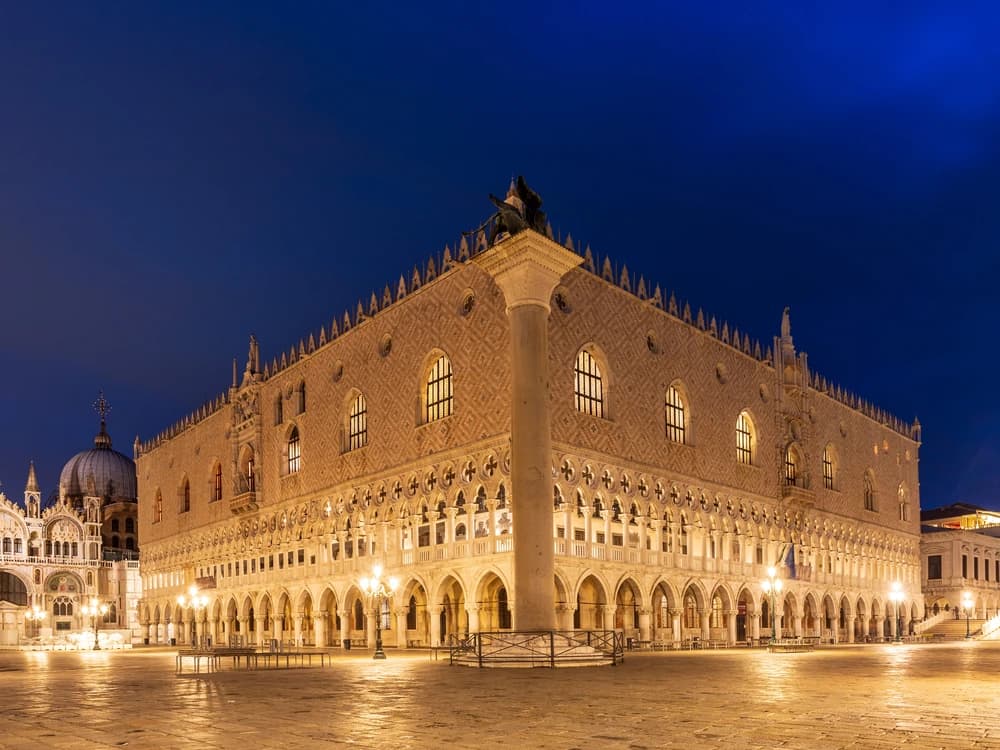
The Doge's Palace reads, from the water, as an architectural inversion: a heavy mass of pink-and-white Istrian stone seemingly floating above two delicate tiers of white marble arcades and Gothic tracery, as though the building's logic has been turned upside down. That visual trick — solid stone resting on lace-like stonework — was entirely deliberate, and it remains one of the most distinctive silhouettes in European architecture, instantly recognisable from the Piazzetta San Marco or from a boat crossing the lagoon.
Inside, the scale of Venetian political ambition becomes explicit. The Sala del Maggior Consiglio, the chamber where up to 2,000 noble members of the Great Council once gathered, is dominated by Tintoretto's Paradise — at roughly 7 by 22 metres, the largest oil painting on canvas in the world. Room after room of the palace's piano nobile is given over to enormous canvases by Veronese and Tintoretto celebrating Venetian naval victories, allegories of justice, and the personification of Venice itself as a serene, golden goddess presiding over the seas. The message, repeated relentlessly across ceilings and walls, is that Venice's wealth and power were divinely sanctioned.
The Bridge of Sighs delivers a sharper experience. Walking through it from the palace side, enclosed marble lattice windows on either side, visitors cross directly from the rooms where the Council of Ten interrogated prisoners into the cramped stone cells of the Doge's prisons. The bridge's name comes from the sighs of condemned prisoners taking their last glimpse of Venice through the small barred openings before disappearing into the cells — a story embellished by 19th-century Romantic writers, but rooted in something real: the physical and symbolic transition from open civic grandeur to total confinement happens within metres.
That contrast — between the painted ceilings of state rooms built to overwhelm visiting ambassadors and the dank, low-ceilinged prison cells directly beneath and across from them — is what makes a visit to the Doge's Palace different from touring any other Renaissance palace. Venice's republic was at once magnificent and ruthless, and the building's two faces sit only a bridge apart.
History
A fortified residence for the Doge, the elected head of the Republic of Venice, has stood on this site since at least 814 CE, when the seat of Venetian government moved from Malamocco to the islands of the Rialto. That early structure was repeatedly rebuilt and expanded over the following centuries, taking on a Byzantine-influenced form before fire and changing taste led the Republic to commission something grander.
The Gothic palace recognisable today was built mainly between 1340 and 1424, replacing the older Romanesque-Byzantine structure on the Piazzetta side and then extending the same style around to the waterfront. Construction proceeded in phases as the Republic's wealth and confidence grew, with the distinctive arcaded façades and ornate tracery completed in stages across nearly a century — an unusually long building campaign that nonetheless produced one of the most stylistically coherent Gothic buildings in Italy.
Two catastrophic fires, in 1574 and 1577, destroyed much of the original painted decoration in the state rooms, including earlier cycles by Gentile Bellini and others. The Republic responded not by retreating but by commissioning an even more ambitious redecoration, turning to Tintoretto and Veronese for the enormous canvases that now define the palace's interior — a direct expression of Venetian self-confidence at a moment when the Republic's Mediterranean trading empire, though past its absolute peak, still commanded immense wealth and political weight.
The palace remained the working seat of Venetian government, courts, and state ceremony for the entire life of the Republic, until Napoleon's forces dissolved it in 1797, ending over a thousand years of Venetian independence. The building was subsequently used for various administrative purposes under French and then Austrian rule before opening as a public museum in the 20th century, a role it has held ever since as one of the most visited sites in Venice.
How to Visit
Getting there: Take vaporetto (water bus) Line 1 or 2 to the San Marco–San Zaccaria stop, a short walk from the palace entrance. From the Rialto Bridge, it is about a 15-minute walk through the calli to Piazza San Marco.
Tickets: Reserved entry tickets cover the main museum route, including the state rooms, the Bridge of Sighs, and the prisons. The Secret Itineraries guided tour is a separate, smaller-group experience covering hidden rooms not on the standard route, including the torture chamber and the Doge's private offices — book this in advance as spaces are limited. Both ticket types are available through GetYourGuide.
Timing: Arrive for the first entry slot at 09:00 to beat the bulk of day-tour groups, which tend to arrive from mid-morning onward. Without a timed ticket, walk-up queues in July and August can run well over two hours.
Combine with: St Mark's Basilica is directly adjacent on the Piazzetta — a separate ticket is required, but the proximity makes pairing the two natural. The standard Doge's Palace ticket also grants admission to the Museo Correr and the Museo Archeologico Nazionale, both on Piazza San Marco, making it worth allocating a full day to the museum complex.
Frequently Asked Questions
The Bridge of Sighs is an enclosed marble bridge connecting the Doge's Palace to the adjoining prisons across a narrow canal. Prisoners convicted by the Council of Ten were led across it from interrogation to incarceration, and the bridge's name — coined by later Romantic writers — refers to the sighs of condemned prisoners catching their last view of Venice through its small barred windows. It can be crossed as part of the standard palace visit and is one of the most photographed structures in the city, though only from the outside; the famous exterior view is from the adjacent Ponte della Paglia.
Location
Piazza San Marco, 1, 30124 Venice, Italy
Nearby Castles
Featured Tour
Venice: Doge's Palace Reserved Entry Ticket
Cancellation available · Instant confirmation
Tours & Tickets
Powered by GetYourGuide
Entry from
€30/ adult