
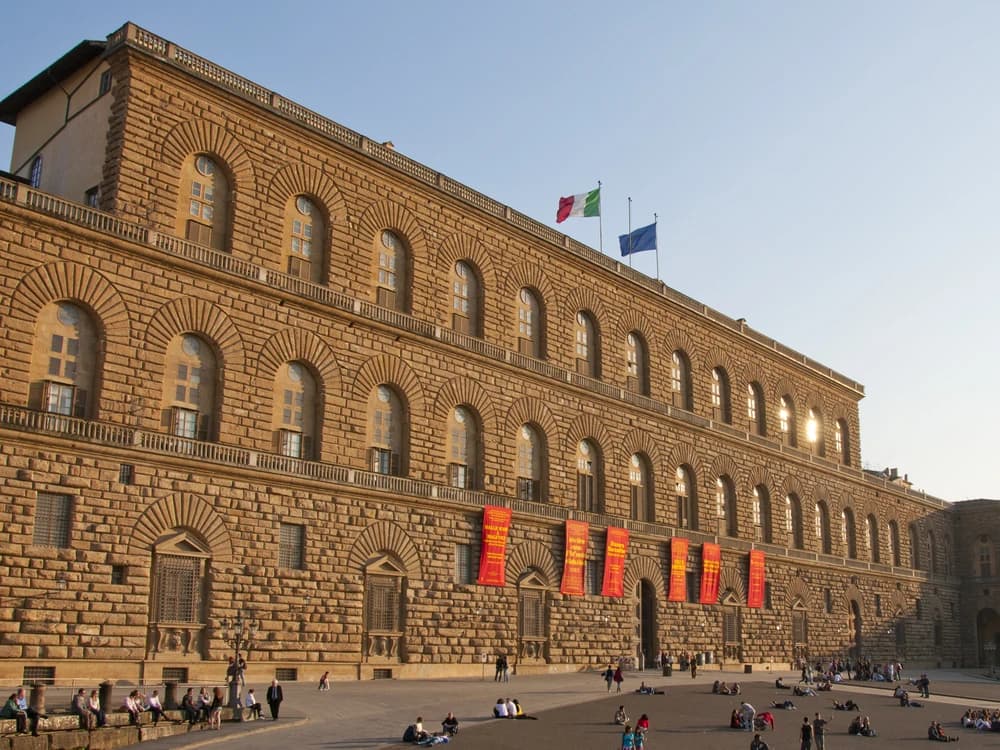
© Unsplash
Palazzo Pitti
Pitti Palace
Italy · Tuscany · Near Florence
Built 1458 · Renaissance, Baroque
Quick Facts
- Hours
- Tue–Sun 08:15–18:30 (last entry 17:30), closed Mondays. Boboli Gardens close earlier in winter (as early as 16:30) and later in summer — check the same-day timing separately from the palace galleries.
- Entry from
- €22
- Duration
- 3–5 hours
- Best time
- April to June and September to October — Boboli Gardens in bloom, comfortable temperatures; avoid August heat
- Booking
- Required — book 7+ days ahead
- Nearest city
- Florence
Highlights
- ✦The Palatine Gallery — the Medici's private art collection hung exactly as they collected it, floor to ceiling, without chronological order; Raphael's La Velata, La Donna Gravida and Madonna della Sedia all visible in adjacent rooms
- ✦The Boboli Gardens — the first terraced hillside garden in Europe, laid out from 1549 and the template for every Italian formal garden since, with an amphitheatre, grottoes, fountains and the Isolotto island garden
- ✦The Royal Apartments — the state rooms of the Savoy monarchs after Italian unification in 1861, still furnished as in the 19th century, offering a different reading of Italian history from the Renaissance rooms around them
- ✦The Treasure of the Grand Dukes — the Medici's pietre dure collection of hardstone inlay, crystal vessels, amber carvings and gem-set objects, the finest intact collection of Renaissance princely objects in Europe
- ✦The Silver Museum (Museo degli Argenti) — the Medici jewellery, 17th-century table silver, and 16 intarsia panels by Giovanni da Udine depicting Lorenzo the Magnificent's antique vase collection, still in its original arrangement
Skip the queue with a guided tour
Skip-the-line tickets & expert guides
The fundamental difference between the Pitti and the Uffizi is one of intention. The Uffizi was always a public institution, built to display the Medici's civic collection in a logical, didactic sequence. The Pitti was their private home, and the Palatine Gallery still hangs its paintings the way a wealthy Renaissance family actually lived with art: layered, contextual, and dense, with no chronological path and no room-by-room explanatory sequence — just accumulation, masterpiece beside masterpiece, exactly as the Medici arranged it.
The Boboli Gardens, rising in terraces up the hillside behind the palace, are arguably Florence's most affecting landscape experience even if they are not its most famous attraction. Laid out from 1549, they were the first terraced hillside garden in Europe and the direct template for every Italian formal garden that followed. Cypress allées, hidden grottoes, and the Isolotto's garden island combine into the sense of standing inside a 500-year-old idea of what a garden should be, with the Florentine skyline and the Duomo visible from the upper terraces.
The building's origin is an irony the Medici would have appreciated. The Pitti family commissioned the palace in 1458 specifically to outdo the Medici in grandeur, and ran out of money within a decade. The Medici bought the half-finished building from the bankrupted Pittis in 1549, made it their principal family residence, and filled it with everything the Pittis had tried to surpass them with — a long, slow act of dynastic revenge played out in marble and paint.
Unlike the Uffizi and the Accademia, the Pitti sits across the Arno in the Oltrarno — the neighbourhood of craftsmen's workshops and local restaurants that most of Florence's visitors never reach. Coming here means crossing the Ponte Vecchio and arriving in a different, quieter Florence, one defined by artisan studios rather than souvenir stalls.
History
The Florentine banker Luca Pitti commissioned the palace around 1458 from a design associated with Filippo Brunelleschi's circle, an act of open competitive ambition against the Medici family he both served and resented. The Pittis overreached badly: the family's fortunes collapsed within a decade of construction beginning, leaving the building unfinished and the family unable to maintain it.
Cosimo I de' Medici purchased the half-built palace from the bankrupted Pittis in 1549. His wife, Eleonora of Toledo, made it the Medici family's main residence and that same year commissioned the landscape architect Niccolò Tribolo to lay out the Boboli Gardens on the hillside behind it. Over the following two centuries the building grew enormously under continuous Medici expansion — from Brunelleschi's original seven-bay facade to the 32-bay structure visible today — with wings added by Bartolomeo Ammannati and later architects, and the Palatine Gallery's core collection assembled through systematic 17th-century acquisitions, including key works by Raphael.
After the last Medici grand duke died without heirs in 1737, the palace passed to the Lorraine grand dukes of Tuscany. The House of Savoy then used it as their royal residence between 1865 and 1871, during the brief period when Florence served as the capital of a newly unified Italy. The palace and its collections were donated to the Italian state in 1919, and it has operated as a major public museum complex ever since.
How to Visit
Getting there: From the Ponte Vecchio, cross the bridge and continue straight ahead through Piazza Santa Felicita for about 5 minutes to reach Piazza de' Pitti. From the Uffizi, it's a 10-minute walk across the same bridge. By bus, routes C3 and D both stop near the Pitti. The palace sits in the Oltrarno, one of the most pleasant neighbourhoods in Florence simply to walk through.
Tickets: The combined ticket — covering the Palatine Gallery, Royal Apartments, Gallery of Modern Art, Silver Museum, Costume Gallery, Boboli Gardens and Bardini Garden — costs €22 for adults and is the best value for a full visit. Individual section tickets exist but rarely make sense unless time is very limited. Book online in advance, particularly in spring and summer, as timed-entry slots can sell out.
Practical tips: Start with the Palatine Gallery as soon as the palace opens — it gets crowded by 11:00. Allow a minimum of 90 minutes for the gallery alone. Save the Boboli Gardens for the afternoon, when the light is at its best and the gardens remain open after the palace galleries close. The upper terrace offers one of the finest views in Florence, looking over the rooftops to the Duomo and Fiesole beyond. The small enoteca inside the gardens is a rare chance to eat and drink within a Renaissance garden.
Combine with: The craftsmen's workshops of Via Maggio and Borgo San Jacopo, and the Brancacci Chapel in Santa Maria del Carmine with Masaccio's frescoes, a 10-minute walk away and a quiet alternative to the crowds in the main tourist centre.
Frequently Asked Questions
The Uffizi was built as the Medici's public administrative offices and civic art gallery, with paintings arranged in a curated, chronological sequence. Palazzo Pitti was the Medici's actual family residence, and its Palatine Gallery still displays paintings the way the family lived with them — densely hung floor to ceiling without strict chronological order. The two sites also hold separate, complementary collections, including major Raphael works at the Pitti.
Location
Piazza de' Pitti, 1, 50125 Florence, Italy
Nearby Castles
Featured Tour
Florence: Pitti Palace, Boboli Garden and Palatine Gallery Tour
Cancellation available · Instant confirmation
Tours & Tickets
Powered by GetYourGuide
Entry from
€22/ adult