
© Unsplash
Castle of the Moors
Castelo dos Mouros
Portugal · Sintra / Lisbon District · Near Lisbon
Built 800 · Moorish / Early Medieval
Quick Facts
- Hours
- Open daily 09:30–20:00 (Jun–Sep); 10:00–18:00 (Oct–May). Last entry 1 hour before closing.
- Skip-the-line from
- €12
- Duration
- 1–2 hours
- Best time
- Spring and autumn for clear views; avoid summer midday heat on the exposed ramparts
- Nearest city
- Lisbon
Highlights
- ✦Built by the Moors in the 8th–9th century — one of the oldest surviving fortifications on the Iberian Peninsula
- ✦The rampart walk offers 360° views: Sintra village, Pena Palace, and on clear days the Atlantic Ocean
- ✦Perched on a granite ridge in the UNESCO-listed Sintra Cultural Landscape
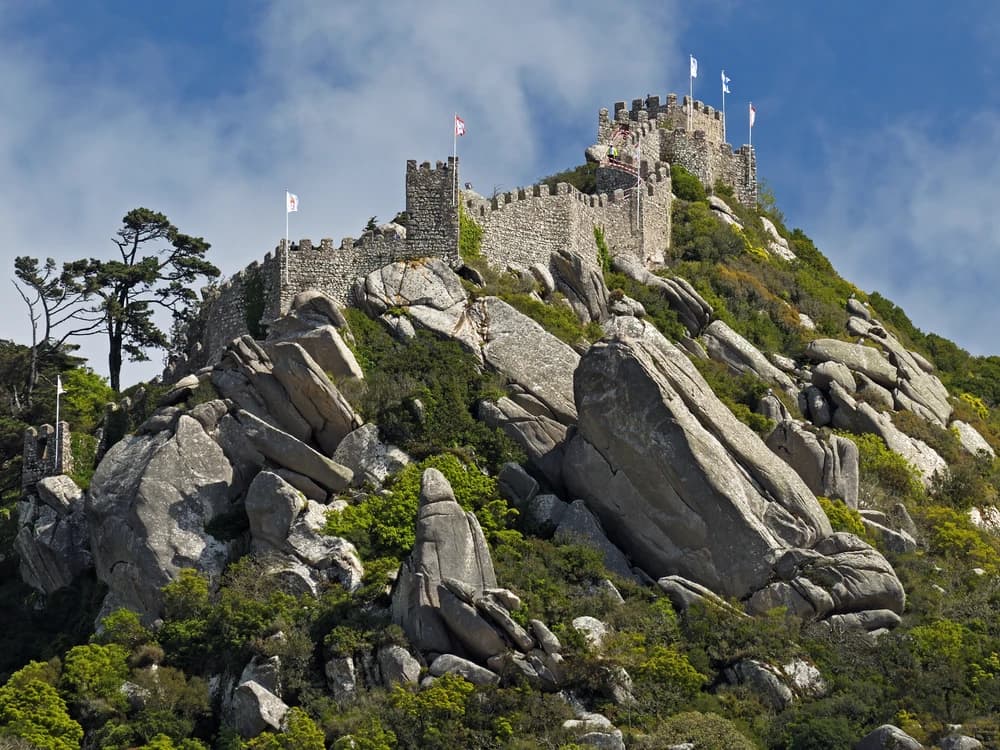
- ✦The 5 towers and 1-kilometre curtain wall are substantially intact after 12 centuries
- ✦Captured by Afonso Henriques in 1147 — the same campaign that founded Portugal as a kingdom
Skip the queue with a guided tour
Skip-the-line tickets & expert guides
The Castelo dos Mouros crests the granite ridge above Sintra like a crown — a 1.2-kilometre curtain wall running along the exposed rock, punctuated by five rectangular towers, with the village of Sintra visible far below and, on clear days, the Atlantic Ocean glinting on the horizon 20 kilometres to the west. It is one of the oldest surviving military fortifications on the Iberian Peninsula, built by North African Moors sometime in the 8th or 9th century to defend the strategic passes through the Serra de Sintra. Standing on those ramparts today, the view is essentially identical to what a Moorish garrison would have seen in 900 AD.
The castle was captured by Afonso Henriques in 1147, the same year he took Lisbon from the Moors — the twin victories that effectively consolidated the Kingdom of Portugal. After the Christian reconquest, the castle lost its strategic importance and gradually fell into disrepair. By the 19th century it was a romantic ruin, and Ferdinand II of Portugal — who also created the fantasy palaces of Sintra including Pena Palace visible on the neighbouring hilltop — ordered a romantic restoration that preserved the walls while adding some 19th-century Gothic touches.
Visiting the Castelo dos Mouros is a completely different experience from Pena Palace next door. Where Pena is colourful, crowded, and architecturally extravagant, the Moorish Castle is stark, exposed, and elemental — just stone walls, rocky hillside, and sky. The rampart walk demands some physical effort (steep stone paths, no shade in summer) but the views justify every step. On a clear day you can see the palaces of Queluz, the Tagus estuary, Lisbon, and the open Atlantic all at once.
History
The Castelo dos Mouros was constructed by Moorish forces between the 8th and 10th centuries on a commanding granite ridge of the Serra de Sintra, approximately 412 metres above sea level. The ridge's position — controlling routes between Lisbon and the Atlantic coast — made it a priority defensive installation during the Moorish occupation of most of the Iberian Peninsula.
The castle fell to Afonso Henriques, first King of Portugal, in 1147 as part of his conquest of western Iberia from the Moors. The Christian forces used it briefly as a garrison before its strategic importance declined. By the 14th century it had been largely abandoned. Medieval chronicles record that King Afonso II died at Sintra in 1223 — though not at the castle itself, which was already becoming a ruin by that point.
The castle's second life came in the 19th century when Ferdinand II, the 'Artist King' and husband of Queen Maria II, acquired the Sintra hillside. Ferdinand had the castle's walls stabilised and cleared of vegetation — creating the romantic ruin walk that visitors experience today. The entire Sintra Cultural Landscape, including the Castelo dos Mouros and the surrounding palaces, was declared a UNESCO World Heritage Site in 1995.
How to Visit
Getting there from Lisbon: Take the scenic train from Rossio station in central Lisbon to Sintra (about 40 minutes, runs every 20–30 minutes). From Sintra station, bus 434 runs a circuit to the castle (about 15 minutes). Alternatively, the climb on foot from the village is strenuous but rewarding — about 45 minutes uphill.
Tickets: The castle has its own entrance ticket (€10). A combined ticket with Pena Palace (€22) offers better value if visiting both — highly recommended, as they are adjacent and the contrast between them is one of the highlights of Sintra. Book combined tickets in advance in summer as Pena Palace can sell out.
Best strategy for Sintra: Arrive early (before 10:00) to avoid the worst of the crowds and the midday heat on the exposed ramparts. Start at the Moorish Castle (lower down, shorter queue), then walk up to Pena Palace. Return to Sintra village for lunch and the National Palace in the afternoon.
What to wear: Sturdy shoes essential — the ramparts are steep and the rock surface can be slippery when wet. No shade on the walls; bring water and sun protection in summer.
Frequently Asked Questions
Absolutely yes — and the two complement each other perfectly. They are adjacent on the same ridge and covered by a combined ticket. The Moorish Castle gives you austere medieval history, sweeping open views, and fresh air on the ramparts. Pena Palace gives you 19th-century Romantic fantasy, colour, and furnished interiors. Together they represent two completely different chapters of Sintra's history and two completely different architectural sensibilities. Allow 1 hour for each.
Location
Estrada da Pena, 2710-609 Sintra, Portugal
Nearby Castles

Featured Tour
Sintra: Castle of the Moors Skip-the-Line Ticket + Audio Guide
Cancellation available · Instant confirmation
Tours & Tickets
Powered by GetYourGuide
Entry from
€10/ adult