
© Unsplash
Orava Castle
Oravský hrad
Slovakia · Orava / Žilina Region · Near Žilina
Built 1267 · Gothic / Renaissance / Baroque
Quick Facts
- Hours
- Open daily May–Sep 08:30–18:00; Oct–Apr 08:30–16:00. Guided tours only — last tour 1 hour before closing. Closed Jan–Feb on weekdays in low season.
- Entry from
- €10
- Duration
- 1.5–2 hours
- Best time
- May to October — the approach road and Orava River valley are spectacular
- Nearest city
- Žilina
Highlights
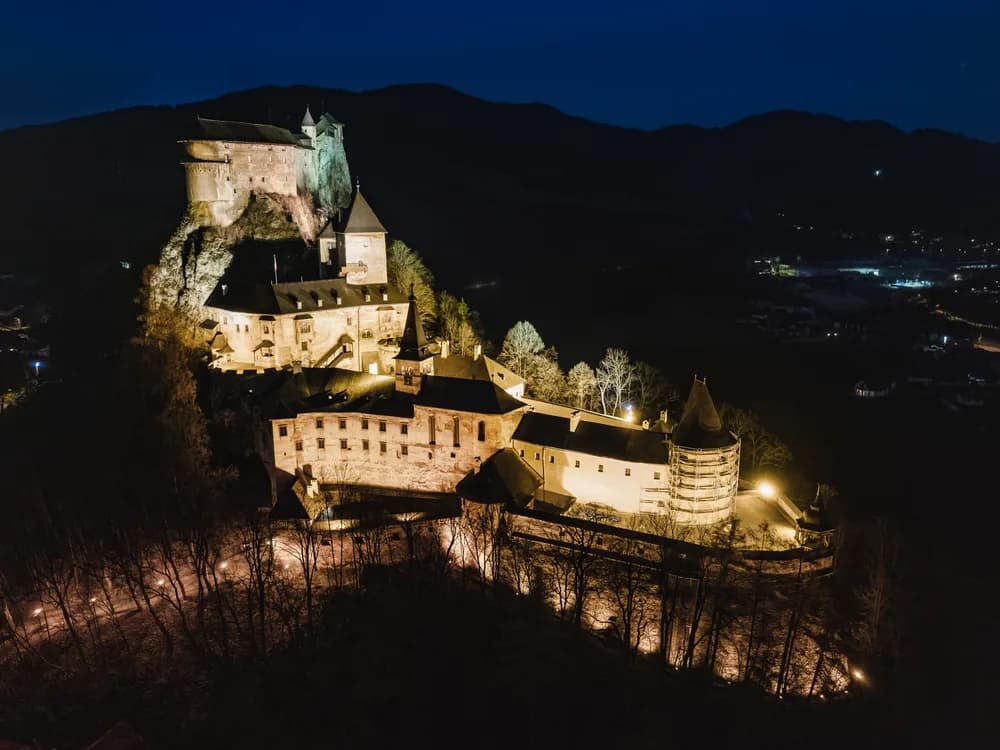
- ✦Built on a sheer 112-metre dolomite rock rising directly from the Orava River — one of the most dramatic castle positions in Central Europe
- ✦The set for F.W. Murnau's Nosferatu (1922), the most famous vampire film ever made
- ✦Three separate castle sections built at different heights correspond to different centuries of occupation
- ✦One of the most visited cultural monuments in Slovakia, yet still relatively unknown outside Central Europe
- ✦The view from the upper castle down to the Orava River winding through the valley is genuinely breathtaking
Skip the queue with a guided tour
Skip-the-line tickets & expert guides
Orava Castle does not gradually reveal itself — it ambushes you. Driving through the Orava River valley, between forested Slovak hills, you round a bend and there it is: a white castle erupting from a sheer dolomite rock 112 metres above the river, three tiers of walls and towers stacked up the face of what appears to be a vertical cliff. It is one of the most startling castle sights in Central Europe, and it was this quality — the expressionist drama of a fortress growing impossibly from bare rock — that brought F.W. Murnau here in 1921 to film the exteriors of Nosferatu.
The castle's three sections reflect its construction across three centuries. The Lower Castle (15th century) sits closest to the river; the Middle Castle (14th–15th century) rises above it; and the Upper Castle, with the oldest surviving tower from the 13th century, crowns the very summit of the rock. The distinction between the sections is visible in the building materials and architectural styles — Gothic masonry in the upper sections, Renaissance loggia in the middle, later additions throughout.
The interior museum contains historical furnishings, weapons, and — fittingly — an exhibition dedicated to vampires and the Nosferatu connection. The guided tour of the castle takes visitors through all three sections, including areas of the cliff-face path that require some head for heights. The final climb to the upper tower, with the Orava River curving far below and the Tatra Mountains visible on the horizon, makes the effort worthwhile many times over.
History
The Orava region — now in north-western Slovakia near the Polish border — was a contested borderland between the medieval Hungarian kingdom and Poland. The castle at Orava appears in written records from 1267, when it was already an established royal fortress controlling the mountain pass and the Orava River trade route.
The castle passed through royal Hungarian ownership before being granted to various noble families. Its most significant expansion came under the Thurzo family in the 16th and early 17th centuries, when the Renaissance loggia, new towers, and the chapel were added. The Thurzo family also gave the castle its most enduring legend: Gábor Bethlen, later Prince of Transylvania, was imprisoned here in the early 17th century.
A major fire in 1800 devastated much of the castle, destroying the roofs and leaving it as a ruin for over a century. Restoration work began in the 1950s and continued through the communist period, restoring the roofs and opening the castle to visitors. Today it operates as a branch of the Orava Museum. F.W. Murnau used the castle exteriors for the Transylvanian castle scenes in Nosferatu (1922), making it permanently associated with the most influential vampire film in cinema history.
How to Visit
Getting there: Orava Castle is in the village of Oravský Podzámok, about 120 km north of Žilina. By car from Žilina, the drive takes about 1.5 hours via the E77 and regional roads through the Orava valley. By train, take the regional service from Žilina towards Trstená and alight at Oravský Podzámok station (about 1.5 hours) — the castle is visible from the train platform. From Bratislava, the drive takes about 3 hours.
The ascent: The castle is reached on foot from the village below — the climb takes about 20 minutes on a steep path. There is no lift or cable car. The path passes through all three castle sections sequentially, so the tour structure follows the ascent naturally.
Combine with: The Orava valley is one of the most scenic areas of Slovakia, and the Orava dam lake (Oravská priehrada) 10 km north is worth a stop. The High Tatras ski and hiking resort area is about 60 km east and easily combined in a longer Slovakia itinerary.
Frequently Asked Questions
Yes — F.W. Murnau's Nosferatu (1922), the first and most influential film adaptation of Bram Stoker's Dracula, used Orava Castle for the exterior scenes of Count Orlok's Transylvanian fortress. Murnau filmed in Slovakia and Germany in 1921, using real locations rather than studio sets to achieve the expressionist atmosphere the film is famous for. The castle's appearance in Nosferatu is still recognisable today and is celebrated in an exhibition inside the museum.
Location
Oravský Podzámok 566, 027 41 Oravský Podzámok, Slovakia
Nearby Castles
Tours & Tickets
Powered by GetYourGuide
Entry from
€10/ adult