
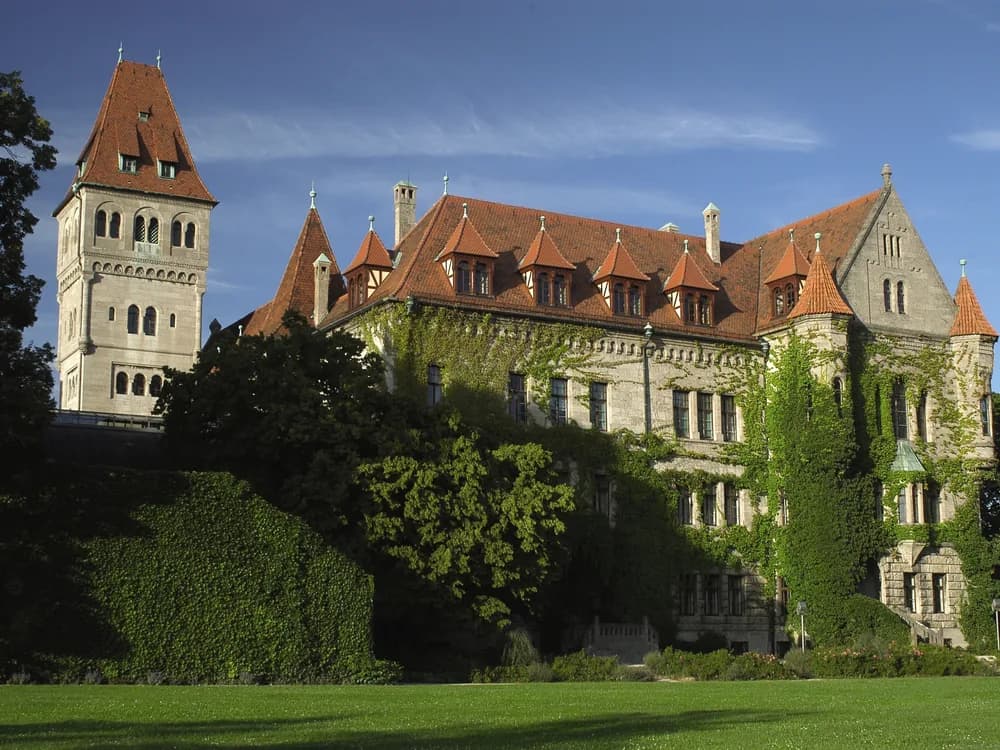
© Castles & Palaces
Faber-Castell Castle
Schloss Faber-Castell
Germany · Bavaria · Near Nuremberg
Built 1760 · Neo-Gothic; original 18th-century manor house transformed 1843 by Baron Lothar von Faber into a neo-Gothic castle with towers and crenellations; enlarged 1874–1877 by Count Ottmar II; the castle is the headquarters and ancestral seat of Faber-Castell, the world's oldest pencil manufacturer (founded 1761)
Quick Facts
- Hours
- Open year-round by guided tour only. Booking at least 3 days in advance is strongly recommended, as tours regularly fill up.
- Entry from
- €14
- Duration
- 1.5 hours
- Best time
- Year-round
- Booking
- Required — book 3+ days ahead
- Nearest city
- Nuremberg
Highlights
- ✦The global headquarters and ancestral seat of Faber-Castell, founded in 1761 and the world's oldest pencil manufacturer, still family-owned today
- ✦Transformed from an 18th-century manor house into a neo-Gothic castle in 1843 by Baron Lothar von Faber, who also invented the modern hexagonal pencil and the H–HB–B grading system
- ✦The top-rated guided tour on this site (4.9★), including original 19th-century pencil-making equipment and a 25% discount in the factory shop
- ✦Countess Ottilie von Faber-Castell's transformation of the company into a global luxury brand, run from the castle through both World Wars
- ✦Faber-Castell pencils were tested by NASA as a zero-gravity writing instrument and flew on the Apollo Moon missions
Skip the queue with a guided tour
Skip-the-line tickets & expert guides
Eight kilometres south of Nuremberg, in the small town of Stein, a neo-Gothic castle rises above the River Rednitz — towers, battlements, and a main gate that could belong to a romantic 19th-century novel. This is Schloss Faber-Castell, the ancestral seat of the Faber-Castell family and the global headquarters of the world's oldest pencil manufacturer. The company was founded in 1761, the same year Mozart was born and three years before James Watt patented his steam engine. The castle, rebuilt in its current neo-Gothic form during the 19th century, houses one of the most unusual family business histories in Germany — a story involving revolutionary manufacturing innovation, a countess who rebranded the company into a luxury empire, and pencils that have travelled into space.
The pencil, as a manufactured object with a reliable graphite core set in a wooden case, is an invention of the 16th century. But it was Kaspar Faber, a cabinetmaker working in Stein, who in 1761 began producing pencils systematically and commercially, establishing the workshop that would grow into a global enterprise. The graphite came from Borrowdale in England, at the time the world's only known source of pure, high-quality graphite. Faber's real innovation was standardisation: producing pencils to consistent dimensions and reliable quality grades, something no manufacturer had previously attempted at scale. By the time Kaspar's great-grandson Lothar von Faber inherited the company in 1839, it was already the largest pencil manufacturer in the world.
Lothar von Faber was a man of considerable ambition, both commercial and social. In 1843 he transformed the family's modest 18th-century manor house at Stein into a neo-Gothic castle, complete with towers, crenellations and a degree of architectural grandeur previously associated with the aristocracy rather than industrialists. He pursued the same ambition with the company itself: he introduced the hexagonal pencil, which does not roll off a desk, developed the standardised hardness grading system (H, HB, B) that the entire pencil industry still uses today, and lobbied the Bavarian government to protect his brand against inferior imitations flooding the market. He also lobbied, successfully, for his own elevation to the nobility. The Faber-Castell name itself arrived a generation later, through his granddaughter Ottilie, who in 1898 married Count Alexander zu Castell-Rüdenhausen, merging the family's commercial name with an aristocratic lineage.
The most consequential figure in the company's modern history is Countess Ottilie von Faber-Castell, who inherited the company in 1896 and ran it with extraordinary energy until her death in 1944. She repositioned Faber-Castell as a luxury brand, developing high-quality artist pencil ranges, expanding into school supplies, and steering the company through two World Wars with considerable commercial skill. She also hosted a notable salon at the castle, entertaining artists, musicians and members of the European aristocracy in rooms that had, only a few decades earlier, belonged to a provincial manor house. The current head of the family, Count Anton von Faber-Castell, is her direct descendant.
The guided tour of the castle covers its staterooms — the banqueting hall, the drawing rooms, the library — which display Faber-Castell family portraits spanning six generations, original 19th-century pencil-making equipment, and objects illustrating the company's unexpectedly vast global reach. Faber-Castell pencils were supplied for use around the first Moon landing, and NASA separately tested the company's pencils as a reliable zero-gravity writing instrument for use aboard spacecraft. The tour includes a souvenir and a 25 percent discount at the adjoining Faber-Castell factory shop, a genuinely useful benefit for anyone with an appreciation for stationery, which at this level of craftsmanship edges toward connoisseurship.
The factory adjoining the castle still manufactures pencils in Stein today. The company has deliberately resisted relocating production to lower-cost countries, arguing that consistent quality depends on the accumulated expertise of a workforce that has made pencils on this same site for over 260 years. Faber-Castell currently produces roughly 2.3 billion pencils annually, and remains, after eight generations, a family-owned company.
History
Kaspar Faber founded what would become the Faber-Castell company in Stein in 1761, establishing a workshop dedicated to the systematic, standardised manufacture of pencils using graphite imported from Borrowdale in England. The business passed down through successive generations of the Faber family, reaching its 19th-century commercial peak under Lothar von Faber, who inherited the company in 1839, became its largest manufacturer worldwide, and in 1843 transformed the family's existing manor house into the neo-Gothic castle that stands today, later enlarged between 1874 and 1877 under Count Ottmar II.
The family name and lineage merged in 1898, when Lothar von Faber's granddaughter Ottilie married Count Alexander zu Castell-Rüdenhausen, creating the Faber-Castell name. Ottilie inherited and ran the company from 1896 until her death in 1944, repositioning it as an international luxury and quality brand and steering it through both World Wars. The castle remains the ancestral seat and global headquarters of the still family-owned company, with the adjoining factory continuing to manufacture pencils on the same site where Kaspar Faber began production over 260 years ago.
How to Visit
Getting there: Stein is 8km from Nuremberg, served by S-Bahn line S1 to Stein station (17 minutes from Nuremberg Hauptbahnhof). The castle is a 10-minute walk from the station.
Booking: Booking is strongly recommended — tours regularly fill up, and the castle advises reserving at least 3 days in advance.
Tickets: GYG tour t922369 is rated 4.9★ from 32 reviews, the highest-rated tour on this site, and includes a souvenir and a 25% discount at the Faber-Castell factory shop. Tours run in both English and German.
Frequently Asked Questions
It is not recommended. Tours of Schloss Faber-Castell run at set times and regularly sell out, and the company advises booking at least three days in advance. Walk-in availability cannot be relied upon, particularly during busier periods, so reserving a place ahead of a visit to Stein is the safer approach.
Location
Mozartstraße 3, 90547 Stein, Germany
Nearby Castles
Featured Tour
Stein near Nuremberg: Faber-Castell Castle Guided Tour
Cancellation available · Instant confirmation
Tours & Tickets
Powered by GetYourGuide
Entry from
€14/ adult