
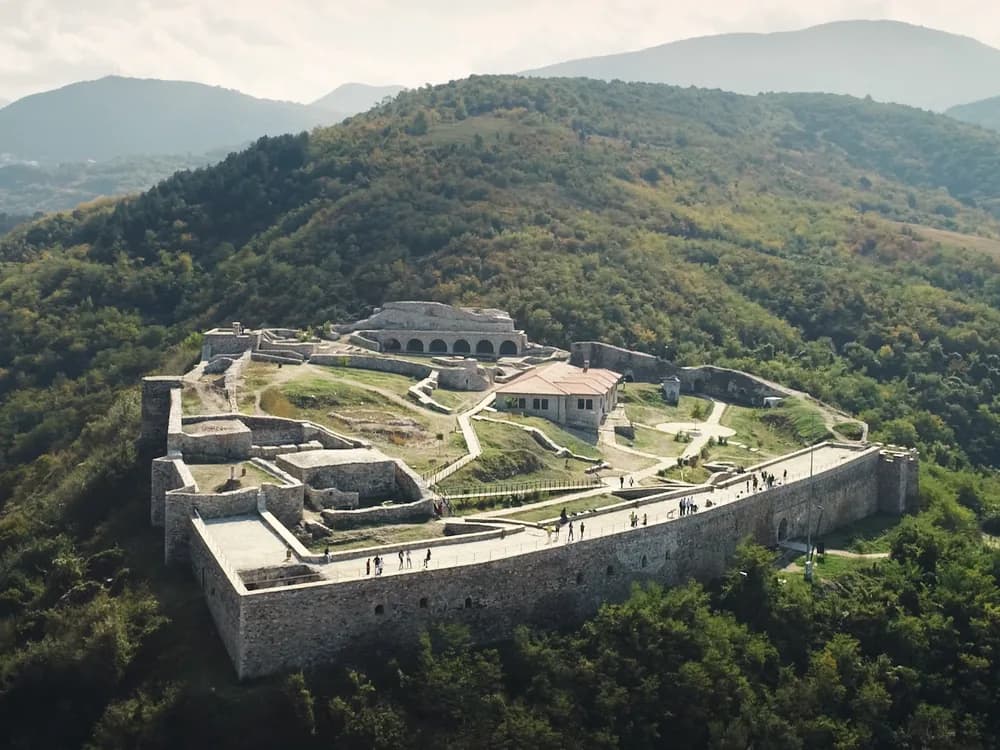
© Unsplash
Prizren Fortress
Kalaja e Prizrenit
Kosovo · Prizren District · Near Prizren
Built 500 · Byzantine foundations (6th century, Justinian I), substantially rebuilt by Ottoman Sultan Mehmed II in 1461; curtain walls with towers incorporating Byzantine and Ottoman construction phases
Quick Facts
- Hours
- The fortress is an open, unguarded ruin with no ticket booth and no fixed closing gate — visitors can walk up at any reasonable daylight hour. Sunset is the most popular time to be on the ramparts.
- Entry from
- €2
- Duration
- 1–1.5 hours (fortress); combine with Old Bazaar for 3–4 hours total
- Best time
- April to October
- Nearest city
- Prizren
Highlights
- ✦Sunset views from the ramparts over the Sinan Pasha Mosque, Prizren's terracotta rooftops, and the Šar Mountains — one of the great panoramas of the Western Balkans
- ✦Byzantine foundations attributed to Emperor Justinian I in the 6th century, rebuilt into their current form by Sultan Mehmed II in 1461 after the conquest of Constantinople
- ✦The League of Prizren, founded in 1878 in a house directly below the fortress — the first organised Albanian national movement and a foundation stone of Kosovo's modern identity
- ✦The 14th-century Church of the Holy Saviour, a Serbian Orthodox church surviving inside the fortress precinct, damaged in the 2004 riots and under restoration since
- ✦The Bistrica River and the Old Bazaar below, one of the best-preserved working Ottoman commercial districts in the Balkans
Skip the queue with a guided tour
Skip-the-line tickets & expert guides
Prizren Fortress rises from a limestone crag above the city of Prizren, overlooking a skyline of Ottoman mosques, Byzantine churches, and the Bistrica River winding through the old bazaar below. This is Kosovo's most photographed historic site — the view from the ramparts at sunset, with the Sinan Pasha Mosque and Prizren's terracotta rooftops lit in the day's last light and the Šar Mountains rising behind the city, ranks among the great panoramas of the Western Balkans. Prizren itself is unusual even by regional standards: a city where Byzantine, Ottoman, Albanian and Serbian histories collide with unusual intensity within a very small area, and the ruins above have watched every one of those transitions.
The fortress sits on Byzantine foundations attributed to Emperor Justinian I in the 6th century AD, built to fortify a strategic pass through the Šar Mountains linking territory that is today divided between Serbia, North Macedonia and Albania. The site's significance continued into the medieval Serbian state — Prizren served as a royal residence under Tsar Stefan Dušan in the 14th century, when it ranked among the largest cities in the Balkans. The defining transformation came between 1455 and 1461, when Ottoman Sultan Mehmed II, fresh from the conquest of Constantinople, rebuilt the fortress into its present form after subduing Kosovo. The Ottomans would hold it for more than four centuries, during which Prizren grew into a provincial capital and one of the most important cities in the European part of the Empire.
What gives the fortress its deepest resonance in Albanian and Kosovar national consciousness, however, is political rather than military. In 1878, representatives of Albanian landowners, intellectuals and military leaders assembled in a house directly below the fortress to form the League of Prizren — the first organised movement for Albanian political rights and the foundation of the modern Albanian national movement. The League called for autonomy within the Ottoman Empire and the unification of Albanian-populated territories. That house is now a museum, and the fortress above it watched the moment that, 130 years later, would culminate in Kosovo's declaration of independence in 2008, making it the newest country in Europe.
Inside the fortress precinct, the 14th-century Church of the Holy Saviour, a Serbian Orthodox church, survives as an unusual case of a Christian church continuing to stand within an Ottoman-controlled fortress. It was damaged during the 2004 Kosovo riots and has been under restoration since. The juxtaposition of Byzantine church foundations, Ottoman walls, and this damaged-and-restored church captures the post-independence complexity of Prizren's history more concisely than any museum exhibit could.
History
The fortress's earliest substantial phase dates to the 6th century AD, when Byzantine builders, traditionally credited to Emperor Justinian I, fortified the hill to control a strategic mountain pass. The site retained its importance through the medieval Serbian period, when Prizren became a royal residence under Tsar Stefan Dušan in the 14th century and one of the largest and wealthiest cities in the Balkans, a status reflected in the churches and monasteries built in and around the city during this era.
The fortress took its current form between 1455 and 1461, when Ottoman Sultan Mehmed II — having just conquered Constantinople in 1453 — rebuilt it after subduing Kosovo, adding the curtain walls and towers that blend Byzantine and Ottoman construction techniques still visible today. Ottoman rule lasted over four centuries, during which Prizren developed into a major regional capital, renowned for its bazaars, mosques and craft guilds.
The fortress's modern significance crystallised in 1878, when Albanian political and military leaders met in a house at its foot to found the League of Prizren, the first organised Albanian national movement, calling for autonomy and the unification of Albanian-populated lands within the Ottoman Empire. That movement's long arc — through Ottoman decline, two World Wars, Yugoslav federation, the Kosovo War of the late 1990s, and UN administration — culminated in Kosovo's declaration of independence in 2008. The fortress, largely a ruin by the 20th century, has since seen partial restoration of its walls and towers, while the Church of the Holy Saviour within its precinct, damaged in the 2004 inter-ethnic riots, remains a visible reminder of the region's continuing complexity.
How to Visit
Getting there: Prizren is 80 km south of Pristina and approximately 100 km from Tirana via the E851 highway. From Shadervan Square in the heart of the old city, the walk up to the fortress takes 10 to 15 minutes on a steep but manageable path. A passport or national ID card is required to cross into Kosovo from most entry points, so carry the appropriate documents if arriving overland from Albania, North Macedonia or Serbia.
Tickets and timing: Entry is nominal, around €2, though this is worth confirming locally as the arrangement can change and the site sometimes has no staffed entrance at all. The fortress has no fixed hours — most visitors climb in the late afternoon to catch the ramparts at sunset, when the light over the Šar Mountains and the mosques below is at its best.
Combine with the Old Bazaar: Below the fortress, the Old Bazaar (Çarshia e Vjetër) is one of the best-preserved Ottoman commercial districts in the Balkans, a long covered arcade of small workshops and cobblestone lanes beside the Bistrica River. The Sinan Pasha Mosque (1615), the Stone Bridge, and Shadervan Square form the heart of the old city and, unlike many Balkan bazaars that have shifted toward souvenir tourism, retain a genuinely working character. Allow at least two to three hours for the city in addition to the fortress. Most international visitors arrive on full-day tours from Tirana, Durrës or Skopje, since Kosovo's tourism infrastructure is built around day trips rather than standalone overnight stays in Prizren.
Frequently Asked Questions
The League of Prizren was founded in 1878 by Albanian landowners, intellectuals and military leaders meeting in a house at the foot of the fortress, in direct response to the territorial settlement imposed on the Ottoman Empire after the Russo-Turkish War. It called for autonomy for Albanian-populated lands and their unification within a single administrative unit — the first organised expression of Albanian national identity. The League is considered the founding moment of the modern Albanian national movement, and its legacy is closely tied to Kosovo's own path to independence in 2008. The original meeting house is now a museum at the base of the fortress hill.
Location
Kalaja Hill, Prizren, Kosovo
Nearby Castles
Featured Tour
Kosovo Day Trip: Prizren & Pristina from Tirana & Durres
Cancellation available · Instant confirmation
Tours & Tickets
Powered by GetYourGuide
Entry from
€2/ adult