Spain · Updated May 2026
The Best Castles in Spain: Alhambra, Alcázar and Moorish Andalusia
Spain's castle heritage is the direct product of eight centuries of conflict between Christian kingdoms and the Moorish civilization that occupied most of the Iberian peninsula from 711 to 1492. The word "castle" itself — via Latin castellum — was filtered through Arabic during this period, and the province of Castilla takes its name from the extraordinary density of fortifications built along the shifting frontier line.
Over 10,000 castle sites have been documented in Spain, more than any other European country. But two sites stand in a category of their own: not merely as castles in the military sense, but as the two most extraordinary surviving expressions of Moorish Islamic palace architecture in the world.
1. The Alhambra — The Most Beautiful Building in the World
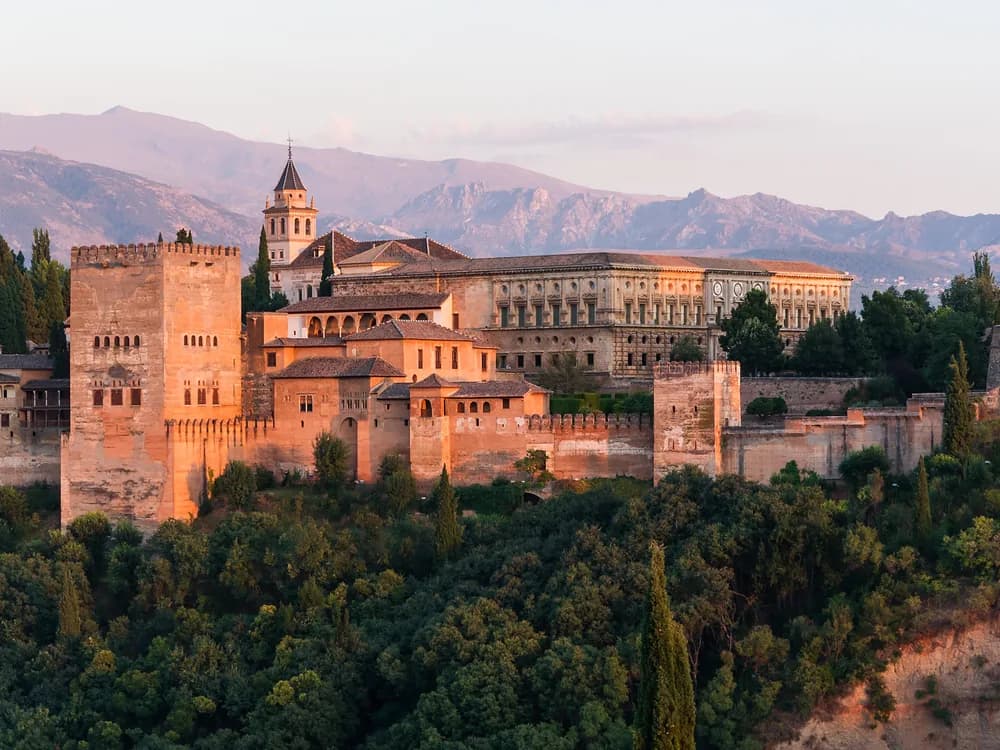
There is no hyperbole in the Alhambra's reputation. It is, by the consensus of architects, art historians and visitors across six centuries, the most perfect surviving example of Islamic palace architecture in existence — a complex of palaces, gardens, fountains and geometric decoration on a forested hilltop above Granada that has never been surpassed in the sophistication of its aesthetics or the intelligence of its spatial design.
The Nasrid Palaces at the core of the complex — built primarily in the 14th century by Yusuf I and Mohammed V — represent the peak of what Moorish craftsmen and architects could achieve. The Court of the Lions, with its twelve marble lions supporting a central fountain and 124 slender columns framing the surrounding arcades, is one of the most reproduced architectural images in history. The Hall of the Ambassadors — a perfect cube 18 metres high, its ceiling a representation of the seven heavens of the Islamic cosmos containing 8,017 individual cedar pieces — would be the finest room in any other building in Europe.
The stucco decoration throughout is of an intricacy and precision that modern craftsmen have difficulty reproducing even with modern tools. The Arabic inscriptions carved into every surface — poetry, Quranic verses, the repeated phrase "There is no conqueror but God" — transform the architecture itself into sacred text.
Boabdil, the last Nasrid sultan, surrendered the Alhambra to Ferdinand and Isabella on 2 January 1492 — the same year Columbus sailed for the Americas. His mother, according to legend, said as he wept looking back at the city: "You weep like a woman for what you could not defend as a man." The spot is still called El Suspiro del Moro — the Moor's Last Sigh.
The Generalife gardens, the summer palace adjacent to the main complex, are among the finest formal Islamic gardens surviving anywhere. The water channels, reflecting pools and fragrant plantings descend the hillside in a series of terraces designed to manage the Granada heat while producing a sensation of paradise — the literal meaning of the Persian word that gives us the English "garden."
Essential info: Book Nasrid Palaces tickets months ahead — slots sell out that far in advance in peak season. The nightly visit (10pm slot, limited numbers) is outstanding if you can get it. Train to Granada from Madrid (4h30 AVE) or Seville (3h). The Alhambra is a 20-minute walk uphill from the city centre or a short taxi ride.
2. Real Alcázar of Seville — The Living Palace
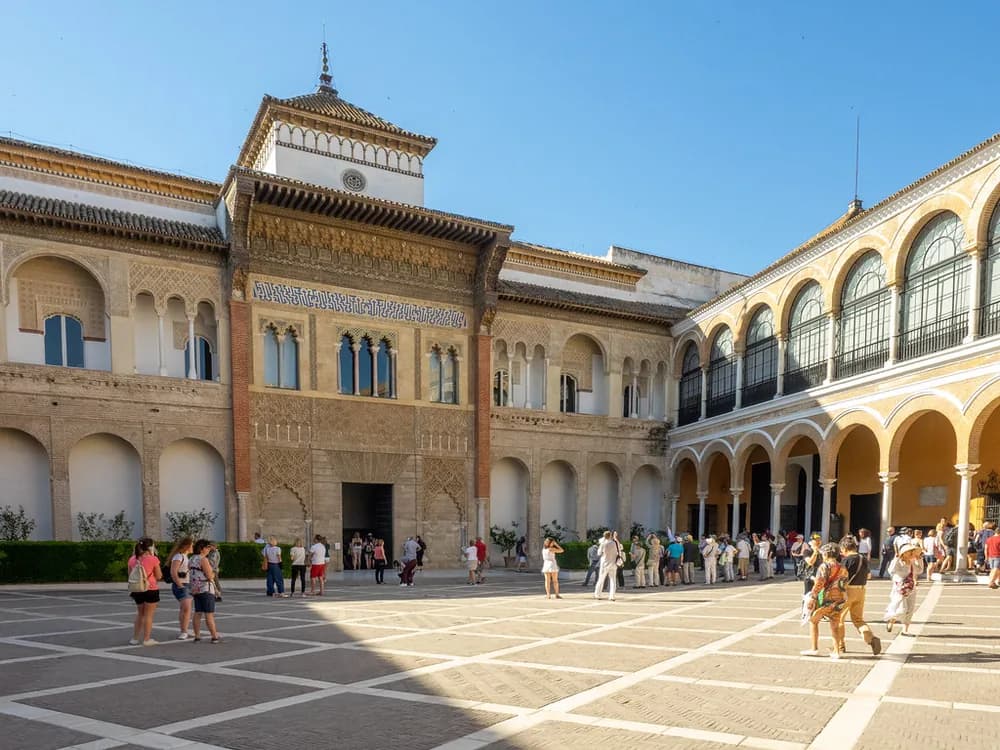
The Alcázar of Seville holds two distinctions that no other castle in this guide can match. It is the oldest royal palace still in active use in Europe — the Spanish royal family maintains an official residence here and uses it to this day. And it was built by a Christian king using Muslim craftsmen and Muslim aesthetic sensibility, creating one of the finest examples of Mudéjar architecture anywhere: a style that represents the extraordinary cultural synthesis of medieval Iberian civilization at its most sophisticated.
Pedro I ("the Cruel" or "the Just", depending on which side you were on) began the current palace in 1364, deliberately importing craftsmen from Granada's Alhambra workshops and from Toledo's Moorish ateliers. The result is a palace that reads as Islamic in every decorative detail — the geometric tilework, the carved plaster arabesques, the horseshoe arches, the emphasis on water and light — while being the residence of a Christian king.
The Palacio del Rey Don Pedro is the masterpiece. The Patio de las Doncellas (Courtyard of the Maidens) rivals the Alhambra's Court of the Lions in the delicacy of its arcaded lower gallery. The Salón de los Embajadores (Hall of Ambassadors) beneath its gilded dome is overwhelming. The apartments where Catherine of Aragon (daughter of Ferdinand and Isabella) spent her early years before sailing to England to marry Prince Arthur are preserved and interpreted.
The palace was expanded and modified by every Spanish monarch from Ferdinand and Isabella onwards. Charles V added a Renaissance palace wing for his marriage in 1526. Philip II used it as his base while overseeing the Armada preparations. The HBO series Game of Thrones used the Alcázar as Dorne in seasons 5 and 6, which has brought a new audience to a building that was already one of Spain's most visited sites.
The gardens — 7 hectares of formal parterres, fountains and English landscape garden — are among the finest palace gardens in Europe and are free to enter after 6pm.
Essential info: Book tickets online — the Alcázar has a daily cap and sells out weeks ahead in spring and autumn. Seville is a natural base for Andalusia: high-speed rail from Madrid (2h30 AVE). Combine the Alcázar with the Gothic Cathedral next door (the world's largest Gothic cathedral and burial place of Columbus) for a full day in the historic centre.
Planning an Andalusian Castle Trip
- ✦Seville and Granada together: The two cities are 2h30 apart by bus (or longer by rail via Córdoba). A four-night Andalusia trip — two nights in Seville, two in Granada — is one of the most rewarding cultural itineraries in Europe.
- ✦Add Córdoba: The Great Mosque (Mezquita) of Córdoba and the Alcázar de los Reyes Cristianos make Córdoba a natural overnight stop between Seville and Granada. The Mezquita is among the most extraordinary buildings in Europe.
- ✦Ticket booking is essential: Both the Alhambra's Nasrid Palaces and the Alcázar of Seville sell out weeks ahead in spring (March-May) and September-October. Book the moment your travel dates are confirmed.
- ✦Best season: March to early June is ideal — warm, long evenings, gardens in bloom, before the crushing summer heat. October to November is also excellent. July and August in Seville regularly exceed 40°C — the Alcázar's thick walls provide some relief but the city is genuinely difficult in high summer.